In January this year, the Indian Navy signed a contract for autonomous armed boat swarms with Sagar Defence Engineering. This was the 50th such contract under Supporting Pole-Vaulting in R&D (SPRINT) via Innovations for Defence Excellence, launched in July 2022. It aims at developing 75 indigenous technologies by the defence industry for the Navy. Under the (DISC 7) SPRINT initiative, the Indian Navy has placed an order for an undisclosed number of systems of the country’s first autonomous weaponised boats that have the capability of swarming to enhance maritime security operations by carrying out a variety of security and naval activities rigorously.
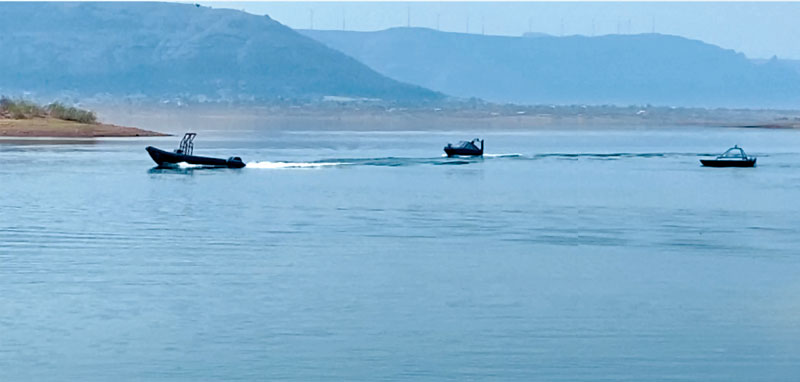
During the Bandhan ceremony at Aero India 2023 in February, Sagar Defence signed an MoU to develop autonomous weaponised boat swarms to collaborate on the Indian design developed and manufactured (IDDM) for India and the global market by October 2023.
This development is significant given the rise of unmanned systems across sectors the world over. For militaries to have unmanned systems, whether on the ground, in the air or in water, they must employ capabilities that will have zero to no human toll. In high-risk environments, unmanned systems also come in handy in delivering ordnance. Some of the most advanced countries worldwide have been inducting systems including unmanned aerial vehicles (UAV) and unmanned ground vehicles (UGV) to be deployed in battlefields. Due to sophisticated sensors and precision weapons atop these systems, militaries get real-time data and prevent the vulnerability of assets in their territory.
The emergence of unmanned systems has played a decisive role in several conflicts in different parts of the world. The US employed several unmanned aerial vehicles (UAVs) in Iraq and Afghanistan such as the MQ-1 Predator and MQ-9 Reaper. Unmanned Ground Vehicles (UGVs) such as TALON and PackBot were mainly used for bomb disposal and reconnaissance. Furthermore, systems such as Unmanned Underwater Vehicles (UUVs) such as the REMUS and Swordfish were also used by the US navy for mine detection and underwater reconnaissance. The US air force made strategic use of the C-17 Globemaster III which was modified with autonomous flight control systems to deliver supplies and cargo to remote areas. Put together, these systems were used for surveillance, reconnaissance and targeted strikes against enemy combatants, meaning that US forces benefited from improved real-time situational awareness, shielding US military personnel from risks while helping them set up better combat and support aid.
Similarly, when Azerbaijan used the Turkish kamikaze Bayraktar TB2 drones and loitering munitions, many of them Israeli-made, over the skies of the disputed Nagorno-Karabakh eventually winning the air war, it was clear that this technology was not limited to the US and Russia militaries. During this conflict, the unmanned aerial systems proved that countries having such prowess can take precise aims and shoot down troops, infantry as well as artillery positions, tanks and other important assets of the adversary with utmost ease and more importantly, with low financial investment into such assets. Foreign Policy quoted Col Scott Shaw in 2021 when he was the outgoing head of the Army’s Asymmetric warfare as saying, “What has become apparent after Azerbaijan routed Armenia last fall is that not only will the US military no longer enjoy uncontested air superiority against peer rivals like China—something Defence Department officials have long resigned themselves to—but that poorer nations can buy themselves a respectable air force mostly off the shelf.”








 VIDEO
VIDEO