

Stop Identity Politics
Manipur joined the Indian Union in 1949 but become a full-fledged state only in 1972; between 1949 and 1972 Manipur remained a Union Territory. It is bounded by Nagaland to the north, Mizoram in the south and Assam in the west. It has approximately a 400 km long border with two regions of Myanmar—Sagaing Region to the east and Chin State to the south. It is the gateway to Southeast Asia and crucial for India’s Look East Policy.
Ever since Manipur joined the Indian Union it has been the site for insurgencies. The number of insurgent groups have grown and this proliferation of armed groups has added to the complexity of the political problem. The events have been unfolding at a rapid pace and the conflicts have been becoming deadlier but like Gabriel Garcia Marquez’s novel Chronicles of a Death Foretold, everyone knows the tragedy will take place, but no one is willing to prevent it.
In a word, the cause of the Manipur tragedy is identity politics. Way back in 1981, Nibedon Biswas, the youngest son of the late Nirod Kumar Biswas, the bishop of Assam, writing under the name, Nirmal Nibedon, published a book titled Northeast India: The Ethnic Explosion (1981). In the preface he predicted: ‘It is an ethnic explosion. Make no mistake about it. Have no doubts about it. World governments, more so India and Southeast Asian countries, will have to closely study the case of the ethnic minorities, whether they are Kachins and Karens of Burma, the Mizos or the Ahoms of India. The ethnic minorities of India, particularly those of the Mongoloid stock, will deserve more attention. For, gone are the days when small bands of proud tribesmen fought and defended themselves with poison-tipped arrows. Today, in the 1980s the ethnic minorities are wielding sophisticated weapons and engaging national armies in combat, increasingly. In brief, they are zealously guarding their ethnic identity… It is going to be a long war for all sides, frighteningly effective and cripplingly expensive for both. None may emerge victorious. Both may be losers.’
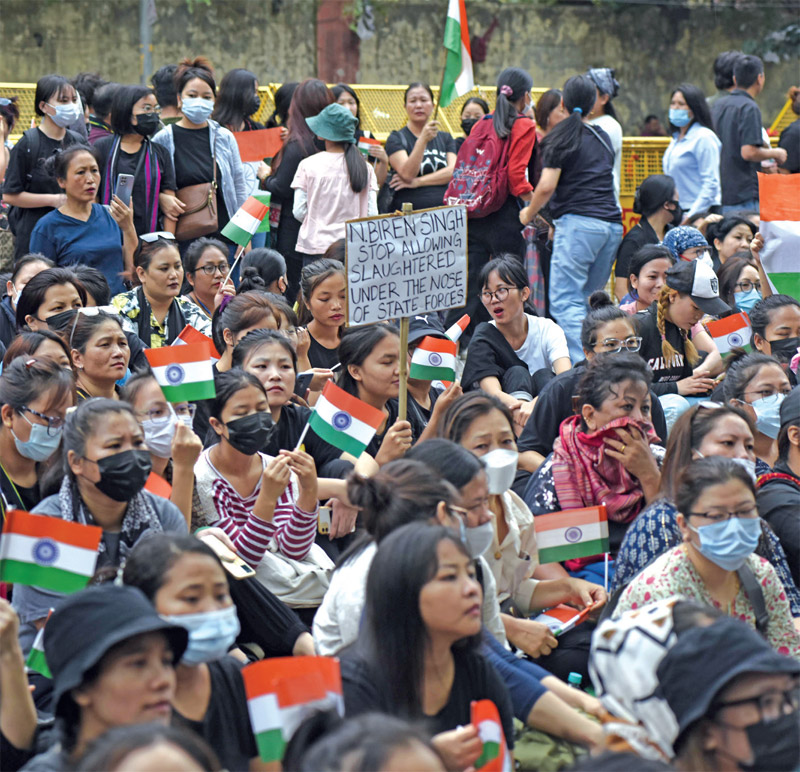
It is difficult to have ‘objective’ or unbiased accounts of the conflicts because each community has its own narrative rooted in its own perception of its past. As one reporter observed: “It is said that there are always two sides to every story and the truth lies somewhere in between. But in Manipur, the truth lies not only somewhere in between, but it is unfailingly wrapped in several layers of conflicting interpretations.”
These controversies over the histories led the government of Manipur to set up a 15-member committee on 16 September 2022 to verify the accuracy of books written about history, culture, tradition, and geography of Manipur, to avoid the distortion of facts. Every author writing on the history of Manipur now has to submit his or her manuscript to the Director of Higher Education and the University of Manipur for verification and approval. What are the issues which are agitating the people and communities of Manipur?
Who is a Tribal?
There is a rich debate on the question on who is a tribal and who is not. A part of the debate is around the colonial classification of people. However, in post-Independence India, a person is a tribal if the community is recognised as a member of a Scheduled Tribe under the provisions of the Constitution and the laws.
In Manipur there are broadly two categories of communities who are designated as Scheduled Tribe—the Naga communities and the Kuki-Chin-Mizo group. However, the majority community, the Meiteis are not designated as Scheduled Tribes. They are demanding to be included in the category and the tribal or hill people are opposing their demand.
Recently, this issue became so controversial and volatile that the Office of the Registrar-General of India (RGI) has declined to make public its position on whether the Meitei (Meetei) community in Manipur can be categorised as a Scheduled Tribes as per the criteria currently in use.
The office of the RGI said disclosing this information to the public would ‘prejudicially affect the sovereignty and integrity of India, the security, strategic, scientific or economic interests of the state, relation with foreign state or lead to incitement of an offence.’
Under international law the word tribal is seen as pejorative and the word indigenous is used. The United Nations Declaration on the Rights of Indigenous Peoples (UNDRIP) was adopted by the General Assembly on 13 September 2007, by a majority of 144 states in favour.
In India, the Constitution has special provisions for the tribal people. In broad terms the tribal peoples are protected from exploitation by more advanced communities and non-tribals cannot own tribal lands. Secondly, there are provisions for a degree of autonomy in administration for the tribal people. Mizoram and Meghalaya are under the Sixth Schedule but Nagaland rejected this provision. The tribal of Manipur are protected by Article 371-C and special laws to protect their lands from being transferred to non-tribals. There are also special welfare schemes to ameliorate the condition of tribals, including reservations in jobs and educational institutions.
Subscribe To Force
Fuel Fearless Journalism with Your Yearly Subscription
SUBSCRIBE NOW
We don’t tell you how to do your job…
But we put the environment in which you do your job in perspective, so that when you step out you do so with the complete picture.






 VIDEO
VIDEO