

Stick to ‘Multi-Alignment’
Within a few days of Prime Minister Narendra Modi’s return from his high-profile US visit, Indian opinion got polarised between those who believe that India has now opted to firmly join the US-led western alliance and those who insist that, while ties with the US have scaled new heights, India “cannot get tied down to exclusive relationships,” as external affairs minister Dr S Jaishankar has clarified.
But the competition among commentators has just begun. Harsh Pant has dourly pointed out that ‘China’s rise and its aggressiveness has made a strong India-US partnership a veritable necessity’ and that the inclusion of India in ‘Nato plus’ would ‘strengthen global security and deter Chinese aggression’. Howard French speaks of a ‘dreamy hope in Washington’ that India can be tempted to give up its long-standing commitment to strategic independence.
Linked with this debate is a specific issue: which of the three grouping of which India is a member—the BRICS, the Shanghai Cooperation Organisation and the Quad—is likely to prevail over others in New Delhi’s priorities? The first two are seen as ‘China-dominated,’ while the third, the Quad, a maritime grouping of the US and three other nations in the Indo-Pacific, reflects the intent of its members to challenge China’s expanding maritime footprint in the west Pacific and the Indian Ocean. Commentators have noted that Modi’s recent visit to the US has affirmed the two countries’ commitment to the Quad and has ‘paved the way for stronger collaboration in the Indo-Pacific region’.
In short, in the face of the security challenge from China, as evidenced by the ongoing three-year standoff at Ladakh, will India abandon strategic autonomy and seek to serve its interests through a robust engagement with the US-led western alliance? To answer this question, India’s place in the three groupings is discussed in the following sections.
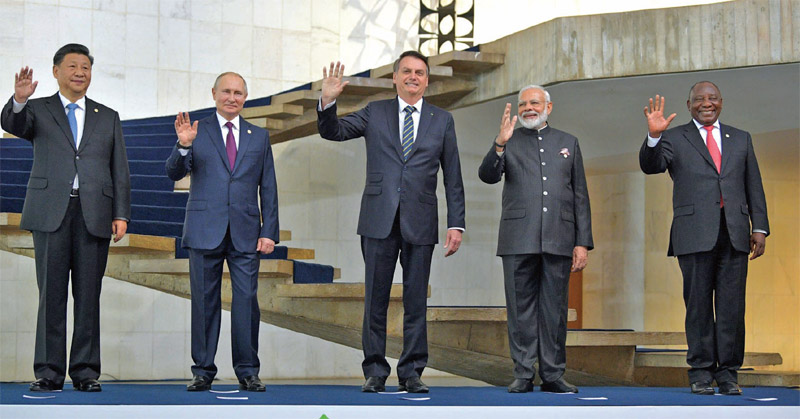
Chinese President Xi Jinping, Russian President Vladimir Putin, Brazilian President Jair Bolsonaro, Indian Prime Minister Narendra Modi, and South African President Cyril Ramaphosa
BRICS’ Growth
The BRICS, which brings together Brazil, Russia, India, China and South Africa, will have its 15th summit in South Africa in August this year. Long derided by western writers as irrelevant and dysfunctional and bound for an early demise, this disparate grouping has resolutely organised annual summits, has established new organisations and gradually broadened its agenda.
In 2014, it set up the New Development Bank (NDB) and the Contingent Reserve Arrangement (CRA). The bank provides funding for development activity on easier terms than entities like the World Bank and the IMF, while the CRA supports countries facing short-term balance-of-payments pressures. These facilities are available not just to members but to other developing and emerging economies as well: in 2021, the UAE, Egypt, Bangladesh and Uruguay joined the bank. India has been an important beneficiary: it has obtained NDB backing for its priority projects in the areas of clean energy, public health, social safety, etc. In May 2022, a regional office of the NBD was opened in Gujarat.
The BRICS’ agenda has moved from economic interests to security, health, science and technology, and culture and civil society. In line with its members’ concerns, it prioritises matters relating to terrorism with special focus on counter-terrorism. BRICS has also begun to look at transnational security issues like drug-trafficking and the dark web and other technologies that support it. At the 14th BRICS summit in China in June 2022, Prime Minister Modi proposed an online database for BRICS documents, a BRICS railways research network and greater cooperation between small and medium enterprises in BRICS countries.
Far from being irrelevant or dysfunctional, as its detractors had described it, amidst ongoing global and regional contentions, BRICS is a central player in the promotion of ‘de-dollarisation’ and is looking at welcoming new members.
De-dollarisation: In March this year, a senior Russian parliamentarian called for the development of a new currency that could be used for cross-border trade by BRICS members. This is a significant intervention in global economics. The GDP of BRICS members at USD 32.72 trillion, i.e., 31.6 per cent of the global GDP, is greater than the GDP of the US, which is USD 25.46 trillion or 24 per cent of the global GDP.
Joseph Sullivan, former economic adviser in the Trump White House, has said that a new currency issued by BRICS (the BRIC?) ‘really could dislodge the US dollar as the reserve currency of BRICS members’. He added that de-dollarisation ‘would represent cooperation in a well-defined area where interests align’. He noted that India and China share an interest in de-dollarising.
While the idea of a BRICS currency is at a nascent stage and several details have to be worked out, the idea of reducing reliance on the dollar for international trade and finance is gaining in appeal. Russia, China and Brazil have turned to greater use of non-dollar currencies in their transactions. In June this year, India paid for its oil imports from Russia in yuan.
Subscribe To Force
Fuel Fearless Journalism with Your Yearly Subscription
SUBSCRIBE NOW
We don’t tell you how to do your job…
But we put the environment in which you do your job in perspective, so that when you step out you do so with the complete picture.






 VIDEO
VIDEO