

Stealth and Speed
The recent retort to national security threats has witnessed the nation shedding the cloak of a soft state, and emboldened by decisive political will, demonstrated military capability and unambiguous strategic messaging. The new normal exhibits a policy of assured retribution with punitive military response capability for proxy war at a time and place of one’s own choosing, irrespective of the erstwhile self-imposed strategic restraints.
Similarly, the challenges of sporadic assertiveness and discerning calm on the Northern front poses concerns for the future, mandating a dissuasive deterrence capability in place. The future challenge, however, lies in adding teeth to this response matrix, bridging operational voids and building future capabilities in a time sensitive domain. The key to this is envisioning future threats, strategising response mechanisms and building matching capabilities, based on a ‘value, vulnerability and risk’ analysis in temporal terms.
Of course, all this will be in vain and ‘business as usual’, without the demonstrated will of the government to provide matching budgetary support, priority clearance of big-ticket defence projects by CCS, overcoming bureaucratic apathy and energising the defence industrial base. The policy makers must not be found wanting in their responsibilities and accountability of translating intents into outcomes.
The reality that must serve as a constant reminder to the nation is that, given our turbulent geo-strategic environment, intentions can change fast, but capability development and equipping future forces takes time. The security challenges of tomorrow will, thus, have to be met by the defence capabilities we develop today. The nation cannot be found wanting at the times of crisis. Indeed, ‘Nation Above All’ is the need of the hour.
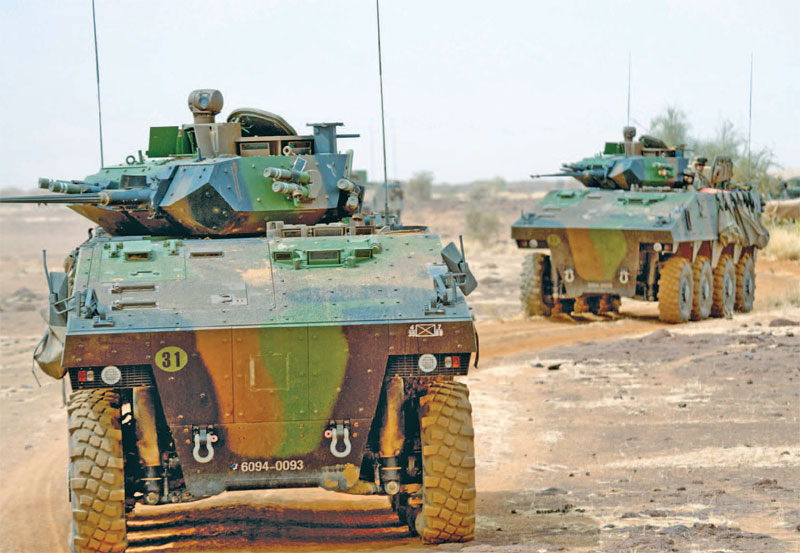
Nexter’s VBCI in operation in Mali
Indian Army Future Ready Forces
It must never be forgotten that a nation with disputed and turbulent borders requires boot and tracks on ground. This is not to dilute but put in right perspective and priority the awed fashionable western terminologies of non-contact warfare, shadow wars and multi-domain warfare. Even in the ongoing proxy war focus, it must not be forgotten that the levers of making proxy war cost prohibitive, lie in generating a superior conventional punitive response capability.
To meet these challenges, the Indian Army is focusing on three key areas of operational readiness, force modernisation and structural transformation to prevail in today’s war and fight to win future wars. However, in the present environment finding ‘novel ways’ with ‘limited means’ to achieve ‘larger ends’ remains a challenge. The imperative, thus, is to restructure and refit a ‘big war military with smart, lean, agile combined arms joint warfare capabilities’. The focus is to develop a technology enabled, future ready, combined arms modular force, capable of decisive operations across the entire spectrum of conflict.
Thus, the need is for a rapid deployable force, to generate a superior mounting tempo and thereafter execute operations at an overwhelming execution tempo, to dominate the key operational factors of ‘Time-Space-Force-Information’. One such capability being generated is the Integrated Battle Group (IBG) concept, spearheaded by the mechanised forces. The rationale of mechanised forces spearheading these IBGs, lies in their basic characteristics of survivability, mobility, lethality and adaptability, across the entire spectrum of conflict.
Besides, wars are lost and won in the minds, and these brutal tank forces with their shock action, aid in strategic and operational dislocation of enemy forces, creating physical and physiological paralysis. Modernisation of the legacy fleet to bridge technology gap and simultaneous time sensitive induction of next generation platforms accordingly assumes operational necessity. It is, thus, imperative for the nation to generate capability for the mechanised forces to be future ready, technologically enabled and versatile instrument of deterrence in peace and a force of decision in war.
Subscribe To Force
Fuel Fearless Journalism with Your Yearly Subscription
SUBSCRIBE NOW
We don’t tell you how to do your job…
But we put the environment in which you do your job in perspective, so that when you step out you do so with the complete picture.



 VIDEO
VIDEO