

Staring at an Abyss
It is now a foregone conclusion that the Indian Air Force’s (IAF) cherished goal of possessing the sanctioned strength of 42 combat aircraft squadrons (leave alone the required 55 for catering to a two-front limited warfighting scenario) will remain unrealised at least for the following three decades.
To make matters worse, the IAF’s force-mix will remain lop-sided, with 60 per cent of its combat aircraft force comprising heavy-multi-role combat aircraft (MRCA) and the remaining 40 per cent medium-MRCAs. And to top it all, the list of required force-multiplier combat-support platform-types (like aerial refuelling tankers, AEW & CS platforms, ISTAR battlespace surveillance platforms and turbofan-powered high-altitude/medium endurance unmanned aerial vehicles) keeps growing with every passing year.
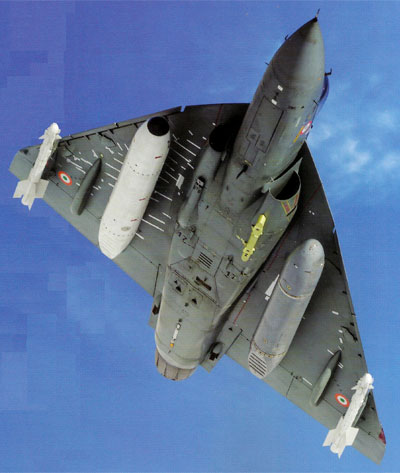 Several reasons exist for such a dismal state of affairs, the foremost of which is the IAF’s institutional inability to foresee by the late Eighties itself that the category of light-MRCA would be superseded in the coming decades on a global scale by that of the M-MRCA. Consequently, the homegrown Tejas Mk.1 and Mk.1A variants as they exist today (designed and built to the two successive air staff qualitative requirements (ASQR) that were released by the IAF between 1983 and 1995) remain severely sub-optimal in terms of performance parameters, while the ASQR for the projected LCA-AF Mk.2 variant has yet to be finalised.
As a result, the IAF will at best possess only 32 Tejas Mk.1 single-seaters and eight Tejas Mk.1 tandem-seaters (with 20 built to initial operational configuration standards and the other 20 to final operational configuration standards, with the latter expected by the year’s end), while the projected 73 Tejas Mk.1A single-seaters and 10 tandem-seaters (for four squadrons) is unlikely to be available for at best another five years due to the 300+ design changes mandated by the IAF (which starkly illustrates the professional ineptitude of the L-MRCA’s designer/developer, the DRDO-owned Aeronautical Development Agency, or ADA), which in turn will require the Mk.1A variant to undergo at least 200 hours of flight-tests in order to obtain its certificate of airworthiness.
And all these, in turn, will make it almost impossible for the IAF to place orders for the projected 201 LCA-AF Mk.2s (for equipping 12 squadrons), whose developmental period will now have to be stretched till 2030. And while ADA has brazenly showcased several designs and scale-models of the LCA-AF Mk.2 since 2013 despite the IAF’s still-elusive ASQRs, the IAF in turn continues to expand its wishlist for incorporating new-generation technologies into the LCA-AF Mk.2’s airframe, like a cockpit hosting panoramic active-matrix liquid-crystal displays, an airframe hosting a 1-metre fuselage stretch, nose-mounted infra-red search-and-track sensor, an internally-mounted wide-band self-protection jammer, four integrated digital radar warning receivers-cum-active jamming transmitters, four laser warning receivers, six missile approach warning sensors in a distributed-architecture layout in order to ensure all-aspect hemispheric coverage, a new-generation jet-fuel starter and on-board oxygen generation system, a combined HF/VHF/UHF-band software-defined radio, a combined air-to-air/air-to-ground software-defined tactical data-link, a SATCOM receiver/transmitter, and finally, a two-axis thrust-vectoring nozzle for the turbofan, all of which will — on paper — transform the LCA-AF Mk.2 into a fourth-generation M-MRCA.
From the above, it can safely be concluded that the IAF, which had 39.5 squadrons of combat aircraft back in 2004 (including the two squadrons of MiG-23MFs, three squadrons of MiG-23BN, five squadrons of MiG-27Ms and 10 squadrons of MiG-21FLs, MiG-21Ms, MiG-21bis and MiG-21 Bisons and all of which will have been decommissioned between 2007 and 2022), will find itself by the year 2022 with only 29 combat aircraft squadrons in another three years. The IAF will thus be devoid of three required squadrons of dedicated tactical interdictors (since only five squadrons of upgraded Jaguar IS/DARIN-3 aircraft will be available), three required squadrons of deep-penetration strike aircraft (since only 36 Dassault Aviation-built Rafales for two squadrons have been ordered thus far), and up to seven required squadrons of M-MRCAs (since only three squadrons each of the upgraded Mirage 2000Ns and MiG-29UPGs will be available).
Subscribe To Force
Fuel Fearless Journalism with Your Yearly Subscription
SUBSCRIBE NOW
We don’t tell you how to do your job…
But we put the environment in which you do your job in perspective, so that when you step out you do so with the complete picture.






 VIDEO
VIDEO