Way back in January 2007, China’s anti-satellite test (ASAT) had brought the focus on militarisation of space, especially in India. The growing space asset technologies and the threat of weaponisation of space have led to increasing research and development of such systems capable of striking from the skies.
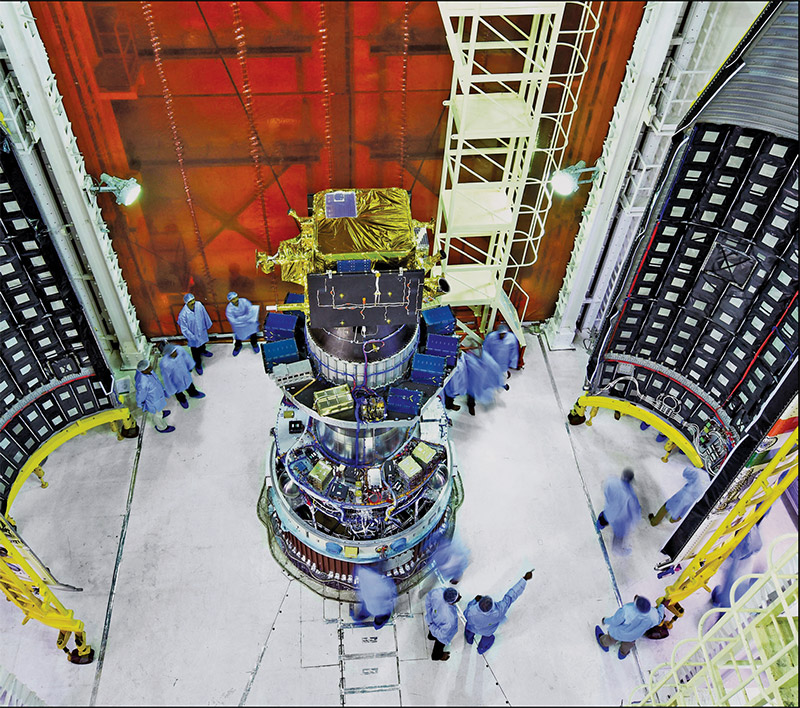
HysIS with 30 Co-passenger Satellites
India has always maintained that space should not be weaponised. The government, too, has denied the development of any ASAT programme. Nonetheless, India can’t close its eyes to the growing murmur of the possibilities of a new form of warfare, which could be fought using space assets. Given the growth of ballistic missiles, the weapons that travel through the upper atmosphere, clearly nations with credible orbit-based assets will have an upper hand in preventing an attack. Then there is the threat of hypersonic glide vehicles, which ascend to higher altitudes and then fall on the target vertically.
Militaries around the world are aggressively pushing for development of space-based weapons. With the announcement of Space Force by the Trump administration, several countries including China, Japan and Russia have already laid out plans to set up a similar space-based operations’ wing. China’s People’s Liberation Army (PLA) in 2015 initiated reforms in its structure of warfighting, which includes the creation of Strategic Support Force (SSF), envisioned to centralise most PLA space, cyber, electronic, and psychological warfare capabilities. Japan, too, is reportedly planning for creating Space Corps in the National Defence Program Guidelines, slated to play a major role in delivering regional surveillance capabilities as well as tracking space debris.
Recognising the growing possibilities of such security threats, government of India in 2008 announced its plans to create an Integrated Space Cell, which is jointly operated by the three-armed forces – army, navy and air force — besides the Defence Research and Development Organisation (DRDO) and Indian Space Research Organisation (ISRO) itself, which makes it more of an information network system. The agency will coordinate and strategise India’s space defence systems, working in collaboration with the defence networks, and develop potential space strategies.
While primarily conceptualised for development of civilian programmes, ISRO has, in collaboration with the DRDO, developed several dual uses as well as purely military satellites for the armed forces. ISRO has been the eyes in the sky for India’s vast defence infrastructure, on the borders as well as on the seas.








 VIDEO
VIDEO