

Speed of Operations
Mobility has always been a decisive and battle winning factor. The advent of tanks in the later stages of World War I introduced a new dimension in mobility. While tanks were in their infancy in that war, the intervening war years brought about a revolution in the development of mechanisation and tactics of mobile forces.
Since the end of World War II, technology has advanced by leaps and bounds and many advancements are still in the offing. Yet, the more things change, the more they remain the same. Locate, engage, destroy—this basic task has always been the keystone of offensive forces on the battlefield, irrespective of the advancement of technology. The essentials remaining the same, the soldier requires mobility, firepower and protection. Tactics may require modification, but basics do not change.
The aim of this article is to examine this premise and related factors. As always, modern battle will require combined arms teams backed by logistics, intelligence, training and coordinated staff work. The human factor will always remain central. Soldiers will need to be highly adaptable, correspondingly trained and technologically competent.
Mobility has both offensive and protective functions. It is crucial in crushing the enemy, while letting your own troops survive and fight. The battle tank and the personnel carrier/ infantry combat vehicle perform these functions admirably.
Our country’s borders encompass a vast variety of terrain. Our warriors (soldiers, sailors and airmen of both sexes) often operate in vastly different milieus. This demands high levels of co-ordination and specialised training, to make soldiers more versatile. Many different factors need to be examined, such as the historical background and developments (the legacy factor), geographical imperatives (constant requirements), organisation and adaptation, and training to suit varying requirements (the future needs factor). All this will have to be backed up by staff operations, logistics, training and cooperation within the Service as well as with other Services.
One could look at mobility and protection in a narrow sense. However, operations backed by competent staff work and sound logistics enhance the fighting capability of the force and add to its protection, in the broader sense. This applies particularly to mobile operations.
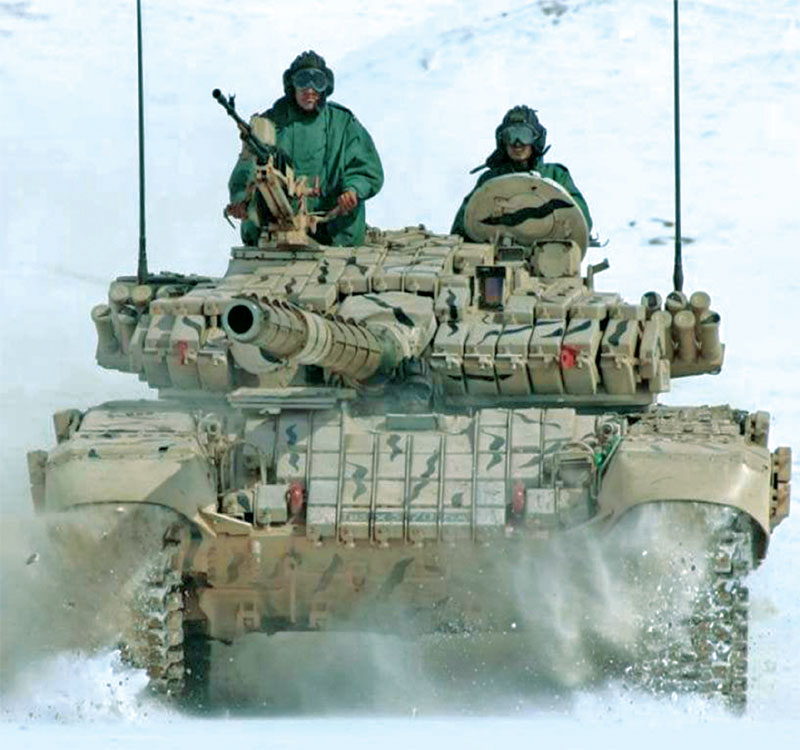
Indian Army T-72CIA MBT
Background
Tanks were first used in an offensive role in the First World War in the battle of Cambrai, in France (November-December 1917). After a few initial gains and surprises, little was achieved - due to various reasons. After the war however, two individuals did much to focus on the tanks as a way to break the stalemate of static trench warfare. The two were Capt. B.H. Liddell Hart and Col. J.F.C. Fuller.
Initially, there was lukewarm response in Britain to the employment of tanks. Considering that Britain was the country that had invented the tank, this was a curious omission. The efforts of the pioneers, however, did not go unnoticed and an experimental tank brigade was formed and exercised on the Salisbury plains in full glare of publicity. Liddell Hart as the military correspondent of the London Times wrote extensively on the development of such a brigade, its organisation, tactics and tasks. The interesting fact is that while the British Army was not particularly interested, these developments and the writings of Liddell Hart and Fuller were keenly followed by Generals of the German and Russian armies. Recall that the Treaty of Versailles in January 1920 had imposed stinging restrictions on the German army which was smarting under the sanctions and was looking for ways to reduce the effect of limited strength that had been imposed on them. The tanks and their employment as offensive weapons appeared as the answer they were seeking to compensate for their deficiencies.
Subscribe To Force
Fuel Fearless Journalism with Your Yearly Subscription
SUBSCRIBE NOW
We don’t tell you how to do your job…
But we put the environment in which you do your job in perspective, so that when you step out you do so with the complete picture.



 VIDEO
VIDEO