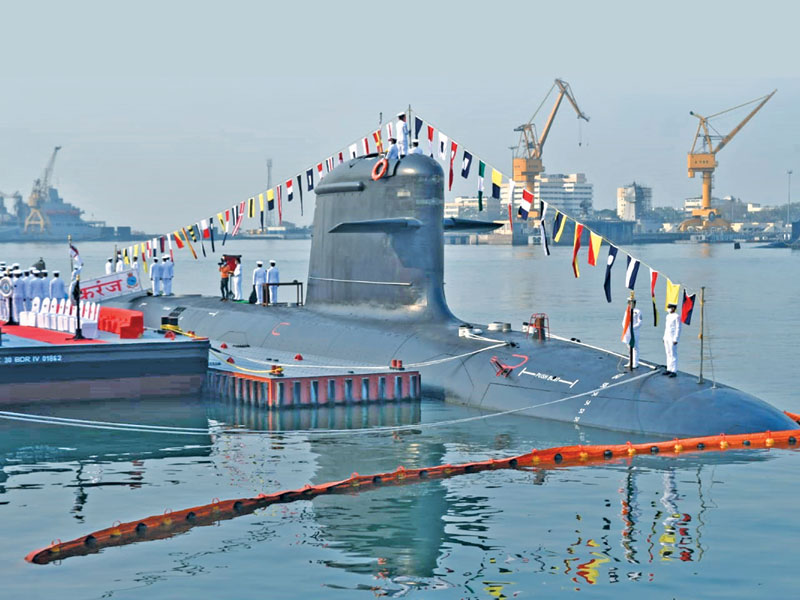
One of the most anticipated Request for Proposal (RFPs) amongst the many that are at various stages of discussion is the one for Project 75(I), a programme for the indigenous construction of six conventional diesel-electric submarines by an Indian entity in collaboration with a foreign submarine builder. This is also the first programme being progressed under the Strategic Partnership (SP) model. This programme, the first Acceptance of Necessity (AoN), which was issued more than a decade ago, has had many ups and downs (with more of the latter) since then and is presently awaiting yet another AoN from the Defence Acquisition Council (DAC) headed by the defence minister which would allow it to progress further. Once the AoN is accorded, it is hoped that the RFP will be expeditiously processed within the ministry of defence (MoD) and issued.
The reasons for this delay are many; the complexity of the process, the lack of professional expertise in the MoD, the reluctance of the Indian Navy to take ownership of the programme and inadequate political direction to ensure timely progress despite its criticality for India’s national security and the many challenges it faces.
There are two fundamental philosophies driving the procurement of military hardware in India. First is that the equipment should be proven and should preferably be in service with the armed forces of the country of origin and second, it should be the cheapest amongst those that meet the basic minimum requirement of the armed forces. This approach is not surprising in a risk-averse and price-conscious MoD; however, the insistence on L1 (lowest cost) in a competitive bidding process where the lack of professional experience or expertise of the generalist bureaucracy limits their understanding to seek a more comprehensive method of price discovery through a weighted matrix which includes other parameters like cutting edge features, transfer of technology, lifecycle support and a host of others.
This leads to creating a competitive bidding scenario more for the sake of competition than gaining anything substantial from it and more often than not ignores the military’s preference for a particular equipment based on experience and professional expertise. Driven by the Defence Acquisition Procedure (formerly known as the Defence Procurement Procedure) which has grown from 200-odd pages to 700-odd pages in the last six years, which provides the MoD the excuse to be inflexible in its approach, these two approaches deliver neither the best nor the cheapest. The Project 75(I) is also likely to become a victim of this inflexible adherence to the DAP which instead of being a facilitator has instead become a victim of the procedure itself.
In 2016, the MoD introduced the SP model with the stated aim of enhancing private sector capacity to augment the existing manufacturing capacity in four high technology big-ticket areas—submarines, fighter aircraft, helicopters and armoured vehicles. Project 75(I) is the first programme being processed under the SP model and is being closely followed by another naval programme for 111 Naval Utility Helicopters (NUH). These two programmes will form the crucible that will decide the fate of this model. When this model was first introduced as Chapter 7 of the DPP 2016, a host of ambiguities were highlighted by industry, the industry associations, original equipment manufacturers (OEMs), experts and other stakeholders. However, the MoD paid little heed to these with the result that the DAP 2020 has replicated Chapter 7 with no changes and in the four years since its promulgation, the SP programme is still awaiting its first AoN.








 VIDEO
VIDEO