

Smartness of Small
Last year, amid tensions with China along the Line of Actual Control (LAC) in Ladakh, the troops of both the countries engaged in brawls, claiming lives on both sides. Twenty army personnel died on the Indian side. Presuming that these tensions could rise further, the Indian administration swung into action for better preparedness along the LAC. As the Indian procurements of armaments have come to be cancelled for an array of reasons continually, subsequent governments have resorted to panic-buying of defence armaments, that too in tranches of the minimum requirement, after tensions have reached a certain level, where there could be a bigger flare up, just like in the case of the India-China standoff.
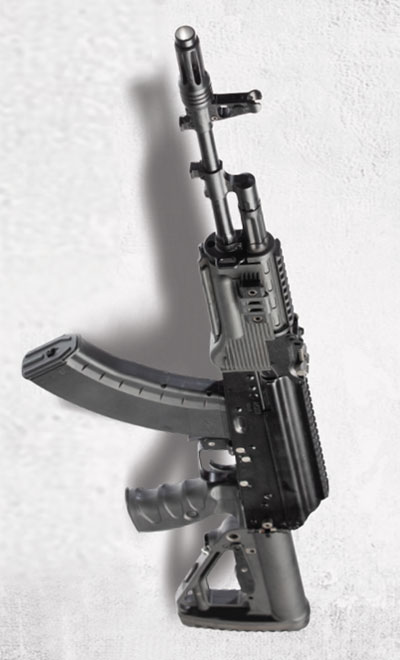
Kalashnikov’s AK-203 Assault Rifle
This stays true for most defence equipment including tanks, aircraft and missiles. Adhering to the most basic of necessities, it is worthy to talk of personal arms that soldiers and police personnel carry along with them. Indian forces are particularly in need of small weapons which can come handy in self-defence. At a time when India-China tensions were high and the soldier engaged in hand-to-hand combat, the Indian Army brought to the fore that they required a ‘limited number of close-quarter battle rifles on an immediate basis’.
As reported in the Economic Times, the army was without a close-quarter battle weapon for years and officials had informed the newspaper that the force had been using regular assault rifles for the purpose, reducing the operational efficiency of the troops. The two types of small weapons—rifles and close quarter carbines—have different uses and serve different purposes. Carbines are used for close quarter battles, whereas rifles, which have long barrels, are generally used for long-range targets due to their ability of giving the user the benefit of distance and accuracy due to the rifle’s ‘spiral groove’ which spins the bullet when fired, for it to reach a further target.
On the other hand, carbines are rifles that have compact, short barrels which is less than 20 inches in length and are comparatively light weight. These are used to fire at a close range, where the target maybe closer to the shooter and movement space maybe limited. Indian forces perform counter insurgency operations in Kashmir where security personnel are required to deal with militants from a very close distance such as confined spaces where militants go into hiding. Carbines, because of their short barrels, can prove to be useful in all theatres that see proximity between the security personnel and their adversaries. Apart from the army and paramilitary forces, carbines may be of crucial use to the state-police forces which function in urban Indian landscapes which are congested and may require police officials to use carbines in case there is a law and order situation. Left-Wing Extremist (LWE) areas also see close-quarter battles, which make it a crucial weapon for self-defence.
Small weapons of different varieties are considered personal to soldiers and act as security cover for them in adverse situations. However, in India, the procurement of small arms has been a long-drawn issue which has compelled forces to make makeshift arrangements or operate without these arms.
India’s attempts at procuring carbines have seen several setbacks over a period of time which have led to deals being cancelled and not culminating into concrete developments for the Indian forces. Only last year in September, the Defence Procurement Board (DPB) informed the Defence Acquisition Council (DAC) of its decision to revoke the USD110 million of contract that was yet to be formally inked with the UAE-based Caracal International for the procurement of 93,895 close-quarter battle CAR.816 CQB carbines for the Indian Army.
The original requirement for small arms in India is huge and reaches a mark of 3.5 lakh, if the paramilitary and the state police forces are included. Caracal had won only a fraction of this contract under the Fast Track Procurement (FTP) of the 5.56x45mm carbines and had finished as the lowest bidder, to replace the existing 9mm Sterling 1A1sub-machine guns, used by the British during World War II, after the domestic industry felt that they could manufacture such a weapon in India. CAR.816 was selected over Thales’ F90 carbine. This deal to secure carbines has hit roadblocks multiple times. As per media reports, Caracal had identified an Indian partner and local manufacturers so the carbine could be locally made with more than ’60 per cent’ of locally-manufactured parts. Apart from bagging more orders for carbines, the company had expressed its intention of participating in other competitions such as in the 9mm pistols and sniper rifles contracts. However, this is not the first time the contract has hit a roadblock. In 2008 and 2010, two subsequent tenders were floated.
Subscribe To Force
Fuel Fearless Journalism with Your Yearly Subscription
SUBSCRIBE NOW
We don’t tell you how to do your job…
But we put the environment in which you do your job in perspective, so that when you step out you do so with the complete picture.



 VIDEO
VIDEO