The arrival of the Rafale with its smart sensors and weapons has provided the IAF with a far enhanced precision strike capability as it has rapidly assimilated the fighter jet into its inventory with 26 aircraft now operational in two squadrons.
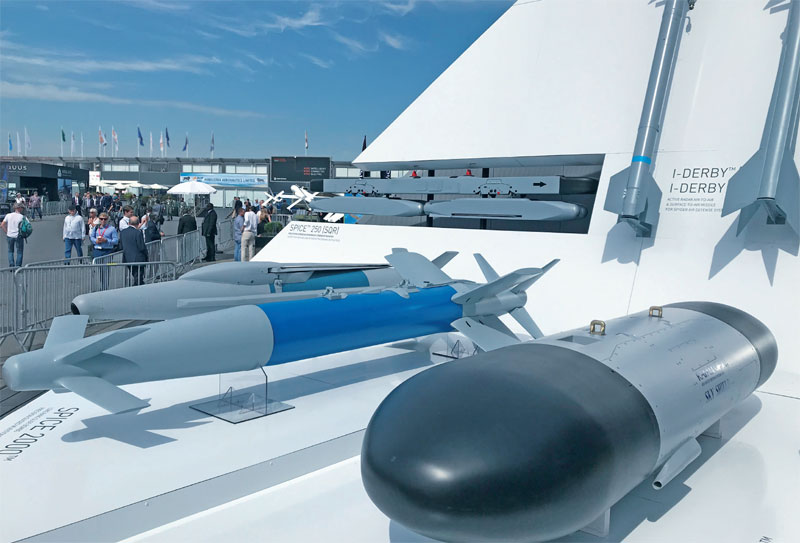
Spice 2000 missile
The IAF inducted the Rafale F3-R into service in July 2020 when the first batch of five aircraft (three single-seat and two twin-seat) joined No. 17 Squadron, ‘Golden Arrows’. The IAF has a squadron each of Rafales based at Ambala and Hashimara. The air and ground crew have already received comprehensive training on the aircraft and its highly advanced weapons systems.
In addition to the Rafale’s air-to-air armament comprising MBDA’s ramjet powered Meteor long-range Beyond Visual Range Air-to-Air Missile (BVRAAM) and MICA Close Combat Missile (CCM), the IAF has also opted for Safran Electronics & Defence’s AASM Hammer bomb guidance and glide kits and Israeli SPICE guided munitions. Both these air-to-ground weapons are considered smart munitions as opposed to previous generation’s precision munitions.
As per the Rafale contract, Dassault Aviation is in charge of the aircraft package supply protocol (APSP) while MBDA is handling the weapons package supply protocol, with Safran Group companies—Safran Aircraft Engines and Safran Electronics & Defence also involved along with Thales. The Rafale due to the sophistication of its sensors and suite of smart weapons is considered as a quantum jump over the IAF’s current fleet of upgraded Mirage 2000 I/TI, MiG-29UPG and Sukhoi Su-30 MKIs.
The development of the Rafale F3-R started towards the end of 2013 and was qualified by the French defence procurement agency DGA in October 2018. The Rafale has several variants starting with ‘F1’ which was specific to the first French Navy aircraft. This was followed by ‘F2’ which added improved air-to-ground and air-to-air capabilities and the ‘F3’ added greater versatility to the aircraft. France is now developing the Rafale F4 which is slated to enter service in two stages in 2023 and 2025 and will deliver a substantial increase to the Rafale’s combat capabilities with greater equipment, increased autonomy and enhanced armament along with higher levels of connectivity allowing it to undertake collaborative combat missions. The Rafale F4 also provides a future upgrade path for the IAF.






 VIDEO
VIDEO