In 2019, when Jet airways failed to remain afloat, India’s commercial airline fleet grew by 29 per cent. Commercial aircraft in that year rose to 669 from 520 in 2018. IndiGo inducted 53, the highest number of aircraft in that year. Vistara brought in 21 aircraft, GoAir-17, AirAsia India inducted eight, Air India and Alliance Air three and one respectively. SpiceJet, which inducted 46 aircraft, however, was the only airline to include six Bombardier Q400, a regional transport aircraft for flying to smaller cities under the regional connectivity scheme.
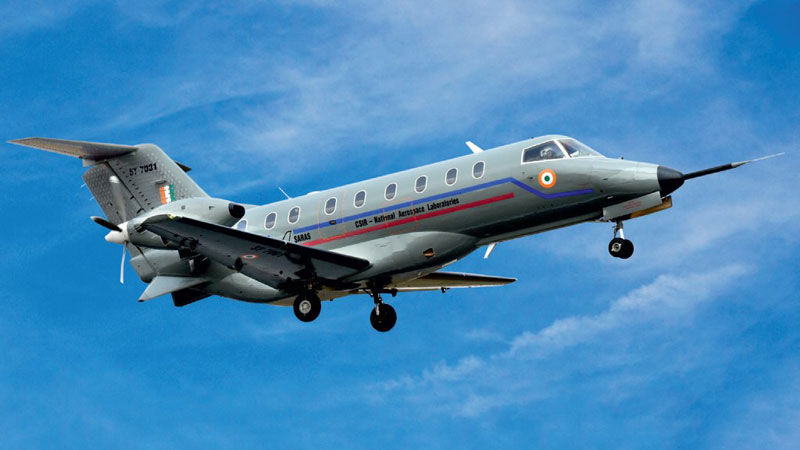
NAL Saras PT1N First Flight
In last one decade, demand in the smaller cities has grown as airline travel became accessible and affordable. Airports have come up in Tier-I and II cities, leading to an increase in passenger traffic.
In 2018, the data compiled by the Airports Authority of India (AAI) had shown that there was a significant rise in passenger traffic from Tier-II cities like Ranchi, Surat, Vijayawada, Varanasi and Bhubaneshwar. The growth rate was even higher in comparison with cities like Delhi, Mumbai, Kolkata and Chennai.
In 2016, the government launched Ude Desh Ka Aam Nagrik (UDAN), a Regional Connectivity Scheme (RCS) with the objective of making air travel affordable and developing air-travel infrastructure all over the country. The scheme was mainly intended to make a few unserved and underserved airports function. The data collected in April 2017, clearly marking the success of the programme, showed that seven of every 10 seats were sold in smaller cities. SpiceJet, which had started operating its 78-seater Bombardier turboprop fleet in 2011 to Tier-I and Tier-II cities, faced huge losses until the RCS was launched.
However, in 2019, it was learnt that the scheme had faced turbulence in its operation. The Selected Airline Operator (SAO) had expressed their unwillingness to fly on most of the routes that were chalked out to connect smaller cities. This came after the airlines faced issues like low demand, poor infrastructure and geographical limitations in mountainous regions. Forty three of the 137 airports under the scheme are functional, which also meant that only few of the 232 routes under the RCS were operational. A report in Mint newspaper, had in relation with the scheme, suggested that airlines were struggling even in places where infrastructure was not an issue due to low demand.
This is a pertinent issue for most airlines as the Indian aviation industry continues to struggle with expenses. Here is where the smaller aircraft come in as they are cost-effective due to less fuel consumption. However, this is not the only solution to the precarious condition of Indian airlines. The central and state governments will need to step in and support the airlines by cutting taxes on Aviation Turbine Fuel (ATF). Other measures are also needed to keep the airlines operational during this pandemic.







 VIDEO
VIDEO