

Six Women in a Boat
Aditya Kakkar
“Those who live by the sea can hardly form a single thought of which the sea would not be part.” When the 20th Century Austrian writer, Hermann Broch, wrote the above lines, he wouldn’t have known that years later, it would apply to six seafaring Indian women who are out to circumnavigate the globe and create history.
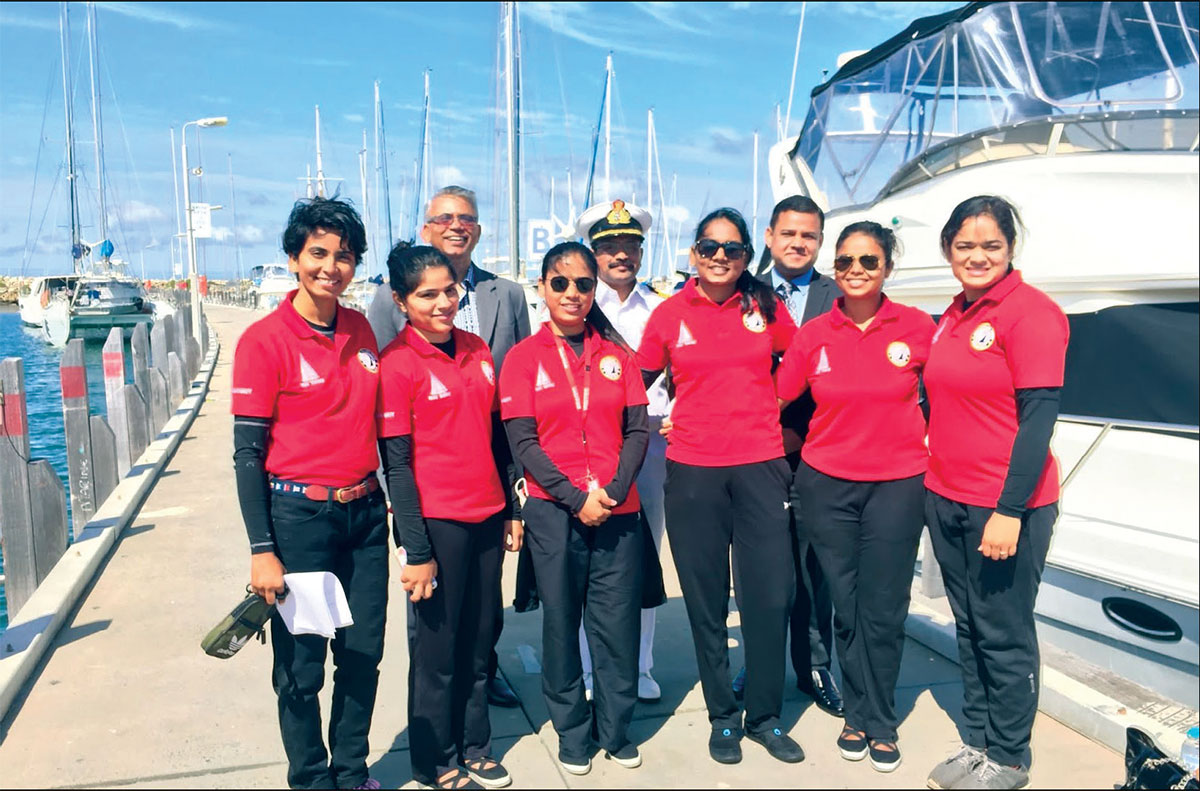
The all-women team of INSV Tarini (© parikrama123.blogspot.in)
The expedition, ‘Navika Sagar Parikrama’, is being led by skipper Lt Cdr Vartika Joshi, who is from Rishikesh. She is accompanied by equally accomplished officers, Lt Cdr Pratibha Jamwal from Kullu, Lt Cdr Swathi P. from Visakhapatnam, Lt Aishwarya Boddapati from Hyderabad, Lt Vijaya Devi from Manipur and Lt Payal Gupta from Dehradun.
This one-of-a-kind expedition will encourage more women to take up sailing, either as naval officers or civilians. It is being covered in five legs with the Pacific leg being the longest. As they have already crossed Fremantle (Australia), the crew will now stop and replenish their supplies at Lyttelton (New Zealand), Port Stanley (Falklands) and Cape Town (South Africa). They will be braving some of the roughest and tumultuous seas of the world, including the dangerous stretch from New Zealand to Falkland Islands, where waves are about 10 feet high on an average day.
The six-member team wrote back to FORCE while sailing from Australia to New Zealand and remarked that “the journey has been a mix of adventure, monotony, thrill, surprises, and boredom. We have been lucky to embark on this journey where we could encounter certain phenomena like bioluminescence and the Aurora Australis, which a landlubber can’t even imagine in dreams.”
Defence minister Nirmala Sitharaman flagged off the journey from Goa on September 10. “We were honoured and privileged to have the esteemed presence of the new defence minister who came all the way to Goa to cast us off for the circumnavigation. Her glorious presence itself has been a huge inspiration for us,” said Lt Cdr Joshi. She further added, “If there is somebody who should be credited for making the all-women crew a possibility, it would be Vice admiral MP Awati (retd), Captain Dilip Donde (retd), and Cdr Abhilash Tomy. The trainings imparted by them helped us to raise our levels from being an absolute layman about sailing, to a state where we could confidently take Tarini out in the water and now across oceans. The experiences of Captain Donde and Cdr Tomy have helped us a great deal in knowing and sailing our boat better and the two have always been there to guide us through thick and thin.”
Captain Donde was the first naval officer from India to circumnavigate the globe in 2009-10 while Cdr Tomy was the first one to do it solo.
The rules of circumnavigating the globe aren’t the most simple. The team must not only cross all meridians and return to the spot they started from but also must avoid straits and canals. They must cross the equator twice and the dateline once, round the great capes, the southern tips of Africa and South America, and must travel more than 21,600 nautical miles.
Having covered about 9,000 nautical miles, one would have expected them to run into some bad weather. “None, we expected that Australia to New Zealand will be the beginning of the rough sea and inclement weather but on the contrary, we encountered a good breeze of about 20 to 25 knots. The ‘Furious Forties’ were not so furious upon us (till now),” said the skipper.
INSV Tarini is the sister vessel of INSV Mhadei, the sailboat on which the six trained extensively. Both Mhadei and Tarini are of the same Dutch design, Van de Stadt-Tonga 56, so there is not much difference between the two and sailing has become second nature to them. INSV Tarini has an inventory of eight sails, two main sails, head sails (two each - Genoa and Stay sail) and a set of downwind sails. At a time only one pair of sails is in use: one main sail along with head sail or downwind sail.
When the six reached Fremantle, completing the first leg of their journey, they were warmly welcomed. “Lot of people of Indian Diaspora, high commissioner of India in Australia, India’s consulate general for Perth and Australian yachtsmen had gathered to welcome us. We were hosted by retired defence officers as well. Meeting Australian scientist, Alan Mackay-Sim was one of the best things that happened randomly while we were in the consulate general’s office. He is a renowned scientist and explained to us the work he has done in the field of science and medicine to help people recover from various injuries. He has been awarded the ‘Australian of the year’ award for his great work. We all felt great after meeting him.”
Smooth sailing is desirable but eventually uneventful and monotonous. The six divide internet data according to the number of days of voyage and call/video call friends and family. This is unlike Cdr Tomy who preferred to avoid contact with family and friends while out at sea. The six also communicate with the world through their blog, parikrama123.blogspot.in, Instagram, Twitter and Indian Navy’s Facebook page.
Lt Payal Gupta spoke about the good times since beginning the journey, “Skipper and I celebrated our birthdays, it was on October 30 and November 7 respectively. So, skipper’s birthday was celebrated in Fremantle and it was a grand celebration. We cut the cake at midnight and the next day it was a small get-together in our apartment where consulate general, his wife and Indians staying in Perth were present. My birthday was celebrated at sea. Manisha and Preeti gifted me a cake and we decorated the boat with balloons. We really enjoyed the day.”
The days are not without a sense of purpose. Data is regularly collated and passed on to the navy. Since INSV Tarini is sailing through high seas, recording changes in weather, sea surface temperature, wind, sea state, and pressure temperature can bring greater insight to sailors in the future. Position and weather reports are periodically sent to the defence attaché and officials of the Indian Navy.
The days are almost a blur with routine being the only constant and some days being tougher than others. When questioned about loneliness setting in, Lt Gupta said, “Well, first of all, we are six so we are never lonely. We keep ourselves busy with books, movies, crafts, colouring, and singing but if you ask me, at times, life at sea can prove extremely challenging for us working onboard, away from our loved ones. A long-distance relationship with our families, limited access to social life, increased psychological and physical pressure sometimes makes us feel low but we are in continuous touch with our families. Most of the time, we wonder how days fly by at sea. It has been almost two years that we six are together, so we are quite comfortable with each other.”
INSV Tarini is not without its modern-day toys. It has an electronic chart plotter which has a feed from the GPS, weather radar, wind indicators for directions and speed, satellite communication for voice and data, a reverse osmosis plant (desalination equipment for water), a diesel generator and an engine, for entering and leaving the harbour. While the vessel primarily needs favourable winds for its journey, having a diesel generator also comes in handy for charging batteries onboard.
It also has weather software such as Bonvoyage and Windytv. These generally provide the team with weather data for the next 10-15 days, helping them with early warning in case of bad weather. Out there, preparation is the key to survival. Since they have weather prediction software on their vessel, the team does not take assistance from other countries for weather updates. The routing of the sailboat is done considering various factors. Piracy is one such constant threat so areas prone to piracy are avoided.
The team sometimes did encounter rough seas and winds up to 40 knots, along with cold fronts and weather depressions but nothing has affected the pace of the journey. The only unpredictable weather phenomenon were some local weather squalls. Apart from some minor cuts and bruises, cold and headaches, no one in the team has fallen seriously ill. Rigorous training and their strong constitution has kept the journey well on track.
“We sail 24x7. Yes, we do take turns on sailing the boat. For our ease of sailing we have divided the team in groups of two who carry out four hours of watch, twice a day, both day and night. For example, 4am to 8am is the first watch, 8am to 12 noon is the second watch and 12 noon to 4pm is the third watch. Then the same cycle repeats. In this way, we decide our routine of preparing breakfast, lunch and dinner. This way for 24x7, two of us are always on watch guarding the vessel from any approaching danger while the other groups take rest or spend their leisure time in their own way. So, we all get a good amount of sleep,” explained Lt Cdr Joshi.
Nothing compares to the joy of being out in the high seas, wind in your hair as birds and marine life blossom around you. The team has been fortunate enough to witness long-tailed tropical birds, albatrosses, seagulls and different birds that frequent the shore. Apart from birds, they also have witnessed flying fishes, killer whales, pilot whales, small fish and dolphins. What has been truly unfortunate has been seeing garbage and oil patches floating in the sea, a sign of human indifference and callousness.
Asked about food and other essential supplies, the captain said, “According to our voyage we provision the boat. We have some means of calculating the quantity of provision to be carried for a voyage, what all is to be carried, both fresh and dry, water etc. We also carry some extra provisions than the required amount. We are a sailing vessel and our ETA (estimated time of arrival) varies according to the type of weather conditions we encounter on the voyage. We don’t have fridge or cold storage for our fresh ration so we do selective purchase of the food items that we have to carry onboard. According to the weather conditions we have different types of meals. We prepare all kinds of food like we eat at homes - chapattis, paranthas, biryani, curry, pakoras, fries, cake and bread. If the weather permits, we have elaborate food.” But when the sea is rough, cooking is limited to ready-to-eat meals. “We carry a good amount of dry food, all kinds of pulses and some tinned food too. So far, the weather has been kind to us, so we are eating well. Since we don’t have refrigeration facility, we first use the food which tends to spoil easily. Potatoes, onions, tomatoes can be stored for quite a long time if we keep them dry. Sometimes we keep the food outside to dry it in the sun and it can be stored for a bit longer,” said Lt Cdr Joshi.
The team is yet to encounter a sailing vessel but did pass by numerous merchant vessels and fishing boats when it set sail from Goa to Australia. They also noticed fishing boats near the ‘south trap’. There have been many military ships and aircrafts that have communicated with the team in their earlier voyages but during this circumnavigation, there has been only one instance so far when the navy’s P8I aircraft communicated with INSV Tarini.
For Lt Gupta, “the best source of entertainment is to look endlessly at the sea and the marine life. We sometimes see bioluminescence at night and countless stars in the sky. We recently also witnessed ‘Southern Lights’, a very rare sight and something we don’t get a chance to see every day. There are other ways to entertain ourselves too. For instance, when the weather is calm, we like watching movies and television series. We also enjoy reading books, indulging in hobbies such as cooking and colouring. We also play Scrabble and Uno.” All of them also maintain individual journals to capture time in words.
They expect to reach Lyttelton by the end of November. There they will focus on getting the boat prepared for the next longest leg, crossing the Pacific to Falkland Islands through Cape Horn. The six are carrying a variety of books, including ones on sailing, navigation, science, religion, spirituality and novels such as Moby Dick and Robinson Crusoe.
‘Navika Sagar Parikrama’ is Indian Navy’s promise that it is indeed an ‘ocean of opportunities’ and it walks the talk when it comes to women empowerment. The importance of the Indian Navy offering this opportunity must be underscored while credit must be given to the six women who have trained meticulously. Sailing has become a part of their life and all actions onboard the vessel are almost a part of their memory.
Circumnavigating the globe can break the mental strength of the best of sailors, it is the vastness of water that overwhelms you. Land almost becomes a distant memory and monotony sets in. It becomes difficult to distinguish between passing days and the changing weather is the only clue that the world has not stood still. It is in this environment that the sailor must learn to master both mind and body. It becomes imperative to push yourself against all odds and learn to accept the sea as an ally. INSV Tarini is not merely crossing the seas but also unshackling women from societal cages. It is giving a new lease of life to all those who dare to dream. Since the dawn of time mankind has leapt from one milestone to another, only to discover that there are miles more to go.
The oceans of the world are impossible to fathom, their mysteries lingering on for centuries, but the six women who are out there, all in their 20s, circumnavigating the globe, see this as an opportunity to lead and inspire. They shall not be forgotten.





 VIDEO
VIDEO