China’s biggest parade staged to date at the Tian’anmen Square in celebration of the 70th founding anniversary of the country, featured 15,000 troops, 160 fixed-wing aircraft and helicopters, and 580 pieces of equipment of which 40 per cent were showcased for the very first time on October 1.
This was also the first parade that was attended by Chinese President Xi Jinping in his capacity as the General Secretary of the Communist Party of China’s (CPC) Central Committee, Chairman of the Central Military Commission, and Commander-in-Chief of the People’s Liberation Army (PLA).
During his pre-parade inspection of the participating contingents, Xi, wearing a high-collar dark grey Chinese-style suit, repeated salutes through microphone: ‘Salute to you, comrades!’ and ‘Comrades, thanks for your hard work!’ The soldiers in turn saluted Xi and exclaimed: ‘Hail to you, Chairman!’ and ‘Serve the people! Follow the Party! Fight to win! Forge exemplary conduct!’
Strategic Weapons
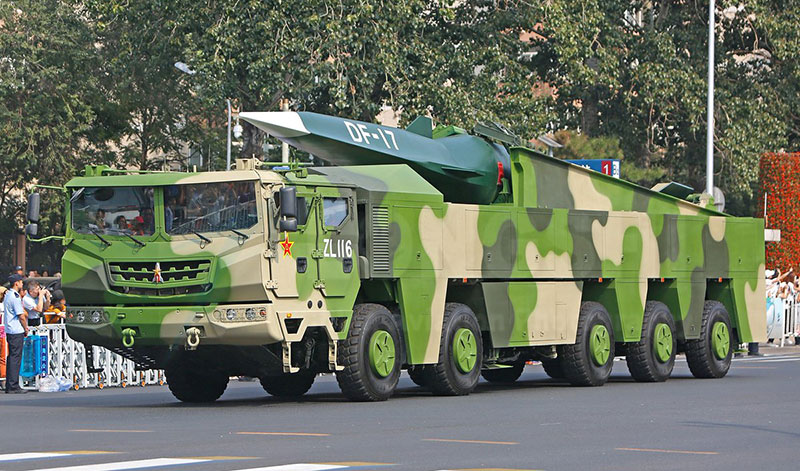
New-generation strategic weapons displayed for the very first time included the multiple independently targetable warhead-equipped DF-41 and DF-31AG road-mobile intercontinental-range ballistic missiles (ICBM), the JL-2 submarine-launched ballistic missile, and the China Aerospace Science and Industry Corp-developed DF-17 conventionally-armed tactical ballistic missile equipped with a DF-ZF hypersonic glide-vehicle (HGV) — all of which are operated by the PLA Strategic Rocket Force (PLARF).
The DF-ZF has been flight-tested by China nine times, on January 9, August 7 and December 2 in 2014; June 7 and November 27 in 2015; and in April 2016. This was followed by its launch from a DF-17 on November 1 and 15, 2017. The DF-ZF detached from the DF-17 during the re-entry phase and flew approximately 1,300km to a target. In actual use, the DF-17 will boost the DF-ZF to Mach 5 or faster, at which point the latter would separate from the booster and angle toward its target, manoeuvring to correct its course or evade enemy air-defences.
An HGV deploys from a ballistic missile, then glides to a target on a flight path much different (and much less predictable) than that of a traditional ballistic missile. The glide path is lower and slower than a normal ballistic missile payload, although still generally higher and faster than a traditional cruise missile. The DF-17/DF-ZF combination is configured as a conventional munition with its destructive effect being derived from the kinetic energy of the HGV. The average speed of the DF-ZF has been assessed at 2,121 metres/second, or about Mach 6. It has been under development since the previous decade by Department 7 of the PLA’s Naval Aeronautical Engineering Institute in Yantai, Shandong province.








 VIDEO
VIDEO