Nearly three years ago, with the objective of enhancing its Intelligence, Surveillance and Reconnaissance (ISR) capabilities, India inducted the indigenous airborne early warning and control (AEW&C) Netra into its armed forces in 2017.
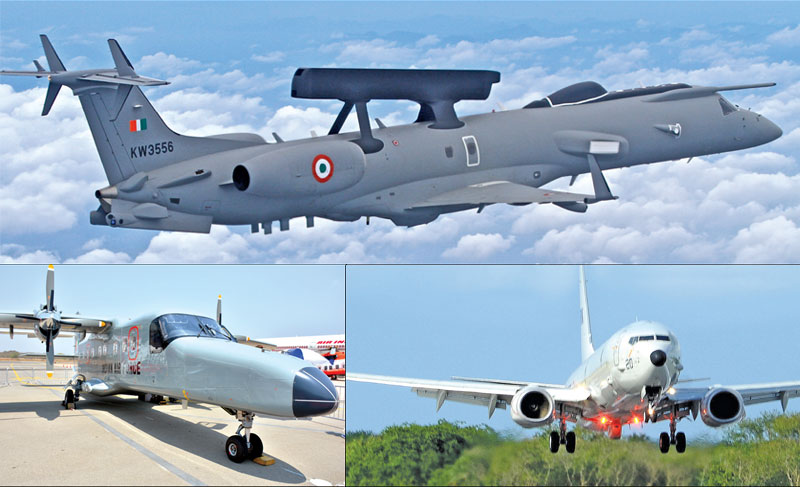
Clockwise from top IAF’s Netra AEW&C; Phalcon A-50I on IL-76; P-8I maritime reconnaissance aircraft;
India currently operates two of Defence Research and Development Organisation (DRDO’s) Netra which is a multi-sensor fitted on an Embraer-145. A third one is being tested. India also has three IL76 Phalcon systems, that were jointly developed with Israel and Russia, in her inventory.
Netra was also used during the February 2019 Balakot strikes.
For any military operation, ISR plays the linchpin role. The key to effective ISR is optimising the interoperability of land, sea, air, space systems and the men behind these machines. This optimised networking and interoperability helps facilitate the conversion of raw data into actionable intelligence rapidly.
The Indian armed forces’ inventory of ISR assets include airborne warning and control system (AWACS) and AEW&C aircraft to maritime reconnaissance aircraft (MRA) and helicopters to specialised surveillance and reconnaissance Unmanned Aerial Platforms and satellites.
ISR, which has several applications at operational, strategic and the tactical level, is crucial for both conventional and nuclear deterrence adding to war-preparedness.
In October 2017, the then Chief of Army Staff, who now serves as Chief of Defence Staff (CDS), General Bipin Rawat, had acknowledged the pressing requirement of equipment that further emboldens the ISR capabilities of the military.
A report by the Hindustan Times published in January 2020 said that the Defence Acquisition Council (DAC) had cleared a joint proposal of the DRDO and the Indian Air Force (IAF) to purchase two Airbus 330s and convert them into 360-degree long-range capability AWACS.








 VIDEO
VIDEO