

Shock and Horror
On his maiden visit to Jammu-Kashmir since the state was reduced to a Union territory in August 2019, home minister Amit Shah told a public meeting held at Sher-e-Kashmir International Convention Centre, “I read in the newspapers today that Farooq (Abdullah) Sahab’s advice to me is that the Government of India should hold talks with Pakistan. He is an experienced leader and has been Chief Minister. It is his advice, but I want to tell Farooq Sahab and especially people here that if talks are to be held, I will speak to my brothers and sisters in the Valley, and the youth in the Valley. Why shouldn’t I speak to you?”
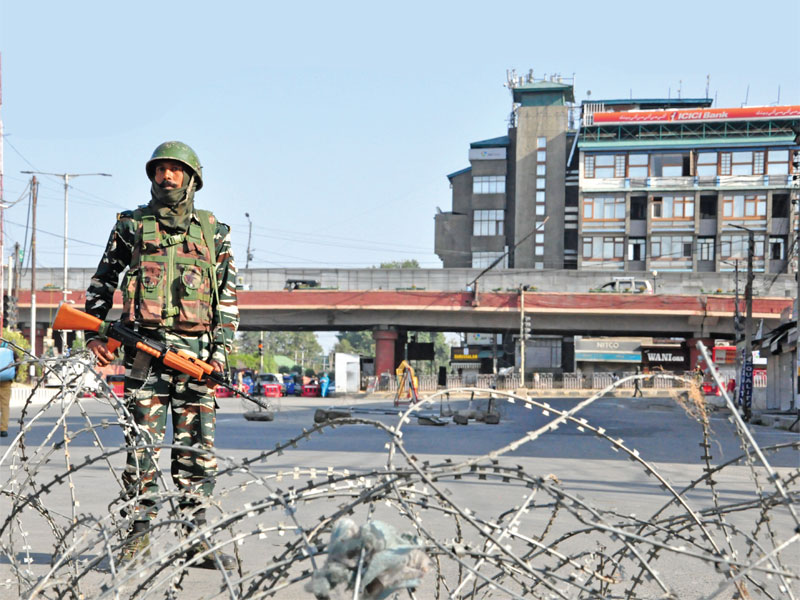
With that, he asked his security staff to remove the bullet proof barrier between him and the audience, comprising Bharatiya Janata Party (BJP) workers, officials from the security forces and the state administration, so that he could do some ‘mann ki baat’ with them. Shah’s confidence that none among the party workers or the state administration would try to harm him was a clear marker of his courage. A small detail though: the home minister had brought his own camera team from Delhi to capture his candid moments with his ‘brothers and sisters’. No local journalist or photographer was allowed to the event.
A day later, a few students of medicine in the university of Kashmir were booked by the state police under the anti-terror Unlawful Activities Prevention Act (UAPA) for celebrating the victory of the Pakistan cricket team over India. The action against the Kashmiri students was not limited to the Valley alone. In the days following the October 24 match, reports of detention, suspension and rustication of Kashmiri students came from states as diverse as Rajasthan and Uttar Pradesh.
Clearly, home minister’s filiality extended only to the select invitees sanitised thoroughly before the ‘public’ rally. In the days preceding the minister’s visit, all possible security details were in place—from temporary confiscation of private bikes and scooters to public demonstration of tactical unmanned aerial systems. Perhaps, to convey to the people that they were being watched.
Meanwhile, in another part of the Union Territory—the Poonch-Rajouri region, south of Pir Panjal—a deadly gunfight was underway even as the home minister was telling his audience in Srinagar how his government has ushered in an era of peace and prosperity, after fully embracing Jammu and Kashmir as its own by removing the artificial barrier of Articles 370 and 35A. Diminution of the state to the UT was merely a matter of nuance, and hence immaterial. After all, his government has brought democracy to the grassroots levels and unshackled the state from the clutches of ‘three families’—a reference to Gandhis, Abdullahs and Muftis.
The Poonch encounter was in its 13th day, even as the home minister was celebrating the end of violence. Nine army personnel had already been killed in the encounter that has been termed as one of the deadliest in over a decade and half. The most worrying aspect of this encounter has been that even after the silence of the enemy guns, there is no way of telling whether all infiltrators/ terrorists have been killed, given the topography of the area and the denseness of the forest. Some could have just slipped away.
Uncertainty is the biggest challenge in Jammu & Kashmir today. Nobody knows what is going to happen. Worse, thoughts remain uncontrolled and indecipherable. No coils of the barbed wire, no midnight crackdowns, no suspension of internet and no threats of retribution have been able to give the state a mechanism of understanding what is going on in the head of a Kashmiri—does she mean what she says, or is she saying what she means.
Insider Outsider
Post-5 August 2019, the situation has worsened. The seemingly seamless network of informers that the state police had assiduously built over the last nearly 30 years has snapped. With the lines clearly drawn between ‘us’ and ‘them’, trust is a perilous notion. The people, even former informers, do not know who they can trust in the current dispensation. Is the officer they worked with over the years trusted by his own superior or not? Or would the said officer sacrifice him at the altar of self-interest to win the trust of his superior?
The local officers also no longer trust their own network. What if the ever opportunist informer is selling contrary information to his superior or, worse, to overground workers (OGW) for more money. The one who is sitting in the market will clearly sell his wares for the highest price possible. After all, who knows how long he will be able to run his shop of information.
Subscribe To Force
Fuel Fearless Journalism with Your Yearly Subscription
SUBSCRIBE NOW
We don’t tell you how to do your job…
But we put the environment in which you do your job in perspective, so that when you step out you do so with the complete picture.






 VIDEO
VIDEO