If the Indian ministry of defence’s (MoD) ‘Technology Perspective & Capability Roadmap-2018’ is to be believed, then in the decade ahead the Indian Army and Navy will require up to 140 new-build medium-altitude, long endurance (MALE) and 80 tactical unmanned aerial vehicles (UAV), while the Indian Air Force (IAF) will require up to 70 stealthy, turbofan-powered, armed unmanned combat aerial vehicles (UCAV), and the navy and air force will have a combined requirement of 100 turbofan-powered high-altitude, long endurance UAVs.
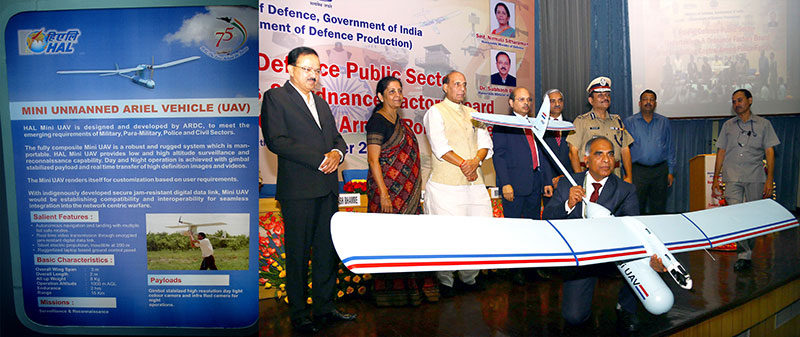
In addition, the navy will require 50 vertically-launched tactical UAVs capable of operating from warships and submarines, while all the three armed services will require more than 2,000 units of mini-UAVs. But exactly how much of all these will be home-grown platforms remains to be seen, especially since all the three armed services have since 1996 been operating imported MALE-UAVs, all of which (Searcher Mk.1 and Mk.2, and Heron-1 and Super Heron) have been imported from Israel Aerospace Industries’ MALAT Division. This despite the fact that the MoD-owned Defence Research and Development Organisation (DRDO)’s Bengaluru-based Aeronautical Development Establishment (ADE) has been entrusted with the task of developing UAVs for the past 30 years.
It was following the conduct of Exercise Brass Tacks and Exercise Checker Board in 1986 that there arose a requirement by the Indian Army for a tactical UAV capable of conducting battlefield surveillance. Consequently, it was decided in September 1988 that ADE would indigenously develop this 380kg UAV known as Nishant. The army finalised its general staff qualitative requirement (GSQR) in May 1990, following which the first Nishant UAV technology demonstrator made its maiden flight in 1995. It was rail-launched from a hydro-pneumatic launcher imported from Finland, while its power-plant was a Vehicles Research & Development Establishment (VRDE)-developed twin-cylinder RE-2-21-P piston engine developing 21hp and weighing 10.5kg.
By 2002, the army had placed an order for eight Nishants along with two ground control stations (GCS) worth Rs 800 million (USD17.9 million). User-assisted field trials commenced in late 2008 and the confirmatory user trials at Pokhran, Rajasthan, were conducted in February 2011, following which the first four UAVs and their launch vehicles were delivered. However, the army in 2015 refused to place a follow-on order for eight Nishants (each costing Rs 22 crore) and two GCS after a spate of crashes involving the already-delivered Nishants. Recovered by a parachute, the Nishants were invariably damaged structurally and rendered unusable for long periods. A wheeled version of the Nishant, named Panchi, has been under development by ADE since 2013 and its first technology demonstrator, powered by a VRDE-developed four-cylinder RE-4-38-P engine (developing 38hp and weighing 22kg), made its maiden flight on 24 December 2014. No orders for this UAV have been placed by any end-user so far.





 VIDEO
VIDEO