Some quarters inside the Indian Army feel that the Improvised Explosive Devices (IEDs) have become the biggest enemy of the forces because they result in colossal casualties. IED attacks result in more deaths and injuries than attacks from any other type of weapon except firearms. Easy availability and lethality have resulted in their widespread use in every conflict around the world. Analysts estimate that about half of the world’s countries have currently been impacted by IEDs.
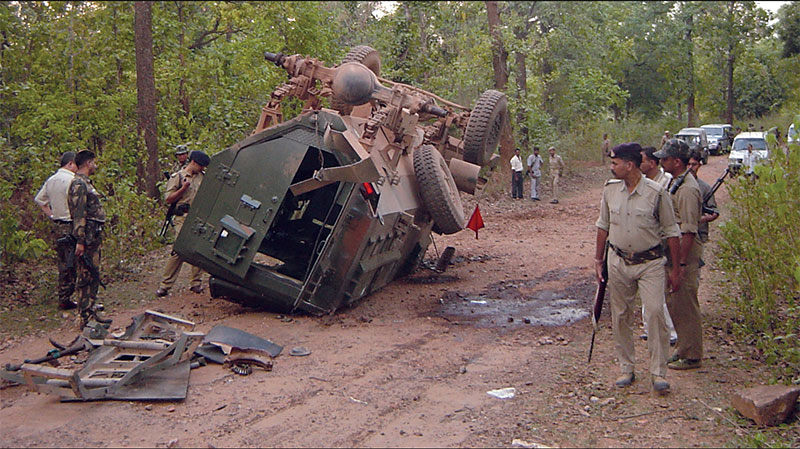
An IED blast topples over a CRPF mine protected vehicle
IEDs are a class of weapons that are simple to design, and whose components remain cheap and easily accessible. These weapons are usually available through criminal networks and porous borders, and as a result of corruption and poor ammunition stockpile management. Consequently, IEDs are being increasingly preferred by anti-national elements across the Indian states. And these weapons will remain a significant threat in days to come because of the advantages they offer to terrorists.
India is among countries which have had maximum bomb blasts – in fact, according to National Bomb Data Centre (NBDC), in 2017, the country had the highest number of bomb blasts in the world, including 337 IED blasts, which was more than even Iraq and Pakistan in that year.
Chhattisgarh registered the highest number at 60 while Jammu and Kashmir saw 31, Kerala 33, Manipur 40, Odisha 29, Tamil Nadu 32 and West Bengal 30. The Left-wing Extremism (LWE) affected states account for about 47 per cent of the IED blast occurrences in India, while the overall rate across the country shot up significantly in the last few years.
IEDs are the biggest challenge for the security forces in the Red Corridor. The IED option has been the most preferred one by the Maoists, which in the last five years has claimed the lives of at least 300 Central Reserve Police Force (CRPF) personnel. The highly talked about Mine Protected Vehicles (MPV), which security forces frequently use, have proved to be a disappointment and failed to protect the personnel. The ministry of home affairs (MHA) often draws parallel with the United States Army in Afghanistan, who, they say were not able to solve the IED problem.








 VIDEO
VIDEO