Smruti Deshpande
Russia’s offensive in Ukraine, which has now entered its ninth month, has been dominated by the use of standoff weapons in a major manner. Russia has made extensive use of air, missile and artillery bombardments on Ukrainian cities and military facilities. A form of non-contact warfare, standoff missiles have been used extensively from the beginning of the war in February 2022. Russia has used several precision standoff missiles to hit key targets in Ukraine. In retaliation, Ukraine too has been gathering similar weaponry from the West.
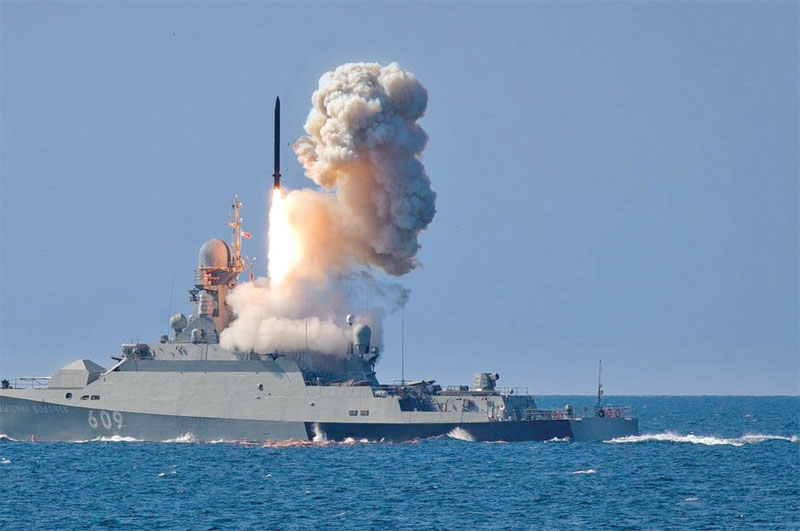
Russia’s Kalibr-launch
On the first day of the war, according to the US, Russia fired roughly 100 missiles from land and sea. This included rockets, short and medium-range ballistic missiles, cruise missiles and surface-to-air missiles. Among the weapons that Russia used were the subsonic 3M14 Kalibr (NATO has termed it as the SS-N-30A), which has a 450-kg payload and a range of 1,500-2,500 kms. Another missile, Iskander, a short-range ballistic missile, was also used by Russia. It has a range of 300-400 kms. Apart from these, Tochka, developed during the Cold War, was employed. It is a short-range ballistic missile and can carry conventional, nuclear or chemical warheads. The missile’s maximum range of fire is 70 kms.
According to reports, Russia had employed the Tochka armed with a 9N123K submunition warhead. The KH-31P, a supersonic anti-radiation missile with a standoff range, was used by Russia to knock out radar sites, according to The Warzone. Reuters reported that on October 10 these missiles tore into intersections, parks and tourist sites in the capital Kyiv. “The barrage of dozens of cruise missiles fired from air, land and sea was the biggest wave of air strikes to hit away from the front line, at least since the initial volleys on the war’s first day, February 24,” it said.
These missiles, launched from land, sea and air targeted command and control facilities, air defence sites, air bases, facilities in the Black Sea port city of Odesa among other important targets. The novelty factor in this is that Russia, in the recent past, was not known to be using precision-guided missiles extensively, unlike the US.
United States
The US established this way of fighting wars during Operation Desert Storm. The war was the first combat test of the cruise missile system. It also marked the first coordinated Tomahawk and manned-aircraft strike in history.
According to the US’ Public Broadcasting Service (PBS) Frontline, “Within the first few minutes of Operation Desert Storm, Tomahawk missiles launched from the battleships Missouri and Wisconsin struck with accuracy at Iraqi command centers, and radar installations.” In the war, Tomahawks were used to destroy surface-to-air missile sites, command and control centres, electrical power facilities and were “credited with the destruction of Iraq’s presidential palace.” After the war, the US’ major emphasis lay on increasing the standoff range of the air-delivered munitions and improving their accuracy and lethality.
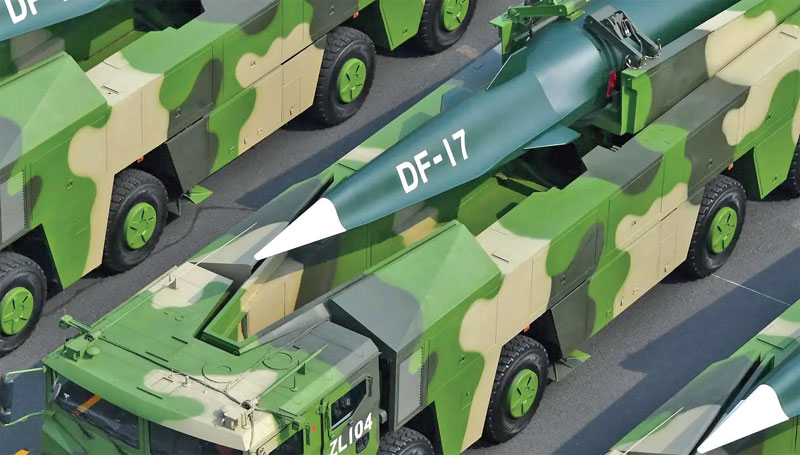
China’s DF-17 TBM with HGV-2
Missiles with standoff ranges include ballistic missiles, cruise missiles and glide bombs. The significance of such weapon systems is that they can be launched from a distance of up to hundreds and thousands of kilometres.
Ukraine has asked the US for its Army Tactical Missile Systems (ATACMS), which the US refused as the Guided Multiple Launch Rocket Systems (GMLRS) that they have sent by the thousands (as per The New York Times) to Ukraine are sufficient to hit their targets even in Crimea. The long-range missile, ATACMS can strike up to 190 miles (300 kms), with the warhead carrying 375 pounds of explosives.





 VIDEO
VIDEO