

Secrets of the Sea
On 4 June 2021, the Defence Acquisition Council (DAC) finally approved the RFP for procurement of six submarines under Project-75(I) through Strategic Partnership route (SP). The much needed, eagerly awaited and inordinately delayed project, which was an important step in the nation’s 30-year submarine building plan approved by the CCS in 1999, is expected to cost INR43,000 crore as of today’s estimate. Financial Express Online has quoted a senior naval officer who believes, ‘However, there is still a long way to go. In a regular procurement process, it takes around three-four years to clear various stages. In this case, there is no clarity on how much time it will take’.
Brief Historical Perspective
The Indian Navy (IN) joined a select band of submarine operating navies on 8 December 1967 by commissioning INS Kalvari, a Foxtrot class submarine at Vladivostok, in erstwhile USSR. Soon seven more submarines joined the IN and saw service for over 40 years. The plan for the next generation of submarines began in 1977 with a two-pronged approach to get submarines of Western as well as Russian origin almost simultaneously. Commencing 30 April 1986, INS Sindhughosh was commissioned at Riga, USSR with seven follow-on submarines of the class joining in quick succession. On the other side, two Shishumar class (HDW Type209/1500 class) submarines were commissioned at Kiel, West Germany in late 1986 and two more were built at Mazagaon docks Mumbai (MDL) under OEM supervision.
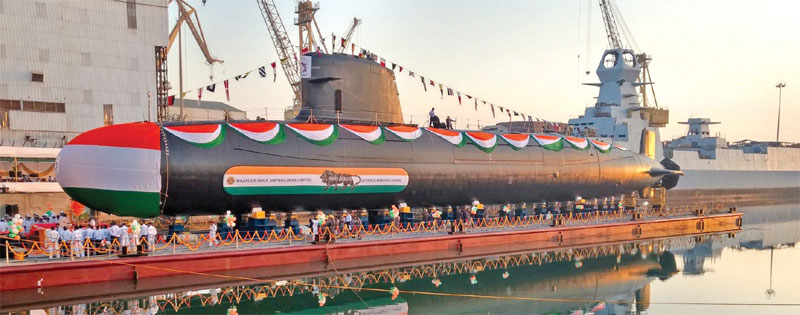
INS Khanderi, second of the Kalvari-class submarine
Of Scams, Scandals and Scallywags
The HDW submarine deal turned out to be one of the most talked about scandals over a seven per cent facilitation fee, about INR25 crore, paid to middlemen, and has had a lasting effect on India’s defence procurement ever since. Along with the Bofors 155mm Howitzer deal, these two arms deals cost the government of Rajiv Gandhi, the general elections in 1989.
After lengthy investigations running into decades and having expended at least 10 times the ‘grease money’ on investigations alone with no results, all cases were closed without anyone found guilty or punished. The only adverse fallout was an unfortunate and inadvisable ban on any future dealings with the OEMs, with complete disregard to the need for continued engagement with the OEM for support of hardware already paid for. The amount spent on investigating the HDW scandal, and the inflated cost of spares bought through third parties at a premium in the last 33 years to support the four HDW submarines, together could easily be more than 10 times the alleged bribe money of INR25 crore. The HDW project, in my opinion, continues to be the best defence project executed till date by India and the failure to persist with it was extremely detrimental to India’s interests. The infrastructure and trained manpower developed at MDL while constructing the last two submarines of the project were laid to waste and the consequent loss, has been far greater than the INR25 crore that till remains untraced.
India’s Submarine Building Plans
The Cabinet Committee on Security approved a 30-year submarine building plan for the Indian Navy on 13 July 1999, aimed at creating indigenous designing and build capability so as to ‘insulate us from submarine technology control that may be imposed’. The plan involved construction of 24 submarines in two phases. Phase I would entail construction of six submarines of Western Design (Project 75) and six more of possibly Russian design (Project 75 (I)), between 2000-2015.
Upon successful completion of these projects, it was hoped that the nation would have assimilated necessary expertise and developed adequate industrial base to design and build 12 indigenous submarines. The ambitious plan failed to take into account some vital factors of our national character such as poor strategic awareness, lack of will and long-term vision in our political leadership; a lethargic bureaucracy that thrived on inaction and a military leadership that would not take a firm stand even when national security clearly mandated so. Consequently, the 30-year submarine building programme is today in its 21st year, with only three of the planned 12 submarines (2000-2015 target) in water.
The Nuclear Submarine Programme
The Advanced Technology Vessel Programme was commenced in 1974 to provide a sea-based deterrence and second-strike capability to India’s nuclear weapon policy. As infrastructure and various organisation were slowly set up, naval engineers were deputed to undergo their M.Tech in nuclear engineering commencing the early 1970s.
Subscribe To Force
Fuel Fearless Journalism with Your Yearly Subscription
SUBSCRIBE NOW
We don’t tell you how to do your job…
But we put the environment in which you do your job in perspective, so that when you step out you do so with the complete picture.






 VIDEO
VIDEO