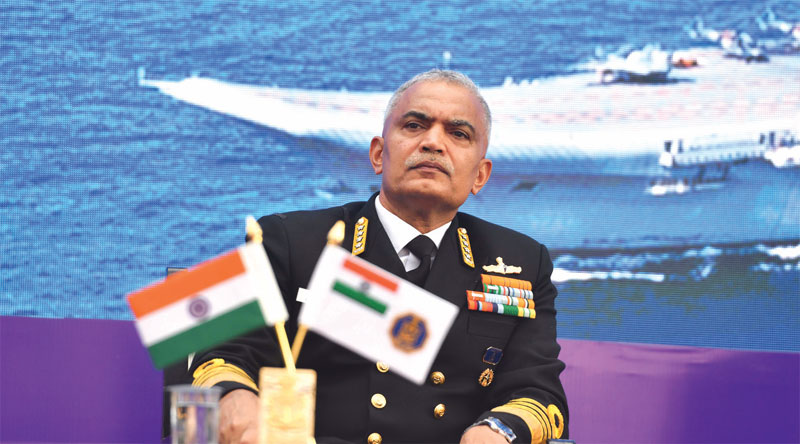
Navy Chief Admiral Hari Kumar has outlined a vision for the Indian Navy in 2024 and beyond, emphasising modernisation, self-reliance, strategic partnerships and a renewed focus on the civilian workforce.
Following Chinese incursions into Ladakh in 2020, plans have been announced to enhance military infrastructure in the Andaman and Nicobar Islands on the eastern seaboard, as well as in Lakshadweep on the western seaboard. This includes the development of island airbases in both the Arabian Sea and the Bay of Bengal. The aim is to establish a network of bases that ensures freedom of navigation and overflight for all Indian territories, bolstering India’s strategic position in the region.
Naval bases and Exercises
The Andaman and Nicobar Islands are strategically located at the juncture of the Bay of Bengal and the Andaman Sea. Upgrading the military facilities here will enhance India’s ability to monitor and control the crucial Six-Degree Channel. The new naval base on the Minicoy island of Lakshadweep, named INS Jatayu, is a strategic initiative by the Indian Navy. This base will not only enhance India’s maritime prowess in the Indian Ocean but also improve interoperability by providing a platform for joint operations with friendly nations. It will also serve as a crucial point for surveillance and monitoring of the sea lanes of communication (SLOCs) in the Arabian Sea.
In 2024, the Indian Navy participated in some exercises aimed at enhancing interoperability and understanding between participating navies. One of these was the 12th edition of the Multilateral Naval Exercise MILAN 24 held in Vishakhapatnam in February 2024. This exercise involved advanced Air Defence, Anti-Submarine and Anti-Surface Warfare drills. The aim of MILAN 2024 was to strengthen regional cooperation and maritime security, foster interoperability and understanding between participating navies, and provide a platform for sharing best practices and expertise. Nearly 20 ships from the Indian Navy, including aircraft carriers INS Vikrant and INS Vikramaditya, and nearly 50 aircraft including MiG29K, LCA, Tejas and P8I participated in the exercise.
Another significant event was Exercise Sea Dragon 24, which aimed to foster enhanced cooperation and seamless interoperability among naval forces from the United States (US), Australia, South Korea, Japan and India. Indian Navy’s P8I aircraft, along with P8A of the US and Australia, P1 from Japan Maritime Self-Defense Force (JMSDF) and P3C from the Republic of Korea Navy (RoKN), participated in the exercise.
Maritime Theatre Commands
The Inter-Services Organisation (ISO) Bill and the creation of theatre commands are expected to bring about significant changes in the functioning of the Indian Navy. The establishment of an Integrated Maritime Theatre Command, as part of the theatre commands initiative, can be particularly beneficial for the Navy. This Maritime Theatre Command (MTC) will be responsible for managing India’s vast maritime border. This means that the Navy will have a more focused area of responsibility, allowing it to better strategise and respond to maritime threats.
The integration of the Navy with the other services under one commander will also lead to improved coordination and efficiency. Based on the information in the public domain, within the MTC the consolidation of air force and army components with naval resources will significantly enhance operational effectiveness. MTC will be overseen by a Vice Admiral and will encompass the current Eastern and Western Naval Commands, a reduced Andaman and Nicobar Command, the Southern Air Command and two army brigades with amphibious capabilities. Additionally, it will include two squadrons of maritime strike aircraft from the Air Force.






 VIDEO
VIDEO