It looks like that the recently released draft Defence Production Policy (DProP) 2018 means different things for different people: For the government, it is a brilliant policy which would position India amongst the top five defence manufacturers and global leader in cyberspace and Artificial Intelligence (AI) by 2025; for the private industry, it provides the opportunity to seek more concessions — if not the level-playing field with the public sector (which is impossible) — from the government; and for the military leadership, it provides post-retirement opportunities as experts with the private industry conglomerates. But for the discerning observer, truth be told, the policy is in the realm of fantasy. Not because it is overtly ambitious, but because it is not rooted in reality.
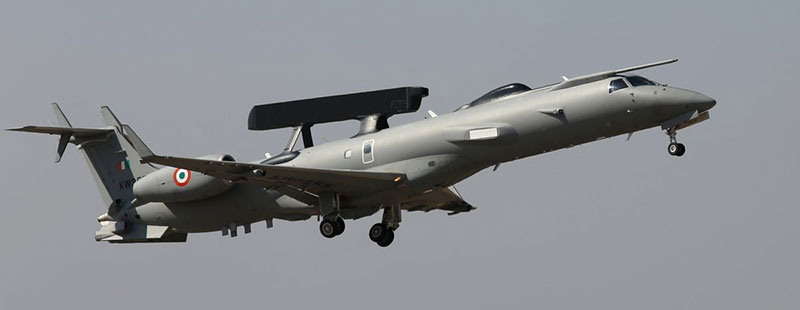
AEW&C
Let’s start with its most ambitious goal: become cyberspace and AI leader seven years hence. This requires supercomputers and the ability to integrate System of Systems (SoS). Both terms need a bit of explaining. China and the United States are world leaders in development of supercomputers, with China being in the lead. For example, China has announced development of exascale supercomputer (which can do one billion billon calculations per second, which roughly equals top 500 supercomputers in the world combined) by 2019; the US hopes to develop it by 2021. With exascale supercomputer, China, according to experts, could create a virtual universe. Supercomputers are at the heart of AI and cyber-warfare.
Meanwhile, SoS is not owning some fancy hardware or advanced systems, but it is the ability to integrate numerous advanced systems into a single system capable of an enormous military advantage through complex networking. The AI and SoS, for example, would help in Chinese maritime expansion (across Western Pacific and Indian Ocean) to the extent that all existing technologies would be rendered obsolete. For this reason, military applications of AI and SoS are referred to as disruptive technologies which would not be just gamechangers. They would dramatically alter the way wars are fought, won and lost. For this reason, the outgoing US Pacific Commander, Admiral Harry Harris recently said that, “China has developed a new wave of advanced hypersonic (upwards of Mach 5 speeds), space and cyber capabilities.”








 VIDEO
VIDEO