

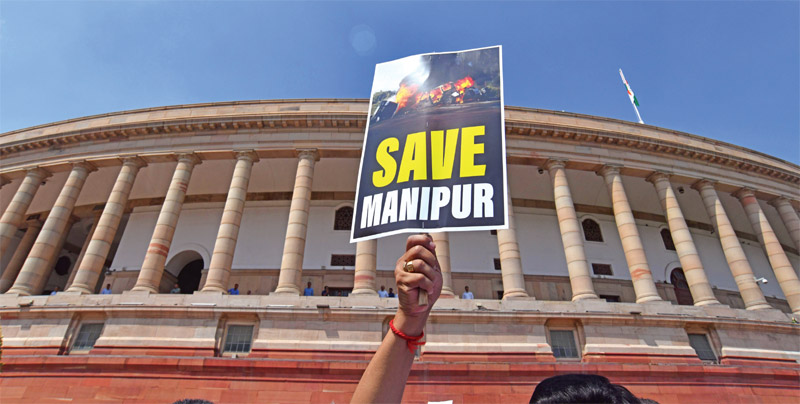
Save Manipur
The violence in Manipur continues, its impact on the neighbouring states, especially Mizoram threatens the peace and stability of the region for a long time to come. A senior retired officer of the Indian Army compared the situation in Manipur to the situation in West Asia.
Now, a retired top Army officer has tweeted the dire state of affairs, equating the situation in his state with that of war-ravaged Libya, Lebanon and Syria. Lt Gen. L Nishikanta Singh (retd) tweeted: “I’m just an ordinary Indian from Manipur living a retired life. The state is now ‘stateless.’ Life and property can be destroyed anytime by anyone, just like in Libya, Lebanon, Nigeria, Syria, etc,”
There have been many ethnic and even religious conflicts in Manipur over the years. In a word, this is a place where identity politics is backed by guns and this has made it a dangerous and difficult to deal with.
While it is important to understand the deep historical roots of this conflict, it should be clear that this time the violence is fundamentally different from all the past conflicts and its implications for India are going to be long term and deeper.
Never before has the violence in Manipur attracted the attention of the international community but this time the American ambassador went so far as to say that the US would be happy to mediate. The European Parliament even discussed the events in Manipur. The violence in Manipur has links to Myanmar and some experts say poppy cultivation may have been encouraged by Chinese businessmen.
However, it is not the international dimension which makes the resolution more difficult but the involvement of the various state institutions. In the past there has been complicity of political parties but from reports it would seem this time both the Centre and the State are complicit.
There are several inquiry committees and a judicial commission that are going into the causes. The three-member judicial commission, led by former Guwahati High Court Chief Justice Ajai Lamba, made its first visit to the troubled state on July 14. The commission has been officially tasked with examining the circumstances that led to the turmoil beginning on May 3. The other members of the commission include Himanshu Shekhar Das, a retired bureaucrat, and Prabhakar Aloka, a former intelligence officer.
Anyone who has accused the state of being complicit in the violence has been accused of defamation by members of the Meitei community and FIRs have filed against them.
During his visit to Manipur, home minister Amit Shah said the Central Bureau of Investigation (CBI) would be tasked with investigating six cases related to the violence. There is another committee which is looking into the issue of poppy cultivation. We will have to wait for the results of these committees and the judicial commission.
Meanwhile, the violence continues unabated with beheadings and shootings, arson and wonton destruction of property. Some have even termed this as ethnic cleansing of one community. The violence would never have reached such levels had it not been for the availability of weapons, the existence of trained militants and even clash between the armed forces and the police.
Guns Galore
These guns are in the hands of insurgents, the militias, armed forces, police and ordinary citizens who have licenced guns. The Wire did a RTI and according to the information they got, there are 35,117 active gun licences in Manipur. This is up from 26,836 in December 2016. The BJP government led by N. Biren Singh came to power in March 2017. Coincidentally, since then, around 8,000 gun licences have been issued. According to reliable sources these guns have been issued overwhelmingly to one community, the majority community. It is important to remember that neighbouring Nagaland has the highest number of active gun licences in the Northeast, more than Manipur.
In addition to these licensed guns there are armed groups belonging to each of the identity groups. The arms are sophisticated, and the militants are well trained. Apart from the militant groups there are various militias; these have been set up by successive governments. The militias are usually of surrendered militants and are known to be merciless.
This time the two militias that have been named by the Kuki and Zomi organisations responsible for the much of the violence: the Arambai Tenggol and the Meitei Leepun. On July 15, came the news that the Meira Paibis handed over a Maring Naga woman to Arambai Tenggol. The Nagas have condemned Arambai Tenggol members for killing the 55-year-old Maring Naga woman, Lucy Marim, in Chandel district. The Nagas have shown great self-restraint despite the fact that there have been consistent efforts to provoke them into joining the conflict.
Subscribe To Force
Fuel Fearless Journalism with Your Yearly Subscription
SUBSCRIBE NOW
We don’t tell you how to do your job…
But we put the environment in which you do your job in perspective, so that when you step out you do so with the complete picture.



 VIDEO
VIDEO