

Safety Comes First
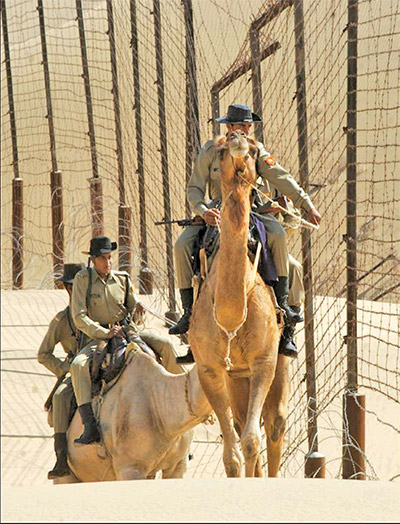
BSF patrolling India’s fenced borders on the western front
Today, India is among the fastest growing economies globally and is considered one of the emerging superpowers. If on one hand, India’s central location and the trans-Indian Ocean routes have contributed to this growth, on the other hand, its large and complex border pose numerous challenges which need to be addressed for India’s continued economic growth.
India shares its border with seven different countries. Most of these borders are man-made and do not follow any natural barrier. India’s vast coastline and island neighbouring countries make border management an important aspect to guard India’s sovereignty.
Border management is a security function that calls for coordination and concerted action by various government agencies within our country. The aim is to secure our frontiers and safeguard our nation from the risks involved in the movement of goods and people from India to other countries and vice versa. Border management itself is a multifaceted term and may include, but is not limited to, the regulation of legal and illegal immigration, ensuring safe and secure movement of authorised people and goods, and prevention of the rapid growth that India is currently experiencing. All this presents an array of opportunities and underlines the need for effective border management.
The India-Myanmar border topography varies from low mountains in the south to high ridges and peaks in the north, adjacent to the Himalayas. As a result, unlike the India-Bangladesh borderland, the region is one of low population density.
The India-Myanmar border is highly vulnerable due to a number of factors. First, the boundary has not yet been concretised on the ground as lines separating two sovereign countries. Second, the border traverses a region in which numerous insurgencies operate. Thirdly, the India-Myanmar border has a unique arrangement in a place called the Free Movement Regime, which permits the tribes residing along the border to travel 16 km across the boundary without visa restrictions. This place becomes a safe haven for different illegal activities like drug smuggling, human trafficking, and infiltration and cross-border movements of insurgents. Finally, there is inadequate management of this border by India.
India shares a 3,325-km border with Pakistan that runs through a diverse terrain which also facilitates illegal cross-border movement and smuggling activities in villages adjacent to the border. The India-Pakistan border is organised in three specific segments.
Segment 1: The IB, which was demarcated and confirmed through the Radcliffe Award in 1947, extends from a point opposite Akhnoor in the Jammu region in the north and is thence aligned southwards through Punjab, Rajasthan and Gujarat.
Segment 2: Line of Control (LC) refers to the military line which starts at a place called Sangam, close to Akhnoor and traversing through the state of Jammu and Kashmir ends at the base of the Siachen glacier, at map point NJ9842.
Segment 3: The Siachen glacier stretches for a length of around 76 km and lies just northeast of the point NJ9842.
The 4,096.7 km long Indo-Bangladesh border is the longest land borderline that India shares with any of its neighbours. In spite of the efforts made in the last four decades to demarcate the entire Indo-Bangladesh border, 6.5 kilometres remain disputed.
The IB between India and Bangladesh is fully settled. The Land Border Agreement of May 2015, concluded between India and Bangladesh, ensures that the IB on land between the two countries is now aligned more in contiguity, and, hence, enables improved surveillance by the security forces of both countries engaged on this common border. The main threat across this IB is that of unabated infiltration which is primarily due to economic causes. Large scale migration continues from this part of the subcontinent to the Indian states contiguous to the border, in particular, West Bengal, from where the migrants gradually spread to other parts of India in search of livelihoods.
Subscribe To Force
Fuel Fearless Journalism with Your Yearly Subscription
SUBSCRIBE NOW
We don’t tell you how to do your job…
But we put the environment in which you do your job in perspective, so that when you step out you do so with the complete picture.
 VIDEO
VIDEO