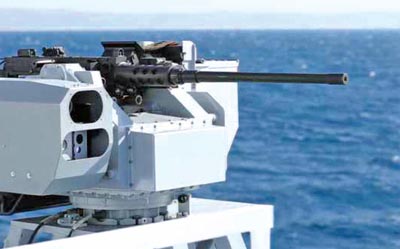
The Indian armed and paramilitary forces have been slow in the adoption of Remote Controlled Weapon Stations (RCWS), which are now commonplace with advanced militaries worldwide. The Indian Army’s large fleet of T-90 and T-72 Main Battle Tanks (MBT) are not fitted with RCWS. They are also not in service with BMP-II Armoured Personnel Carriers (APC). The Arjun Mk-1A MBT was to be delivered with an RCWS fitted with a 12.7 mm heavy machine gun supplied by defence PSU Bharat Electronics Ltd (BEL). However, a newer RCWS appears to have been integrated on the Arjun Mk-1A.
Safe Distance
At the recently concluded DefExpo, companies were exhibiting a wide range of vehicles fitted with RCWS and as a result the pace of induction of these systems will accelerate over the next few years. An RCWS enables the soldier to aim and fire at targets from within the safer confines of a vehicle or ship and are fitted with a range of sensors which not only considerably improve accuracy but also engagement of targets at night time or in conditions of reduced visibility. An RCWS also provides an important defence against intruding drones and can also be integrated on Unmanned Ground Vehicles (UGV) providing additional combat capability.
Added Firepower
However, in a positive sign, newly-inducted armoured vehicles are now being delivered to the army with RCWS. The Tata Advanced Systems Limited (TASL) delivered the first batch of Infantry Protected Mobility Vehicles (IPMV) to the Indian Army in April and these were fitted with TASL’s in-house designed and developed RCWS. The army will deploy the new infantry vehicles in high-altitude areas and the new IPMV is India’s first indigenously developed Amphibious Wheeled Infantry Combat Vehicle (ICV).







 VIDEO
VIDEO