In January 2020, Brigadier Gavin Thompson, defence adviser (ministry of defence), British High Commission, New Delhi, said that the UK government had begun its work on a government-to-government (G2G) framework for future defence deals with India and this was due to India’s preference for such an arrangement.
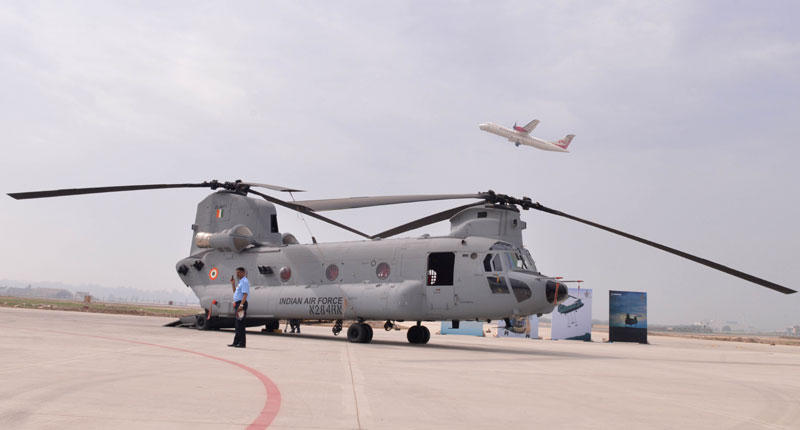
CH-47F(I) Chinook helicopter
This was a result of India and the UK in 2017 agreeing to cooperate in developing and advancing defence projects such as gas turbine engine and air defence missile systems. Rolls Royce and Defence Research and Development Organisation (DRDO) also explored the possibility of cooperation on jet engine technology in August 2019.
For the longest time, India has preferred G2G deals or what are also known as Foreign Military Sales (FMS) in the US, when it comes to defence equipment. In fact, most of India’s arms import have been done on a G2G basis because it fast-tracks the process of acquiring arms and eliminates the lengthy process of Request for Information (RFI), Request for Proposal (RFP), trials and negotiations.
Avnish Patnaik, defence industry analyst at an industry association says, “G2G deals are a good proposition to position its diplomatic standing with the respective country. We have seen it in the case of Russia and the US most recently which has strengthened our bilateral relationship. In the case of assault rifles procured recently from the US through the FMS route, it served to meet our immediate operational requirements as well as hold good stead with the US government.”
The other reasons for G2G deals are that they cut out corruption, act as a tool for strengthening government’s foreign policy towards friendly countries and allow integration and configuration of complex weapon systems. This may pose a problem when foreign vendors present tenders and only one vendor is favoured.
However, as G2G deals aim at lowering prices, they foreclose the option of multi-vendor competition. Moreover, the seller is not required to invest part of the sale in the Indian industry as offsets, which is mandatory under the Defence Procurement Procedure (DPP) for all competitive tendering. With the Indian government actively promoting ‘Make in India’, taking a dip in the offsets may not be sensible in view of indigenous defence production.
Patnaik disagrees on the point of compromise of technology. He says, “There are some niche technologies that India does not presently have but are required by the armed forces. Once the Indian industry develops such capability, import of these technologies will certainly reduce in the future.”
Historically, India’s trusted strategic ally was Russia. In the Seventies and Eighties, India bought its defence hardware from Russia which led to an era of modernisation. It was a G2G trade where cost consideration was a priority. This bilateral trade continues even today.
In May 1998, after Pokhran-II, the US banned all defence trade with India. This prompted India to seek Israeli defence equipment. But when the US lifted military sanctions in 2005, India started its trade once again by procuring Lockheed Martin C-130 J, Boeing C-17 Globemaster, P-8I maritime surveillance among others through G2G deals.








 VIDEO
VIDEO