

Robots Are Here
As technological shift happens in different sectors, the focus for long has been on replacing the humans with machines. Different manufacturing industries have already taken the leap with autonomous or semi-autonomous machines being used to perform human-intensive tasks.
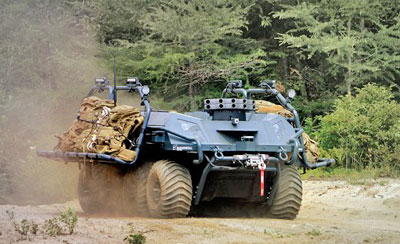
Rheinmetall’s Mission Master, a multi-purpose
reconnaissance and surveillance vehicle
An estimate published by Oxford Economics in 2019 stated that 20 million human beings in the manufacturing sector stared at being replaced by robots in 2030. The report particularly flagged China as taking the lead in this area. Mentioning China’s shift towards overall automation, Oxford Economics reported that globally approximately 1.7 million manufacturing jobs have been lost to robots since 2000. In China alone, the figure stood at 5,50,000. The US and Europe accounted for 2,60,000 and 4,00,000 job replacements respectively. By 2030, it is predicted that China will have 14 million industrial robots.
Manufacturing sector, however, is not the only one which is seeing technological advancements. An area of growing concern is automation in the defence industry. The use of artificial intelligence (AI) is enabling the militaries to carry out tasks such as surveillance, weapons targeting, cyber and homeland security, logistics and transportation. It is expected that overtime offensive weapons would also become autonomous.
The use of AI, in contrast to application of human intelligence, would gather data faster coupled with efficiency. The employment of AI-empowered tools and machines reduces human engagement but is not entirely devoid of it. The working together of human and artificial intelligence helps forces in undertaking large-scale operations in a quick manner. They act as force multipliers and can be more lethal than manned machines, depending on the weapon systems that they are equipped with. Therefore, human involvement in autonomous systems is needed to ensure oversight.
Complete autonomy in drones continues to be debated as there is a belief that a machine’s autonomy may be too devastating as opposed to the ones that are controlled externally. In a research paper for Chatham House, titled ‘International Security Department and US and the Americas Programme’, M.L Cummings says that both, military and commercial robots will in the future incorporate ‘artificial intelligence’ that could make them capable of undertaking tasks and missions on their own. With the arms race on, countries vying for greater influence have started investing in military robotics. The US and China are leading in research and development of robotics that may be used in war. As per the data released by Statista in February 2021, the global spending in military robotics between 2000 and 2025 has increased steadily all over the world. In 2000, the amount stood at USD 2.4 billion. In 2015, it was USD 7.5 billion, and in 2025 it is expected to reach USD 16.5 billion.
Robotics as a domain has evolved over time. After automated and pre-programmed robots, now the time has come for Artificial Intelligence (AI)-infused robots. Talking about the evolution of robotics, FORCE editor, Pravin Sawhney says, “Robots have been around for a long time. They were automated and were required to carry out the same task repeatedly. In the industrial sector a lot of such robots were used. The main intention was that the repetitive work the humans were doing would be better performed by robots. The second stage came when they could be pre-programmed. And now we are in the third stage, where we are going into a specialized area called AI. This comes with sensors. You use sensors anywhere because they are cheap and smart. In the third and current stage, rather than being given a specific job, robots will be able to access information from the cloud. There will be number of sensors attached to the cloud. The robot too is attached to the cloud. Through the cloud, the robot becomes a part of a larger network with other robots. This concept is the latest within Robotics and is called Advanced Artificial Intelligence Robotics.”
Subscribe To Force
Fuel Fearless Journalism with Your Yearly Subscription
SUBSCRIBE NOW
We don’t tell you how to do your job…
But we put the environment in which you do your job in perspective, so that when you step out you do so with the complete picture.





 VIDEO
VIDEO