

Roar of Machines
Nato’s factory floor takes centre stage in Türkiye
Iftikhar Gilani
Ankara: While presidents and prime ministers assembled at Türkiye’s sprawling Beştepe Presidential Complex for the North Atlantic Treaty Organization (Nato) Summit on 8-9 July 2026 the machinery intended to give effect to their political decisions was on display about a mile away in the Turkish capital, Ankara.
At the ATO Congresium, Nato officials, military planners, procurement executives, bankers and representatives of more than 100 defence companies gathered for the Nato Summit Defence Industry Forum on July 7. It was less ceremonial than the proceedings at Beştepe, but arguably more consequential for the future shape of the alliance.
The discussions inside the Congresium were not primarily about communiqués, diplomatic formulations or burden-sharing percentages. They were about aircraft, missiles, drones, factories, secure clouds, critical raw materials, production lines and the time required to convert expanding defence budgets into deployable combat capability.
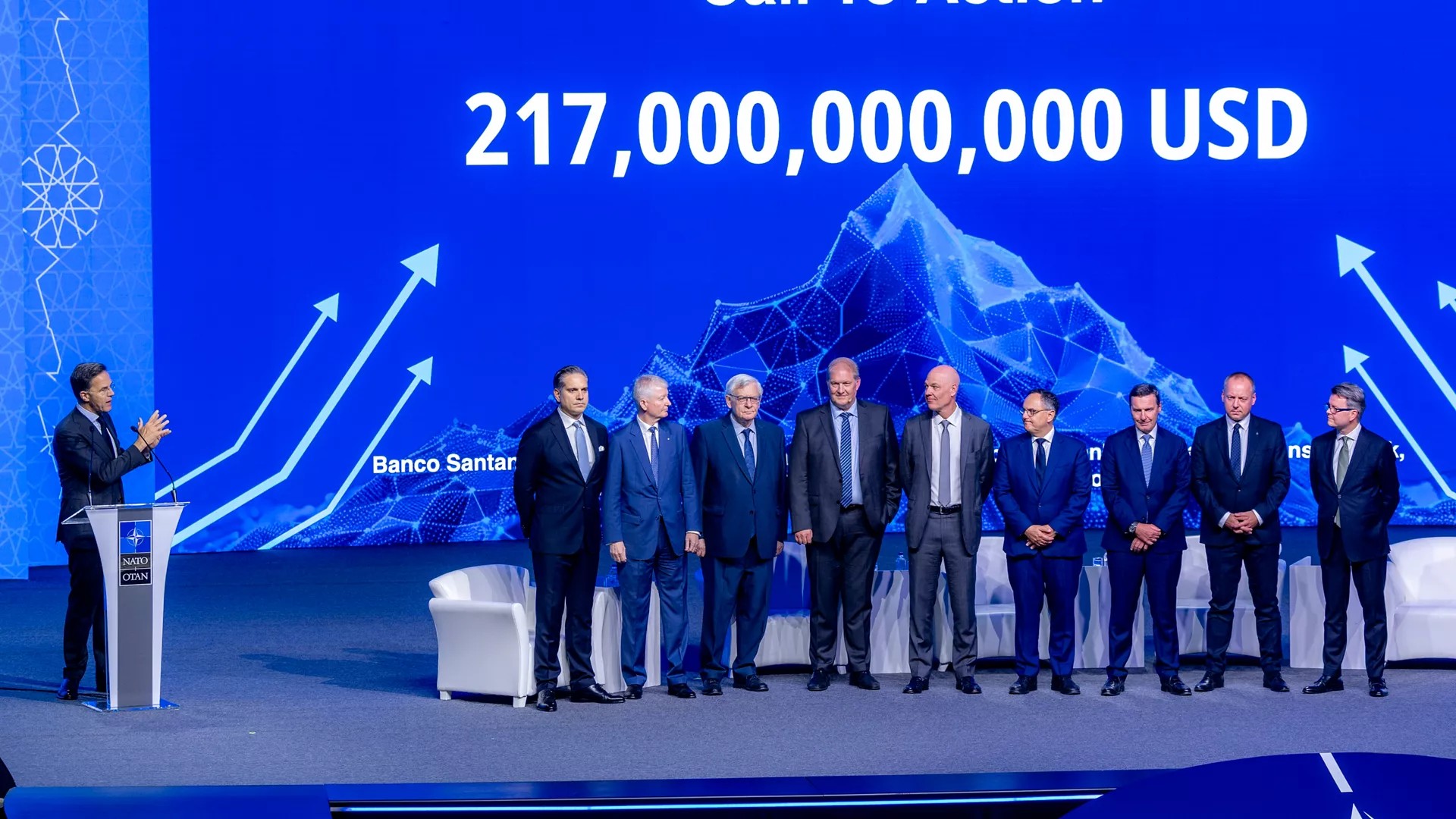
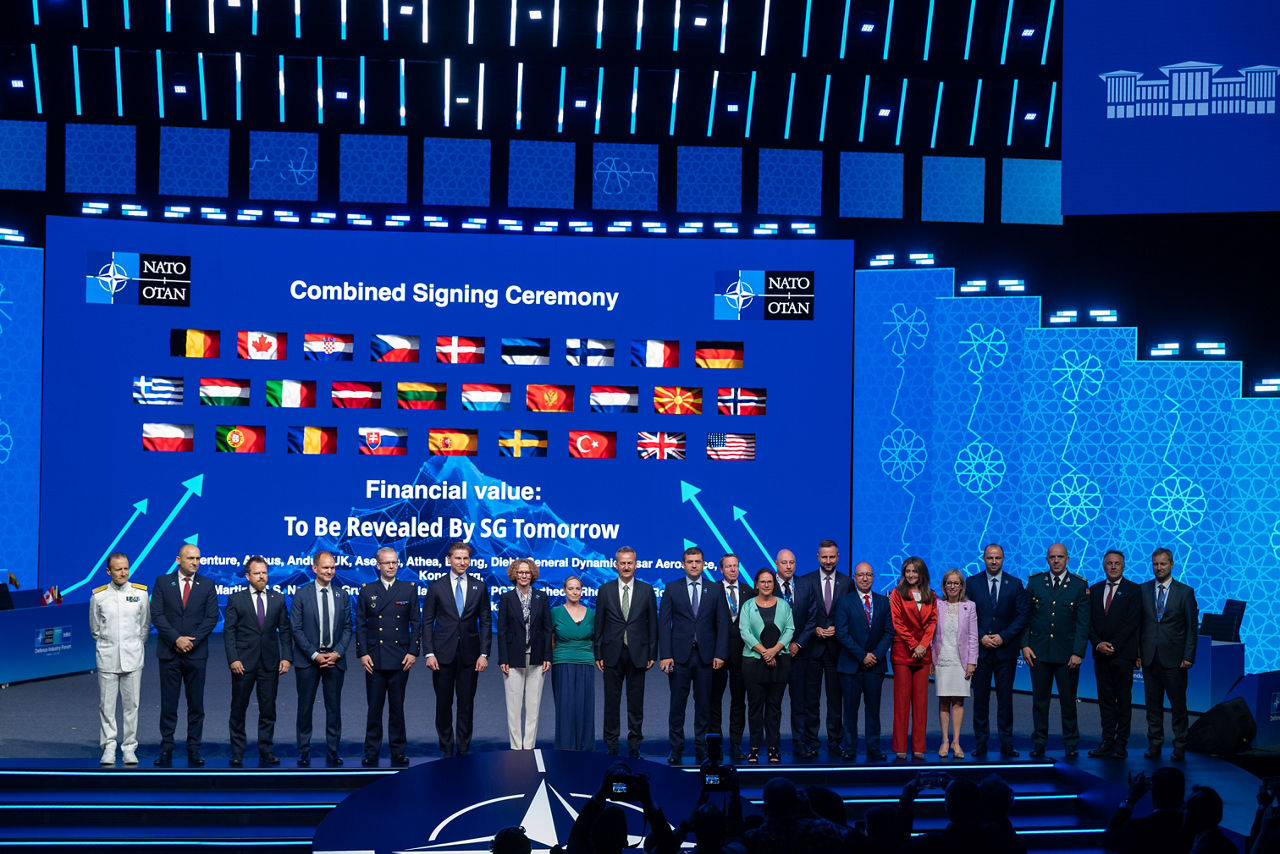
Several announcements were choreographed on stage, with groups of officials and company executives repeatedly assembling for photographs. Yet behind the display was a serious attempt to address Nato’s most persistent industrial problem: its members possess enormous technological and financial resources, but remain divided by fragmented procurement, national regulations, incompatible requirements and production lines that cannot always surge during a crisis.
Nato Secretary General Mark Rutte reduced the day’s message to three words: “Do more, faster, together.”
“The money is there and much more is coming,” he said. “But this cash must be put to work. It needs to purchase capabilities to actually deter and defend.” He admitted that it was US President Donald Trump’s persistent push, which has now led European powers to find ways to spend more on armaments.
Rutte said European allies and Canada spent nearly 20 per cent more on defence last year, adding about USD139 billion. Across 2025 and 2026, he put their additional expenditure at USD258 billion. A further USD37 billion, he said, had been invested in expanding the defence industrial base through larger factories, additional production lines and greater capacity.
The Forum produced procurement and industrial announcements valued at more than USD50 billion, according to Nato officials. These included surveillance aircraft, strategic airlift and refuelling platforms, missile production, ammunition, counter-drone systems and secure digital infrastructure.
New Eyes in the Sky
Among the most important announcements was Nato’s decision to proceed towards the joint procurement of up to 10 Saab GlobalEye aircraft under its future surveillance and control programme.
For decades, Nato’s E-3 Airborne Warning and Control System (AWCS) aircraft have served as the alliance’s principal airborne command, surveillance and early-warning platforms. They have operated from northern Norway to southern Türkiye, but the fleet is ageing and approaching retirement.
This was necessitated as on 3 March 2026 when an Iranian missile dodged the American system deployed in Turkiye and hit a UK military base in Cyprus.
GlobalEye, built around Bombardier’s Global 6000/6500 business jet and Saab’s Erieye extended-range radar, offers simultaneous surveillance of the air, maritime and land domains. Nato presented it as a system capable of tracking conventional aircraft as well as smaller and more difficult targets, including cruise missiles, ballistic missiles and drone formations.
“GlobalEye will provide simultaneous surveillance across air, maritime and land domains from a single platform, giving commanders a clear operational picture,” Rutte said.
Experts at the forum told FORCE that unlike earlier airborne warning aircraft built primarily to track fast-moving combat aircraft, the next generation must operate in a far more crowded battlespace.
“It must distinguish small drones from civilian traffic, identify low-flying cruise missiles and feed targeting-quality information into an integrated air and missile defence network,” said a Turkish military official, who did not want to be named.
GlobalEye is led by Swedish industry but incorporates Canadian and American contributions.
Nato also announced plans to add up to five Northrop Grumman MQ-4C Triton high-altitude, long-endurance uncrewed aircraft to its intelligence, surveillance and reconnaissance force.
Designed for persistent maritime surveillance, Triton can remain airborne for extended periods and monitor vast ocean spaces. Denmark, Finland, Germany and Norway were identified as participating allies. The focus on the High North reflected Nato’s growing concern about maritime routes, submarine activity and critical undersea infrastructure in the North Atlantic and Arctic regions.
“The Triton will help us detect threats early, protect our sea lines of communication, and support operations in demanding regions, such as the High North,” Rutte said.
The aircraft is particularly relevant to the emerging contest over seabed cables, pipelines and maritime communications. Nato has concluded that episodic patrols are no longer sufficient. Persistent sensing, data fusion and the ability to cue naval or air assets are becoming central to maritime deterrence.
Hidden Architecture of Air Power
The more visible combat systems received attention, but the Forum also emphasised the less glamorous platforms without which sustained military operations are impossible.
Nato announced the forthcoming delivery of a 10th Airbus A330 Multi-Role Tanker Transport aircraft to its multinational tanker fleet, moving it closer to the planned strength of 12 aircraft. Belgium, Czechia, Denmark, Finland, Germany, Luxembourg, the Netherlands, Norway and Sweden participate in the programme.
Aerial refuelling has long been one of Europe’s critical capability deficiencies. European air forces rely heavily on the United States for tankers during large operations. A multinational fleet allows smaller countries to purchase flying hours rather than maintain independent aircraft that may be too expensive to acquire and operate nationally.
A new multinational initiative centred on the Airbus A400M was also announced, with Belgium, Croatia, France, Poland, Spain, Türkiye and the United Kingdom among the participating countries. The aim is to use a shared framework to improve strategic and tactical mobility.
The war in Ukraine has underlined that mobility is not simply a logistical matter. An alliance must be able to move troops, air-defence batteries, ammunition and spare parts rapidly across national borders. Aircraft such as the A400M and A330 MRTT therefore form part of the enabling architecture behind Nato’s combat formations.
Nato also unveiled the Drone Edge initiative, backed by planned allied investment of more than USD40 billion in counter-drone capabilities over five years. The alliance also intends to train five times as many drone operators by the end of 2027.
A Nato counter-drone marketplace will offer systems that have been tested for alliance compatibility, while the Nato Flight Training Europe framework will be expanded to include drone-operator training.
This was more than an announcement about buying additional unmanned aircraft. Nato is attempting to institutionalise lessons from Ukraine, where relatively inexpensive drones have transformed surveillance, artillery correction, logistics and precision attack. At the same time, the proliferation of first person-view drones has exposed the vulnerability of armoured vehicles, command posts and troops to systems costing a fraction of their targets.
Experts say that economics remains the central challenge. A defender cannot sustainably use a missile costing hundreds of thousands of dollars to destroy every drone worth a few thousand dollars. They said the response requires layered defences combining electronic warfare, jamming, automatic cannon, interceptor drones, directed energy and more selective missile use.
Alp Cenk Arslan, a security specialist at the Turkish National Police Academy, described Ankara as a geopolitically appropriate location for unveiling the initiative.
“The Black Sea-Eastern Mediterranean-Levantine corridor has already become the principal laboratory for asymmetric aerial contestation,” he said, arguing that low-cost drones had demonstrated their capacity to impose disproportionate costs and compress military decision-making cycles.
A workable counter-drone shield, he added, could not be built through separate national sensors and occasional intelligence exchanges. It would require “a unified, real-time data-fusion and processing network capable of machine-speed detection, identification and neutralisation.”
The Forum also showcased an expanding network of transatlantic production agreements. American companies, including Anduril, Boeing, General Dynamics Land Systems, Lockheed Martin and Raytheon, announced cooperation with European groups such as Diehl, Rheinmetall and Poland’s PGZ.
The arrangements are expected to permit the production or sustainment in Europe of systems including Abrams tanks, AMRAAM air-to-air missiles, ATACMS tactical missiles, Stinger missiles, Small Diameter Bombs and Anduril’s Barracuda-500M autonomous air vehicle.
Lockheed Martin and Rheinmetall plan to establish ATACMS production in Germany, which would be the first production arrangement for the missile outside the US. They also intend to develop a European maintenance facility for the PAC-3 interceptor used by the Patriot air-defence system.
Other multinational procurement coalitions covered Naval Strike Missiles, Joint Strike Missiles and Small Diameter Bombs, involving companies such as Kongsberg, Raytheon, Boeing and RWM Italia.
Yet the agreements also reveal a continuing tension. Europe wants greater strategic autonomy, but many of its most urgent requirements are still met by American technology. Local assembly can reduce delivery times and strengthen supply security, but it does not automatically transfer complete intellectual property or design authority.
Nato Engine
One of the Forum’s more innovative proposals was not a weapon at all.
The Nato Engine is intended to connect companies possessing promising defence technologies with civilian or military factories that have spare production capacity. Under what Nato calls a ‘factory-for-hire’ model, a smaller company without its own manufacturing infrastructure could use an established facility to industrialise and scale its product.
“No single nation has the industrial capacity required to meet the large and growing demand,” Rutte said.
The Nato Support and Procurement Agency will manage an initial pilot covering additive manufacturing, engineering services and manufacturing-as-a-service. Ukraine will be invited to participate.
The concept is an acknowledgement that innovation and manufacturing are increasingly separated. A start-up may develop software, sensors, autonomous platforms or electronic-warfare equipment, but lack the capital and expertise required for serial production. At the same time, established manufacturers may possess underused machinery, certified workers and supply networks.
For smaller companies, Nato has often appeared as a maze of agencies, procurement portals and national authorities. The newly launched Nato Front Door for Industry is intended to become a single-entry point for procurement opportunities, innovation programmes, test ranges and industry events.
Rutte told the gathering: “The door is now open.”
The platform is expected to become fully operational in 2027. It will eventually aggregate procurement opportunities and connect companies with programmes run by the Defence Innovation Accelerator for the North Atlantic, or DIANA, the Nato Innovation Fund and Nato test facilities.
Nato also released its first public, unclassified demand signal, identifying priority areas where the alliance wants industry to concentrate. These include strengthening large land formations, defence against air and missile attacks, deep-strike capability, scalable medical evacuation and adaptable battlefield logistics.
Modernisation was also visible in the less tangible but equally important field of digital infrastructure.
The Nato Communications and Information Agency signed an approximately Euro 200 million contract with Accenture for the Protected Business Network. Leonardo will contribute cloud and security capabilities.
Over seven years, the programme is expected to establish a secure, multi-cloud environment supporting about 29,000 users across Nato. It will replace older digital arrangements and allow new services to be developed and deployed more rapidly.
Dr Dylan Browne, general manager of the Nato Communications and Information Agency, described it as a move towards “a more connected, data-driven enterprise” capable of delivering digital systems “at speed and scale.”
The importance of such infrastructure is easily underestimated. Aircraft, missiles, drones and air-defence batteries become substantially more effective when they share a common operational picture. Without secure networks and standardised data, a multinational force remains a collection of national systems rather than an integrated combat organisation.
Türkiye’s Industrial Moment
The choice of Ankara allowed Türkiye to project itself not simply as Nato’s southeastern military power, but as a growing defence production hub.
Türkiye has developed a broad industrial ecosystem covering unmanned aircraft, missiles, electronic warfare, sensors, armoured vehicles, naval platforms and ammunition. Turkish executives used the Forum to argue that this capacity should be integrated more deeply into European and transatlantic supply chains.
Baykar chief executive Haluk Bayraktar called for industrial partnerships that combine existing strengths rather than forcing every country to develop complete systems independently.
“The main point should be to combine these strengths instead of developing everything from zero,” he said, citing Baykar’s partnership with Italy’s Leonardo.
Three Turkish firms had also been selected for Nato’s 2026 DIANA programme. Their projects cover communications for drone operations without satellite navigation, artificial intelligence for defence production and throwable 360-degree reconnaissance systems. DIANA provides selected firms with funding and access to 16 accelerator sites and more than 200 test centres across the alliance.
Türkiye’s experience carries a broader lesson. Restrictions on foreign procurement pushed Ankara to invest in domestic alternatives. But its recent strategy increasingly combines national design capabilities with international partnerships, particularly in areas where joint production offers faster access to markets, technology and scale.
Lessons for India
The Ankara Forum contained several lessons relevant to Indian defence modernisation.
The first is that increased budgets alone do not produce military capability. Long-term demand signals, assured orders, testing pathways and procurement reform are necessary to persuade private companies to invest in production.
Second, innovation must be connected to acquisition. India has launched start-up and innovation programmes, but successful prototypes frequently struggle to cross the gap between trials and sizeable military orders. NATO’s attempt to connect accelerators, test ranges, procurement catalogues and manufacturing capacity deserves examination.
Third, interoperability, modularity and open architecture should be treated as design requirements rather than corrections introduced after induction. India operates equipment from multiple foreign and domestic sources. Unless data standards and interfaces are planned from the beginning, platforms can remain technologically advanced but operationally isolated.
Finally, the Nato Engine concept may offer a useful model for linking Indian start-ups with public-sector facilities, private manufacturers and underused civilian production capacity. India’s objective should not merely be import substitution, but the creation of an ecosystem capable of rapid scaling during a crisis.
While the political summit at Beştepe addressed threats, commitments and alliance unity, the defence forum, the Congresium, focused on whether the industrial base could deliver the forces needed to sustain those commitments.
Nato projects that its members will be able to produce about four million artillery shells annually by next year, nearly double the output of the previous year. But the Forum made clear that ammunition is only part of the equation. The alliance is seeking persistent surveillance, massed drones, layered air defence, long-range strike, resilient logistics and a secure digital network capable of connecting them.
The political declaration of Nato avoided repeating the explicit five percent of GDP defence spending target pushed at the previous Hague summit at the insistence of Trump. Behind closed doors, sources said Spain and many other countries flagged that they cannot divert resources from social spending, which in current circumstances will be a recipe for domestic unrest.
Nevertheless, the Ankara Forum marked a change in Nato’s industrial vocabulary. The emphasis was no longer solely on spending more. It was on aggregated demand, shared production, cross-border sustainment, open architectures and the ability to manufacture at wartime speed.
Rutte called for a “transatlantic defence industrial revolution”, declaring that the hum of machinery must become a roar.
That may have been the day’s most ambitious phrase. But it captured the strategic reality on display at ATO Congresium: military power in the coming decade will belong not only to those possessing the most sophisticated weapons, but to those able to connect, finance, manufacture, repair and replace them faster than their adversaries.






 VIDEO
VIDEO