

Reforming of Reforms
The People’s Republic of China’s military development goals were first quietly announced in the late Nineties, then announced more publicly in 2006. They all described a three-step development process for military modernisation: placing benchmarks at 2010, 2020 and mid-century, meaning 2049, indicating a very long-term outlook for military modernisation.
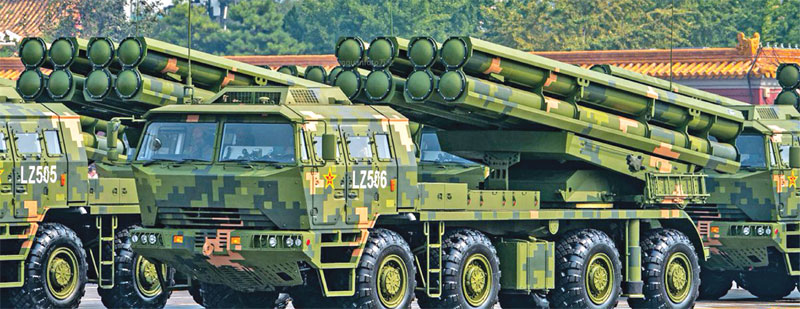
R-3-370mm MBRL
Specific objectives have been adjusted slightly over the years and President Xi Jinping recently added a new milestone of 2035, acknowledging that the 2010 date had passed. By 2020, the People’s Liberation Army (PLA) expected its current set of reforms to be complete and had achieved significant mechanisation of the PLA Ground Forces (PLAGF). By 2035, the PLAGF seeks to have fully modernised equipment, training, personnel structure, and doctrine. By 2049, the PLAGF looks to be a ‘world-class military.’ Officially, the Communist Party of China (CPC) consistently calls it ‘A’ world-class military, not ‘The’ world-class military. But the CPC does not define what a world-class military is, a lesson learned from previous rounds of reforms, where certain goals were set out, and then adjusted.
It was in the spring of 2014 that a task force was formed in Beijing to draw up an over-arching reform blueprint for the entire PLAGF. It involved more 690 civilian and military departments, 900 serving and retired commanders and experts, 2,165 Brigade-level and above officers, and ultimately resulted in excess of 800 meetings and took into account more than 3,400 comments and recommendations from the rank-and-file. The blueprint was revised more than 150 times and was finalised in November 2015. Subsequently, the PLAGF underwent thorough reforms, demobilising 300,000 personnel, constituting almost half of non-combat positions and 30 per cent of the officer corps. It is the most comprehensive of all PLAGF reforms in recent memory and has radically changed the way the PLAGF operates. A new training syllabus also went into effect in January 2018, having been in the works since April 2013. The overriding priority of the new syllabus is to have a high degree of realism with emphasis on new modes of warfare such as jointness and network-centric manoeuvre warfare.
The PLAGF is thus certainly moving in the direction it wants to go, but the more it tries to implement some of these initiatives, the more it discovers that these things are harder to do in real-life than it is to write about them in field manuals. In fact, the PLAGF in particular has already begun to reform some of its earlier reforms. One good example is standardising the structure of the Group Army (GA), the Corps-level organisation. Three years ago, GAs were standardised with six Combined-Arms Brigades and six supporting Brigades, one each artillery, air-defence, SOF, army aviation (helicopter), engineer and CBRN defence, and a Service Support Brigade.
A recent change the PLA made has been to break up the engineer and CBRN Defence Brigade into two separate Brigades: an Engineer Brigade and a CBRN Defence Brigade. This change is not universal yet,—at least one GA has retained the old structure. This series of rapid changes illustrates that the PLAGF will decide on something, experiment and train with it, and discover what does and does not work. It then must go back and revise based on the lessons learned. Many of these new adjustments are not announced officially. Every time a PLAGF unit goes on a field exercise, new equipment, unit structure, tactics, and doctrine are tested. The results of these tests get sent up the chain of command, and then drives change throughout the institution.
Running up to the 2035 ‘deadline’, one can anticipate many more significant changes in the PLAGF. It is very likely that the complete overhaul of the PLA’s equipment—begun under Deng Xiaoping back in the early Eighties—will finally be complete by then. All of the early Cold War era material will finally be gone, replaced by mostly China-designed equipment dating from the Nineties or 2000s. For example, about three years ago more than half of the main battle tank (MBT) force of the PLAGF was composed of Type-59 and Type-69 MBTs, a USSR-derived design dating from the Fifties. Today, newer Type-96, Type-99 and Type 15 MBTs, designed in the Nineties, slightly outnumber the Type-59s. It took almost 20 years to move to a majority modern MBT-types and it will take another decade at least to finally purge all of the legacy MBTs from the inventory. Ironically, by that time, some of the early Type-96 and 99 MBTs may themselves be obsolete and ready for replacement. The same process is underway for every category of equipment—modernised wheeled/tracked armoured personnel carriers (APC), tracked infantry combat vehicles (ICV), tube/rocket artillery and helicopters—with many of the same challenges and similar timelines.
Subscribe To Force
Fuel Fearless Journalism with Your Yearly Subscription
SUBSCRIBE NOW
We don’t tell you how to do your job…
But we put the environment in which you do your job in perspective, so that when you step out you do so with the complete picture.






 VIDEO
VIDEO