In an unstarred question on December 7, 2022, Rajya Sabha member from the Bharat Rashtra Samithi, K.R. Suresh Reddy, asked the ministry of home affairs (MHA) whether the government agreed that there should be a comprehensive review of India’s counterinsurgency strategy. More specifically, he wanted to know if the Central Reserve Police Force should be restructured so that the armed forces are free to perform their primary function.
Minister of state for home affairs Nityanand Rai replied that the police and public order were state subjects under the Seventh Schedule of the Constitution and the primary responsibility of maintaining law and order rested with state governments. He further said that the central government, through the deployment of central armed police forces (CAPFs) and various other measures, was committed to help state governments. He said the strengthening of the CAPFs through training and other measures was a continuous process.
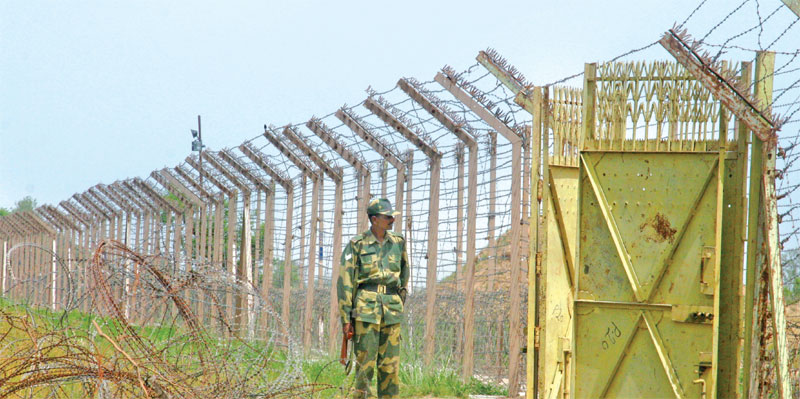
Security personnel guarding fence
The question Reddy posed calls for an urgent need to carry out a review of the national security strategy and initiate restructuring of the security forces at the macro and micro levels. A national security analysis needs to be undertaken regularly so that the security apparatus keeps pace with emerging security challenges and geo-strategic environment. But unfortunately, India does not have a documented national security doctrine for external and internal threats.
India’s national security apparatus can be broadly categorised into two domains: external and internal. Both domains fall under separate constitutional authorities. While the defence of India falls under the union list and is the preserve of the armed forces, public order falls under the state list and is a police domain. But over a period, our national security structure has changed, and internal security has moved beyond the police domain because of its inability to handle the challenges. This may be due to fact that the police leadership lacks long-term vision and appreciation of emerging internal security challenges. They could not appreciate that in new security dynamics, the lines between external and internal security are blurred, rendering state governments and the police as marginal players in the maintenance of internal security. The armed forces and the CAPFs have now assumed a major role. Their continued involvement in internal security duties has adversely affected their primary role.
Security Compromised
Despite the existence of the National Security Council Secretariat (NSCS), different security organisations lack coordination and work at cross purposes, affecting inter-organisational harmony. India is grappling with an unconventional warfare unleashed by its adversaries. This requires synergy among the security forces but instead there is an internecine struggle for organisational primacy. There is an urgent need to take corrective steps through reforms and restructuring.






 VIDEO
VIDEO