

Realise the Shortcomings
The Indian Army (IA) continues to be beset with block obsolescence of military hardware in several niche areas of its principal combat arms, thereby affecting its war preparedness for even waging limited, high-intensity conventional warfare. The only tangible accretions in this decade have been in the arenas of tube and rocket artillery.
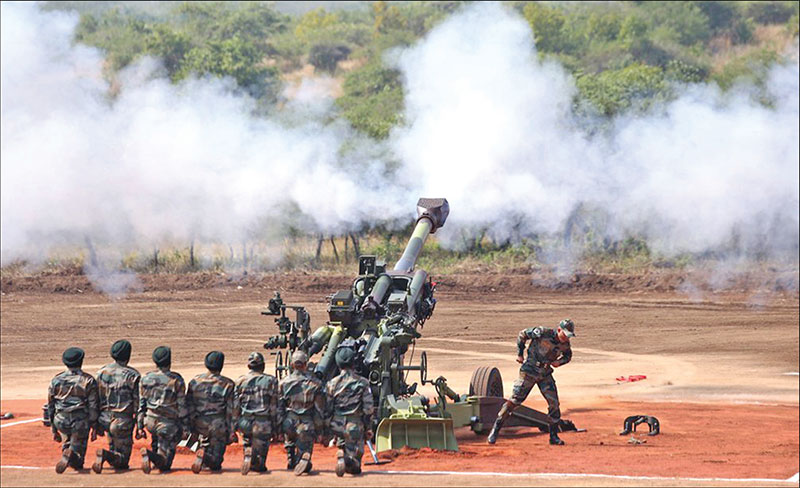
Indian Army testing the M-777 howitzer
For instance, the IA on November 9 last year formally inducted the BAE Systems-supplied M-777 ultra-lightweight 155mm/39-calibre field howitzer and the Hanwha-Techwin-supplied K-9 Vajra 155mm/52-cal tracked self-propelled howitzer into service. The IA took delivery of 10 of the 100 K-9s that it had ordered in mid-2016 at a cost of Rs 43.66 billion (USD600.4 million) at the IA’s Field Artillery Training Centre at Deolali in Maharashtra, western India.
The remaining 90 Vajras will be delivered by Larsen & Toubro to the IA by November 2020, with the first K-9 Regiment becoming operational last July. The IA has so far also inducted five M-777s, with another 25 units now being supplied directly to the IA along with Selex-built Laser Inertial Artillery Pointing Systems. The remaining 120 of a total of 145 M-777s ordered in 2016 for USD737 million, will be built at the BAE Systems/Mahindra Defence Assembly, Integration and Training (AIT) facility, with all deliveries being completed by mid-2021.
On April 8 last year, following eight years of laborious developmental work, the first six of 114 Dhanush-45 towed 155mm/45-cal field howitzers, each costing USD2 million, were delivered to the IA by the Jabalpur-based Gun Carriage Factory of the state-owned Ordnance Factory Board (OFB). The first 36 Dhanush-45s were due for delivery by last month, with another 48 to be delivered this year, with the remaining 48 to be delivered by the end of 2022. Presently, 81 percent of the Dhanush’s components are indigenously made, with the number expected to rise to 90 percent in subsequent production tranches.
Meanwhile, the Advanced Towed Artillery Gun System (ATAGS) project, initiated in 2013 for developing a homegrown, 18-tonne 155mm/52-cal towed howitzer, continues its developmental phase, with two competing designs being developed — one each by Kalyani Strategic Systems/Bharat Forge (G-2 prototype) and the TATA Aerospace & Defence (Tata A&D) Group (G-1 prototype). So far, 10 prototype units have been sanctioned. Following final selection of the lowest bidder, or L-1, the winner will be awarded a contract to build 100 of the 150 ATAGS (costing USD524 million), while the L-2 runner-up will be contracted for producing the remaining 50 under India’s first-ever public-private partnership (PPP) project in the defence production sector. The total requirement for ATAGs is pegged at 1,850 units. For the IA’s requirement for 814 155mm/52-cal mounted gun systems (MGS), the OFB is proposing a locally developed Dhanush-52 solution.
It was in March 2006 that the IA had placed a USD45 million contract with Tata A&D and Larsen & Toubro for delivering 40 Pinaka-1 multi-barrel rocket launchers (MRBL) for equipping two Regiments. Even then, the Pinaka-1’s rocket — developed by the Defence Research and Development Organisation’s (DRDO) Pune-based Armament Research & Development Establishment (ARDE) — could not achieve the specified CEP at its maximum range of 40km. Subsequently, Israel Military Industries (IMI) was contracted for supplying trajectory correction systems (TCS) for the rockets.
However, the subsequent blacklisting of IMI in 2012 left the Pinaka-1 rockets bereft of their TCS modules, which then forced the IA to limit the rocket’s maximum engagement range to 35km. The DRDO next proposed that a Pinaka-2 rocket incorporating a precision-guidance kit could be developed within three years by the ARDE, the Hyderabad-based Research Centre, Imarat (RCI) and the Defence Research & Development Laboratory (DRDL). However, matters did not move as expected and the DRDO in 2016 sought MBDA’s assistance in developing a precision-guidance kit, which was subsequently subjected to two test-firings on May 30 and 31, 2018. As of now, the specified maximum range of this rocket stands at 55km. These rockets, powered by higher-energy solid propellants, will be fired from the same launchers as those of existing the existing Pinaka-1 MBRL.
Subscribe To Force
Fuel Fearless Journalism with Your Yearly Subscription
SUBSCRIBE NOW
We don’t tell you how to do your job…
But we put the environment in which you do your job in perspective, so that when you step out you do so with the complete picture.






 VIDEO
VIDEO