

Reach is Power

But Indian Navy also needs to build capabilities for threats in the neighbourhood

RAdm. Sudhir Pillai (retd)

The Indo-Pacific is entering a period in which the usual norms of naval warfare and operations no longer hold. China’s extending maritime reach, the proliferation of long-range precision weapons, and the rapid growth of unmanned systems that can sense, track and strike across vast distances have already begun reshaping operational realities. These developments are not abstract; they shape how the Indian Navy must think, plan and operate. Surveillance is increasingly persistent, decision cycles are increasingly compressed, and threats can now emerge from the air, the surface, the subsurface, outer space or the electromagnetic spectrum. Geography still matters, but the Indian Ocean’s natural spread and depth no longer guarantee strategic warning. In this environment, the navy’s ability to sense early, respond quickly and act as a single, coherent combat system will decide how effectively India can secure its maritime interests.

The war in Ukraine offers the clearest real-world demonstration of this shift. It shows how modern warfare, with sensors, drones, electronic warfare, automated targeting, and long-range precision weapons, operates within a tightly interlinked system. Russian forces now compress their sensor-to-shooter cycle to minutes, creating a battlespace that functions like a living surveillance-and-strike web. The lesson is stark: the decisive factor is not the performance of any single platform, but the speed, resilience and automation of the system that links sensors to weapons and decision-makers to effects.

These lessons apply directly to maritime theatres. Ukraine’s use of satellites, long-range missiles, coastal surveillance networks and explosive unmanned surface vehicles in the Black Sea reveals a new model of naval coercion. Russia, for its part, has fused drones, electromagnetic geolocation, artillery and loitering munitions into an integrated reconnaissance-strike system. Navies that continue to think in platform-versus-platform terms will fight the last war; those that adapt to this system-first logic will shape the next.

India’s naval aviation stands precisely at this point of transition. It must evolve from a collection of capable platforms into the central nervous system of an Indian maritime reconnaissance-and-strike complex—linking air, surface, subsurface, space and cyber inputs into a theatre-wide sensing, fusing and striking organism.
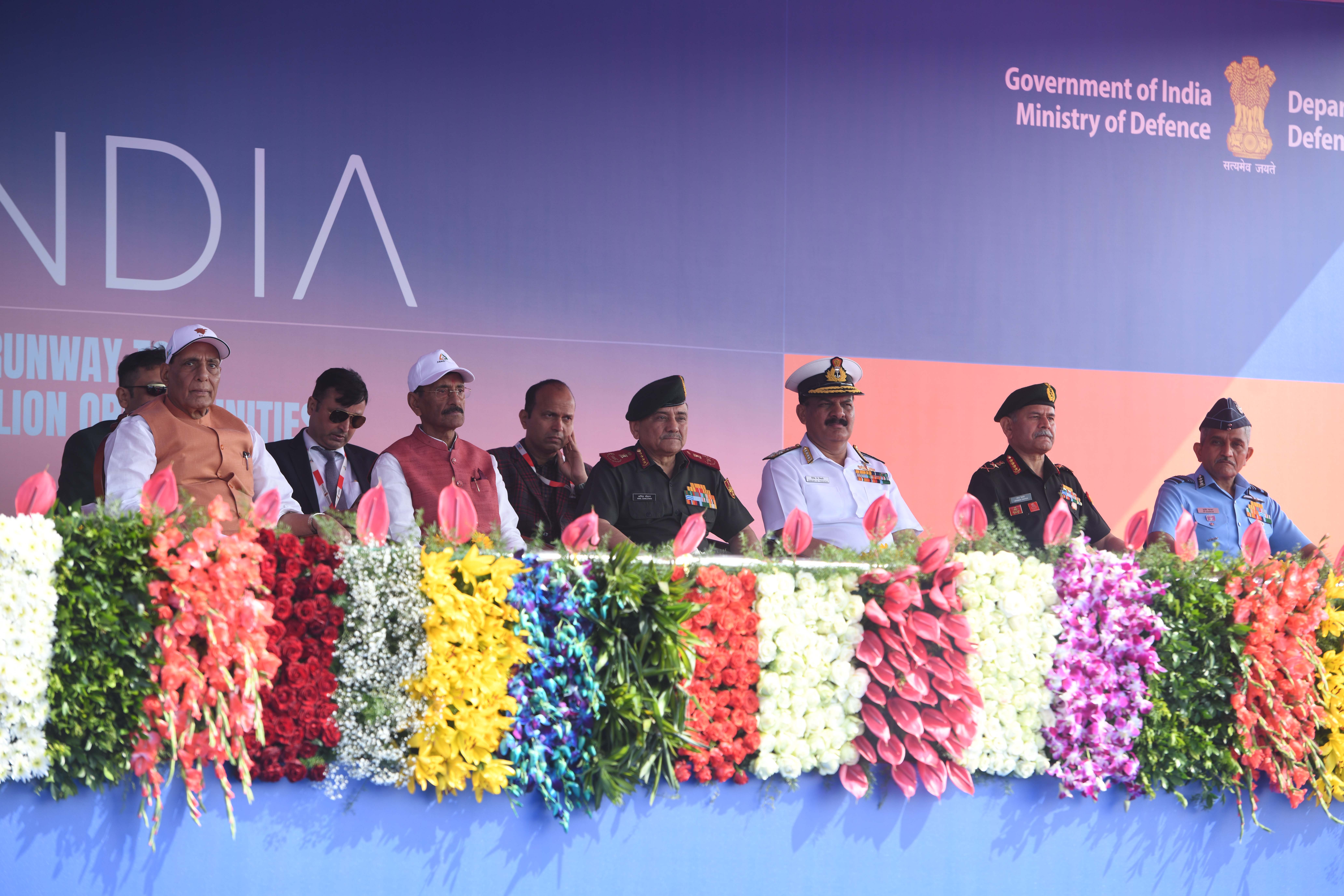


 AERO INDIA 2025 Admiral Dinesh K. Tripathi unveiled the indian Naval
Aviation-technological Roadmap 2047 during the Show


India’s Naval Aviation

A Capable But Thin Force: India today operates a mature and broadly effective set of naval air assets across the full spectrum of maritime missions. The Boeing P-8I remains the navy’s most potent airborne anti-submarine warfare (ASW) and intelligence, surveillance and reconnaissance (ISR) platform, able to stitch together a three-dimensional picture using sensors, reach and sophisticated fusion tools. The MiG-29K and, in time, the Rafale-M, with its more advanced sensors and operational reliability, provide the backbone of fleet air defence and maritime strike.

The MH-60R Seahawk has finally added long-overdue depth in air-delivered ASW and anti-surface warfare, allowing surface combatants to prosecute contacts well beyond their organic sensor limits. At the endurance end, the MQ-9B Sea Guardian—strengthened by operational experience from the leased fleet—will deepen persistent maritime ISR across the Indian Ocean Region (IOR), including key choke points, island territories and the wider seaward arcs that shape India’s maritime security.

This is a strong foundation. But it is a thin one. The numbers of each type are simply insufficient to cover the vast maritime spaces India must monitor. They are too few to sustain a continuous presence across multiple theatres, and too small a pool to absorb losses or support extended operations. In a theatre stretching from the Gulf of Aden to the Western Pacific, quality cannot substitute for quantity. The platforms are strong; the density is not.

A System of Systems: The central lesson from Ukraine is that platform excellence must sit inside a system that is coherent, fast and deeply connected. Modern warfare demands integration across air, surface, subsurface, space, cyber and electronic layers. It requires networks that do more than move information—they must continuously generate theatre-level kill chains.

Taken together, India’s naval aviation assets already offer the outline of something far more powerful than a list of platforms. They hint at the beginnings of a maritime kill chain that links activities under the sea, on the sea, in the air and in orbit into a single operational framework. The human resource base remains strong. The navy has decades of operational experience in the Indian Ocean. The material pieces exist. What matters now is how they are connected.

And here lies the challenge. The real risk for India does not lie in its aircraft or helicopters or drones, but in the structure that binds them into a coherent reconnaissance-and-strike system. Ukraine demonstrates brutally that highly sophisticated individual systems have limited value if they sit outside a fast, resilient kill chain. Russia has destroyed hundreds of Ukrainian platforms not because each weapon is extraordinary, but because the wider system detects, decides and acts in near-real time.

If India does not tightly integrate its systems, it will fight within someone else’s decision cycle.

The Platform Bias: Even as the Naval Aviation 2047 roadmap lays out a progressive vision, the wider national conversation still gravitates towards platform counts, fighter-replacement timelines, helicopter shortages and production rates. These issues matter, but they continue to overshadow the harder and more consequential question: how will all these assets be fused into a single, automated, continuously updated maritime reconnaissance-and-strike web?

This broader vision was articulated publicly during the seminar ‘Transition to Aatmanirbhar Indian Naval Aviation-2047 and its Associated Ecosystem’ at Aero India on 12 February 2025, where minister of state for defence and chief of the naval staff, Admiral Dinesh K. Tripathi unveiled the Indian Naval Aviation-Technological Roadmap 2047. Yet, the national discourse remains anchored in high-level, slogan-level aspirations—Viksit Bharat, Atmanirbhar 2047, etc.,— helpful in providing direction but not operational enough to explain how the Navy will actually bind its air, surface, subsurface, space, and cyber assets into a functioning kill web.

The platform-first mindset is most visible in employment patterns. The P-8I, despite its exceptional reach, sensors, and fusion tools, is often employed as a stand-alone, high-end platform rather than as a persistent node within a wider targeting enterprise. The MQ-9B Sea Guardian, with its long endurance and maritime ISR potential, remains more episodic in use than fully absorbed into carrier-air and surface-force cycles. And while Indian naval doctrine increasingly highlights indigenous sensors, radars, and command systems, it has not yet publicly articulated an end-to-end maritime reconnaissance-and-strike architecture that fuses submarines, surface combatants, aircraft, unmanned systems, and space-based inputs into a single dynamic operational picture.

These are not criticisms of the platforms themselves. They are signals that the system-of-systems required to exploit them at scale is still taking shape.

Structural Gaps: Several structural gaps stand in the way. Airborne electronic warfare remains a significant shortfall. India has nothing comparable to the dedicated electronic-attack and spectrum-shaping assets Western carrier aviation uses to prepare the battlespace. Airborne early warning is thin: the Ka-31 has served well, but its limited range and persistence expose a key vulnerability in high-threat missile environments. A follow-on Airborne Early Warning and Control (AEW&C) solution for carriers remains overdue.

Unmanned undersea warfare concepts are still at an exploratory stage. India often views unmanned underwater vehicles (UUVs) as future enablers; adversaries view them as future weapons. Airborne mine countermeasures remain entirely absent from India’s toolset. This gap affects both carrier operations and littoral dominance, because mine warfare is poised to return as a major strategic lever in the Indo-Pacific.


NATION’S PRIDE Indigenously built aircraft carrier INS Vikrant sails home


ANTI-SUBMARINE WARFARE Indian Navy’s MH-60R multirole helicopters at Kochi


Data fusion too remains largely battle-group centric. Without theatre-level nodes that bring together tracks from multiple fleets, ISR assets and space systems, the navy cannot maintain a persistent operational picture across the Indian Ocean.

None of these gaps is irreversible. But closing them requires doctrine, investment and a shift in training toward complex networked operations.

The Human Factor: The human machinery behind India’s naval aviation has held firm, but it is under strain. India still has a cadre of trained aviators and maintainers, but the deep engineering continuity once guaranteed by the specialised Artificer apprenticeship has been sharply reduced. The Agniveer scheme has effectively ended a pathway that produced technicians with four to five years of structured, sea-facing engineering education and a decade or more of system-sense and retention. Numbers can be replaced; the lived familiarity with naval systems cannot. For an aviation arm built around high-end sensors, acoustics, electronics and mission systems, this loss of technical depth will be felt unless a modern equivalent pipeline is created.


Lessons from Ukraine

Ukraine has shown four realities that now define the modern battlespace: speed, mass, spectrum and systems.

Speed decides survival because units detected by sensors are often struck within minutes. Mass matters because waves of low-cost drones can overwhelm expensive systems. Control of the electromagnetic spectrum is essential because electronic warfare can blind, jam or deceive entire formations. And systems win, not platforms, because the side that maintains a functioning reconnaissance-and-strike network dictates the tempo.

These lessons translate directly to the maritime domain.

Ukraine repeatedly shows that any unit exposed to sensors without immediate movement risks destruction. Russian kill chains compress into three to five minutes, enabled not by any single weapon but by constant drone surveillance, automated target nomination, electromagnetic geolocation and rapid routing of information to loitering munitions. A modern naval battlespace will behave similarly—only faster and over greater distances.

It also shows that numbers matter. On the ground in Ukraine, large numbers of small, cheap, camera‑equipped drones have changed how battles are fought. At sea, something similar is likely to happen: many unmanned aircraft will patrol overhead in layers, while swarms of small underwater drones will move below the surface. Together, these unmanned systems will constantly search for targets and help direct attacks, changing how navies fight at sea. Electronic warfare will shape the fight. Russian electromagnetic activity regularly neutralises Ukrainian drones within minutes; a similar density should be expected in any Indo-Pacific conflict. Spectrum manoeuvre and deception will soon be as central to naval warfare as gunnery once was.

But Ukraine’s most important lesson is conceptual: victory does not lie in destroying platforms; it lies in collapsing systems.

The Reconnaissance-Deep-Strike Paradigm: Nearly a century ago, Soviet theorists argued that true advantage lay not in attacking the frontline but in attacking an enemy’s entire depth: sensors, logistics, command, mobility and cohesion. They stressed simultaneity—striking across layers so an adversary could not respond—and continuity, sustaining pressure without pause.

In the late Seventies and early Eighties, thinkers such as Marshal Nikolai Ogarkov updated these ideas for the era of precision weapons. They imagined a reconnaissance–strike complex: a fused system of sensors, automated command tools and long-range strike assets operating in near-real time.

Ukraine is simply the modern expression of what Ogarkov described. The maritime translation is straightforward: advantage will belong to the side that builds the faster, more resilient sensor-to-shooter web across the air, surface, subsurface, cyber and space layers. This is the lens through which to assess India’s naval aviation today.


ABOvE AND RIghT P-8I; Rafale Marine


The Shift India Must Now Make

P-8I as the Theatre Fusion Backbone: The Boeing P-8I already provides India with formidable ISR and ASW reach. But its real value lies not in what it can do independently, but in how it can orchestrate the wider kill web. It must evolve from an exceptional reconnaissance aircraft into a theatre-level fusion node.

In that role, it should pull in tracks from satellites, coastal radars, submarines, seabed sensors and UAVs into a single, live operational picture. It should pass targeting-quality data to land-based missile regiments and island outposts. It should guide long-range strikes launched from ships or land. It should coordinate UUV networks, manage multi-static sonar fields and maintain persistent electronic-intelligence sweeps. This is the maritime equivalent of the orchestration role Russian drones now play over Ukraine.

A Three-Tier Unmanned Aviation Force: Ukraine has demonstrated the value of differentiated unmanned systems, each contributing a distinct layer of sensing, cueing and strike. Naval aviation, therefore, needs a structured unmanned ecosystem rather than a collection of drones. At the widest end, high-altitude long-endurance (HALE) and medium-altitude long-endurance (MALE) systems, such as the MQ-9B, should provide broad-area surveillance and cueing for air, surface, and subsurface forces. A second tier should sit aboard destroyers and frigates, where medium-range shipborne UAVs can extend radar and electronic horizons and improve over-the-horizon targeting. The third tier belongs on the carrier deck, where carrier-borne ISR and light-strike UAVs can add sensing density and strike mass to the air wing. Together, these layers would give India an unmanned architecture that matches the scale and speed of the modern maritime battlespace.

Reinventing ASW for UUV Systems: A UUV-heavy future is inevitable. ASW must shift from helicopter-centric hunting to aviation-led orchestration of unmanned undersea systems. MH-60Rs should evolve into airborne controllers of UUV networks. P-8Is should manage multi-static sonar grids. Air-droppable UUVs should provide persistent coverage in contested littorals. And anti-UUV weapons must become standard payload options for naval aircraft.

Airborne Mine Countermeasures: Mine warfare is likely to become a central strategic lever in the Indo-Pacific, particularly as adversaries look for asymmetric ways to slow or disrupt naval operations. Mine countermeasures remain a recognised weak link in India’s maritime force structure, and naval aviation reflects this gap sharply. The navy has no dedicated airborne mine-countermeasures (AMCM) helicopters or podded systems in service, and this leaves India overly dependent on surface assets to deal with a threat that is increasingly mobile, layered and technologically sophisticated. Modern mine warfare cannot be countered from the surface alone. Helicopter-towed sonars, laser-based detection suites, magnetic sled devices, and UAV-enabled seabed and water-column mapping will all be essential to keep sea lines open and maintain the mobility of carrier and amphibious groups. Without a credible AMCM capability, even a small but well-laid minefield near a chokepoint could delay, degrade or deny operations at precisely the moment India needs freedom of manoeuvre most.

Mastering the EM Spectrum: Electronic warfare must move from a peripheral skill to a central operational discipline. Naval aviation needs emissions-control training, spectrum-deception tools, airborne jamming, expendable EW drones and theatre-scale spectral mapping. The electromagnetic environment is no longer a backdrop—it is a manoeuvre domain.

Training for Networks: For India to shift from platform excellence to system excellence, training must reflect networked combat. Detection-to-strike drills involving aircraft, drones, ships, submarines and UUVs must become routine. Multi-domain simulators and joint targeting centres will be required. AI-driven fusion engines and decision-support tools will need to shorten the loop between sensing and acting. The industrial base too must prepare for high-usage and attrition-friendly production of unmanned systems and expendables.

Legacy Decks to MUM Ops: The path to future naval aviation begins on the ship’s flight deck. India’s ship-helicopter interface remains basic for the high-sea-state, all-weather operations the Indo-Pacific will demand. Present handling systems depend too heavily on human chains, offer thin safety margins in rough seas and struggle to support reliable night operations.

As unmanned systems become central to ASW and ISR, the navy cannot rely on traditional launch-and-recovery routines. It needs automated systems that can manage mixed manned–unmanned (MUM) cycles, handle multiple aircraft types and reduce stress on platforms. This is the logic behind modern Electromagnetic Aircraft Launch System (EMALS) technologies and Aircraft Ship Integrated Secure and Traverse (ASIST) systems: precision, tempo and safety.

India’s deck systems were designed for an earlier era. They work, but they were never meant to support helicopters, shipborne UAVs and UUV-linked equipment operating from the same ship in complex sea states. This is where India must act without delay.

The good news is that India does not need to reinvent these systems. Modern deck-handling, securing and recovery technologies already exist and have been proven abroad. The challenge is not invention; it is early standardisation and fleet-wide adoption. Retrofitting each class with a different solution creates training overload, uneven safety standards and avoidable maintenance complexity.

The better Approach is Straightforward: Define requirements early, select a proven baseline design, license-produce it in India and integrate it into new warships from the design stage. Indian shipyards already have the necessary engineering competence. What they need is a stable naval mandate: mixed manned–unmanned decks, robotic handlers, stabilised landing aids, UAV recovery rails and digital interfaces linked directly to ship sensors and aviation networks.

If India adopts this path, it will move from isolated experimentation to fielding a fleet genuinely ready for manned–unmanned teaming operations (MUM-ops). Training will simplify, logistics will rationalise and unmanned aviation will scale without friction. Most importantly, India will deploy flight decks built for the tempo that the Indo-Pacific demands.


Naval Aviation as the Navy’s Nerve Centre

China has already internalised Ukraine’s lessons and embedded them into a dense multi-domain kill web linking satellites, drones, UUVs and long-range missiles into a formidable anti-access and area-denial system. Its progress in carrier aviation is even more telling. China has moved rapidly from Short Take-Off But Arrested Recovery (STOBAR) carriers to Catapult Assisted Take-Off But Arrested Recovery (CATOBAR) designs equipped with Electromagnetic Aircraft Launch System (EMALS) technology. It is simultaneously investing in carrier-borne Unmanned Aerial Vehicles (UAVs) and steadily improving the composition, range and persistence of its carrier air wings. Together, these developments point to a navy that increasingly treats aviation as the organising centre of maritime power.

India’s geography is different, but no less demanding. The Indian Ocean’s sheer scale makes platform-centric thinking untenable. What India needs is distributed sensing, layered fusion and faster decision cycles—an architecture in which naval aviation, unmanned systems and space- and cyber-enabled networks operate as one.

If India moves early to build such a maritime reconnaissance-and-strike complex, it will gain leverage at choke points, shape events on its terms and hold the initiative across the region.

India’s naval aviation has strong foundations: capable platforms, skilled people and hard-won experience. But the Indo-Pacific’s future will not be shaped by platforms alone. It will be shaped by kill webs—the ability to sense first, fuse fastest and strike as one system. The intellectual path is clear, from deep operations theory to the modern reconnaissance-strike complex. The technology, the experience, and the platforms exist. What India must now build is the system that binds them.

Naval aviation is uniquely placed to become the nerve centre of India’s maritime battlespace. If it succeeds, India could shape the tempo and balance of power across the Indian Ocean. If it does not, others will do it for us.

(The writer served as Flag Officer Naval Aviation, Chief of Staff HQ Andaman & Nicobar Command, and Chief Instructor (Navy) at DSSC Wellington. His writings focus on joint doctrine, maritime strategy, and defence reform)


Subscribe To Force

Fuel Fearless Journalism with Your Yearly Subscription

SUBSCRIBE NOW

We don’t tell you how to do your job…
But we put the environment in which you do your job in perspective, so that when you step out you do so with the complete picture.






