The evolving research in nanotechnology and semiconductors is shaping the future of radars. The new technologies have helped in miniaturisation and diversified utilities of the radar. The 3D radar systems are occupying the attention of many companies and military organisations worldwide, as they are more efficient and precise, and dual-use. The 3D radar system involves the measurement of all three space coordinates of an object resulting in a precise pinpointing of the target. 3D radars are now replacing 2D radars increasingly in defence and meteorological industries.
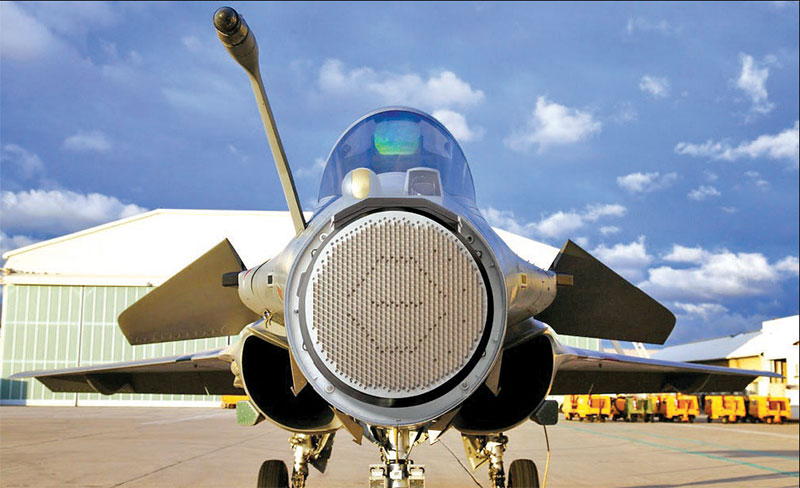
Rafale fighter aircraft with Thales RBE2 AESA radar
Another trend has been the emergence of passive radars, which are becoming the new choice of militaries around the world for being both economical and efficient. The passive radar systems work by detecting and tracking their targets through reflections from non-cooperative sources of illumination such as commercial and communication signals. Unlike conventional radars, passive radars do not send any electromagnetic signals towards the target, they rather use the already existing electromagnetic signals from the atmosphere to support imaging and tracking capabilities.
Another prominent technology which is gaining traction these days is the Active Electronically Steered Array Radar (AESA) which employs the new generation of Trans-Receive (TR) modules. These are highly capable Software Defined Radios (SDR) that can also be used for radio communication with very high data rates. AESA is increasingly being used to replace the older radar technology because of its advanced tracking and detection capabilities. The controlled array antenna in AESA and the beam of radio waves can be made to point in different directions while the antenna remains at the same position. With its efficient detection, targeting, tracking and self-protection capabilities, AESA has an edge over the older technologies.








 VIDEO
VIDEO