Globally, naval aviation has over the years evolved exponentially. Naval warships face two threats, from the air and under the sea. Modern warships have powerful anti-aircraft batteries and missiles that can deal with the threat from air, but it is aviation, fighters and helicopter gunships, which can take off from the ships’ decks that have made naval ships more lethal than ever. Ship-borne aviation can deal with both the attacking warplanes as well as the lurking danger beneath, which is submarines.
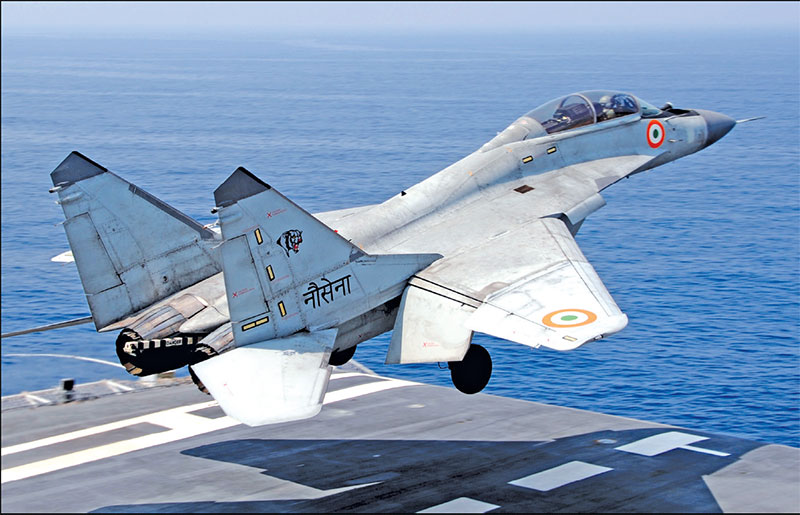
MiG-29k taking off from INS Vikramaditya
The concept of using air power from ships was first initiated by the British. The French soon followed suit. The US Navy’s first test aircraft take-off and landing from a ship were performed by pioneer aviator Glenn Curtiss and US Navy Lt. Theodore G. Ellyson.
According to GlobalSecurity.org, Japanese seaplane carrier Wakamiya was used in support of a conflict between Japanese and German forces at Tsingtao in China during World War I. Air units of the Wakamiya also engaged in an attack which purportedly sunk a German minelayer and damaged shore installations, arguably the first air raid in history to result in a success.
The first reported torpedo ‘kill’ happened when a Short Type 184 flown by Flight Commander Charles Edmonds from HMS Ben-my-Chree sank a Turkish supply ship in World War I in 1915. Using a 14-inch-diameter, 370 kg torpedo the pilot sank the Turkish ship which had earlier been hit by a torpedo from another ship.
The success of naval aviation during World War I prompted the world powers to take a closer look at the concept. Britain’s Royal Ark was the world’s first modern ‘aircraft carrier’. The tag of the world’s first purpose-built aircraft carrier goes to Japanese ship Hōshō (1921).
But naval aviation actually became a force to reckon with only during World War II. As they had interests in the Pacific to protect, Japan and the US were the main proponents of naval aviation along with Britain. To a lesser extent France, Soviet Union and Italy also used naval aviation.








 VIDEO
VIDEO