I have had opportunity to attend several Inspector General and Director General Level Border Conferences in India and Bangladesh while commanding the North Bengal frontier of the Border Security Force (BSF) for over three years. The press in Bangladesh invariably alleged violence by the BSF against whom they referred as cattle traders.
The response by one of the Directors General—the late U.K. Bansal—was firm and appropriate. He asked a counter question and wanted to know who were these cattle traders the Bangladesh media was referring to, adding that there was no formal cattle trade between India and Bangladesh. According to Bansal, those who were attempting to smuggle cattle to Bangladesh from India were smugglers and trans-border criminals be they Indian or Bangladeshi nationals.
If those who were injured or killed were traders, why did they carry arms and attack BSF troops, he wished to know. He asserted that BSF troops who are tasked to patrol the border to prevent illegal activities used force, including opening fire, only to defend themselves against attacks by the cattle smugglers with sharp edged weapons and firearms. He concluded by saying that patrol commanders on the spot were well trained and responded only to an emerging operational situation and never used excessive force.
Bansal’s response brings out the dilemma before the BSF in preventing cattle smuggling to Bangladesh, which emanates from one of the mandated tasks of preventing smuggling. Indian cattle are in huge demand in Bangladesh because of better breed and larger yield of meat. The locally available cattle in Bangladesh are not adequate to meet the high demand for their beef and leather industry. This demand is met by smuggling of Indian cattle, mainly through riverine gaps in border fences and also by cutting the fence wherever it is beyond the observation of the BSF patrol even for a short period.
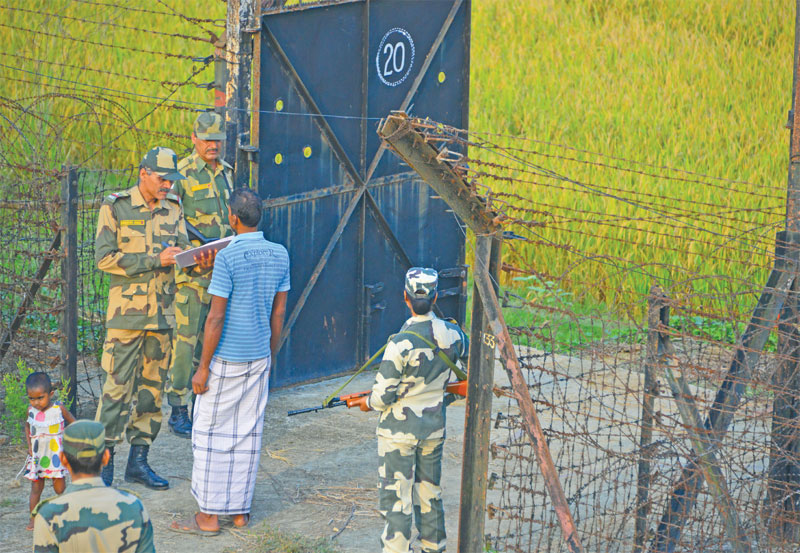
BSF personnel at the Bangladesh border
Both Indian and Bangladeshi nationals are involved in this illegal activity. The magnitude of cattle smuggled to Bangladesh can be gauged from the fact that a total of 5,65,141 cattle heads were seized by troops all along 4,096 km long India-Bangladesh border from 2014 to 2018. The quantum of cattle seizure has come down drastically in recent years, with 2,27,799 cattle heads being seized during the five-year-period from 2018 to 2022. The declining trend of cattle seizures also gives credence to the reported initiative of the Bangladesh government to encourage cattle rearing in Bangladesh itself in order to reduce the violence along the border and adverse impact to the government’s image.
The quantum of seizure of cattle may, however, not be the true indicator of actual numbers smuggled, which may be much larger. The cattle seized by the BSF, even though very little percentage of the total quantum smuggled are channelized back into smuggling because the same cartel buys them in auction from customs. As per a 2019 estimate, cattle smuggling to Bangladesh is estimated to be worth more than USD 500 million annually.








 VIDEO
VIDEO