Since late 2019 China’s People’s Liberation Army Ground Forces (PLAGF) has been giving high-publicity to the service induction of the 33-tonne ZTQ-105 medium battle tank (MBT), which is presently undergoing service induction within both the Tibet Military District (TMD) and the South Xinjiang Military District (XMD) of the Western Theatre Command, as well as in the Eastern Theatre Command. In addition, the PLA Marines have begun receiving their ZTQ-105s. Claimed by the PLAGF to be capable of firing armour-piercing APFSDS projectiles out to a distance of 3km and supposedly penetrating 500mm of rolled homogenous armour, the ZTQ-105 is arguably the most recognisable component of the PLAGF’s equipment modernisation.
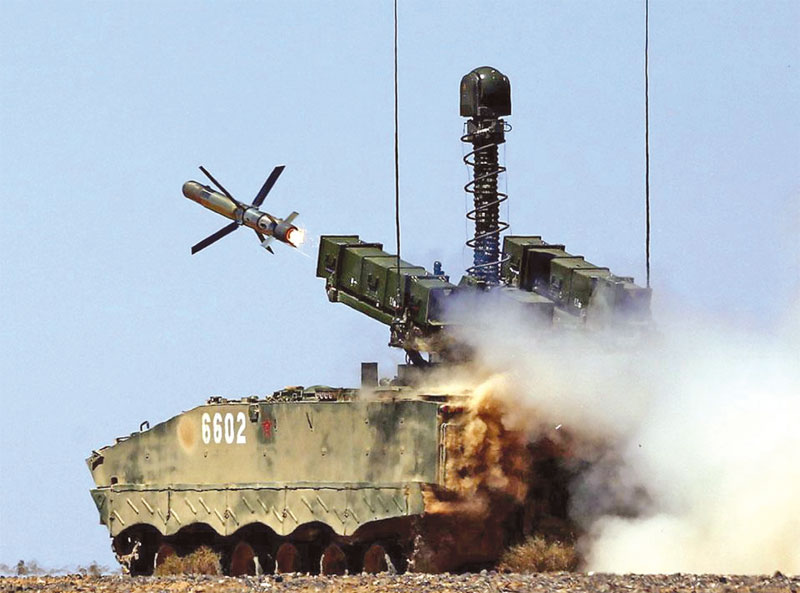
Red Arrow-10A wire-guided ATGM
Developed by China North Industries Corp (NORINCO, the ZTQ-105 is thus a good case study to illustrate the direction of the PLAGF’s hardware upgrades. It was tailored for operations in hostile environments such as altitudes over 4,500 metres above sea level and soft muddy terrain. Its V8 engine with a bore diameter of 132mm, stroke length of 145mm, and maximum RPM of 2,600, and output of 660kW of maximum continuous power gives the MBT a power-to-weight ratio of 20kW/tonne. To overcome the thin air of the Tibetan Plateau, the engine is equipped with a two-stage turbocharger that minimises power loss. It is also equipped with a warmer to facilitate quick ignition in extremely cold weather. The engine is coupled to a hydro-mechanical automatic transmission together as a powerpack that can be replaced within 30 minutes. The suspension is a semi-active torsion bar system sporting electronically controlled viscous dampers with adjustable orifices that are narrowed or widened in real-time depending on sensor readings, thereby providing a smoother ride and reducing crew fatigue—important in the oxygen-sparse atmosphere. If the system breaks down, it simply becomes a passive viscous damper that still provides decent ride quality.
Due to its unique operating environment of highly adverse and isolated terrain where resupply and replacements have great difficulty reaching, the ZTQ-105 is designed with multipurpose functionality to get as much bang for the buck as possible. Its digital fire-control system (FCS) is integrated with both direct and indirect fire modes, allowing the ZTQ-105 to stand in for field artillery howitzers if needed. This is achieved by equipping the MBT with high-precision inertial measurement gyros and Beidou GPS receivers connected via a CAN databus to a central computer. This allows its position and orientation in space to be precisely known so that the Battalion or Brigade Fires Director can construct an accurate spatial representation of shooters and targets in 3-D and accurately plan indirect fires. Another feature enabled by constant position and orientation awareness is that a ZTQ-105 can hand over prosecution of a target to another ZTQ-105 in the network if it is unable to prosecute the target itself due to, say, a damaged gun or lack of ammo; essentially remote-controlling someone else’s gun to shoot whatever it is looking at even if the target is obscured to the shooter vehicle. This is possible because every vehicle in the network knows its position and orientation relative to everyone else, and if one MBT knows the position of the target in a 3-D space, everyone does.








 VIDEO
VIDEO