

Power of Narrative
Iran is succeeding on the battlefield and in telling its truth
 Ghazala Wahab
On April 8, the United States (US) agreed to a two-week ceasefire--mediated by Pakistan--with Iran to discuss a comprehensive end of the war on latter’s 10-points proposal. This is no less than a victory for Iran.
Despite being the worst sufferer of the war, in human and material terms, Iran managed to find for itself a sweet spot where it was able to absorb the casualties and damage to its infrastructure yet still managed to hit out at Israel and the US assets in West Asia. Such had been Iran’s ability to inflict punishment that not only its West Asian neighbours, but Trump himself had been trying to get it to come onboard the peace talks for nearly three weeks.
But Iran was steadfast in its position. It did not want a mere ceasefire. It wanted a comprehensive end to war. From Iran’s perspective, if it accepted a ceasefire, especially of the kind Trump was proposing, it would have given the US an exit claiming victory, without leashing Israel. Iran’s position then would have been reduced to that of Gaza. Israel would continue to periodically attack Iran (as it’s still doing and did last year too after the declaration of the ceasefire) and carry out assassinations of its leaders with impunity as it has been doing for over a decade now. Worse, Iran’s retaliation against Israel then could be labelled as aggression, bringing the sanctions back on the table.
Iran’s firm stance on its conditions to end the war, as opposed to progressive whittling down of supposed US objectives of the war, has not only added to its credibility as a nation, but has demonstrated that it won the 40-day war imposed upon it by Israel and the US—both on the battlefield as well as in narrative.
To be fair, as far as the narrative was concerned, Iran had no competition. For three reasons: one, it was the aggrieved party. It was repeatedly betrayed whenever in pursuit of peace it agreed to the conditions imposed by the US. It happened in 2025, when the US-Israel betrayal led to the 12-day war. And it happened in February when Iran had gone beyond everything it had done before to accept US conditions to avert an attack on itself. Yet, the US-Israel duo launched the war against Iran on February 28. So, from day one, the popular global opinion was against them, despite western governments expressing support for them in the beginning. Gradually, that vocal support also started to wane because of the pressure from their civilians. The starkest example of this was the turnaround of Italy, which belatedly condemned the attack on the primary school in Minab by the US.
Two, Israel really didn’t care for any narrative or a moral upper ground in this war. Its only purpose was to use the US umbrella to inflict as much damage on Iran as possible--degrade its military, industrial, infrastructural, economic, intellectual and leadership capabilities to the extent that Iran would take at least a decade to recover, if not more. Hence, global opinion didn’t matter, as long as the US had its back. After all, it continues with its genocidal violence in Palestine despite worldwide condemnation and an international arrest warrant for its prime minister Benjamin Netanyahu.
Three, for all his bluster, which became increasingly deranged as the war progressed, US President Donald Trump was conscious of the illegality and immorality of it. He had succumbed to Netanyahu’s pressure (or blackmail, depending upon what one may want to believe) in the hope that Iranian government would cave in once Ayatollah Ali Khamenei and other senior leaders were killed. Israel would once again be successful in triggering a popular uprising as happened in January, and there would be a successful regime change. Thereafter, the US would declare victory and exit the theatre with full control over Iranian oil. But none of this happened. And despite utmost censorship about the losses the US-Israel combined were suffering, news continued to trickle out. This made the already unpopular war even more unpopular among Trump’s own support base.
Hence, the frequent ranting on his social media handle Truth Social. In his Easter post on Truth Social, he referred to Iranians as ‘crazy bastards’, demanding that they open the Strait of Hormuz immediately. He topped that post on April 7, with the threat that ‘A whole civilisation will die tonight, never to be brought back again.’ These were not warnings. These were rants of an extremely frustrated man on the edge of helplessness. The combination of brag and threats was almost a plea to Iran for help for an ‘off-ramp’. With this background, US couldn’t have built an alternative narrative of justness or even victory in the unnecessary war against Iran.
Incidentally, Israel had wanted to attack Iran since 2008, when Prime Minister Ehud Barak proposed it to the visiting US President George W. Bush. Bush categorically refused, though he ignored the special operations that Israel was undertaking against Iran, including illegal assassinations of its scientists and military leaders. Trump also resisted Israeli pressure in his first term despite tearing off the nuclear agreement with Iran, the Joint Comprehensive Plan of Action signed during his predecessor’s term. But this time, he couldn’t resist Israeli machinations. Hence, the limitation of spinning a positive narrative.
And that’s the key requirement of successive narrative-building. It must be rooted in truth, which can thereafter be exaggerated or deployed selectively. A narrative spun with complete falsehoods does not hold for long. It may have an instant appeal but is always vulnerable to factchecking.
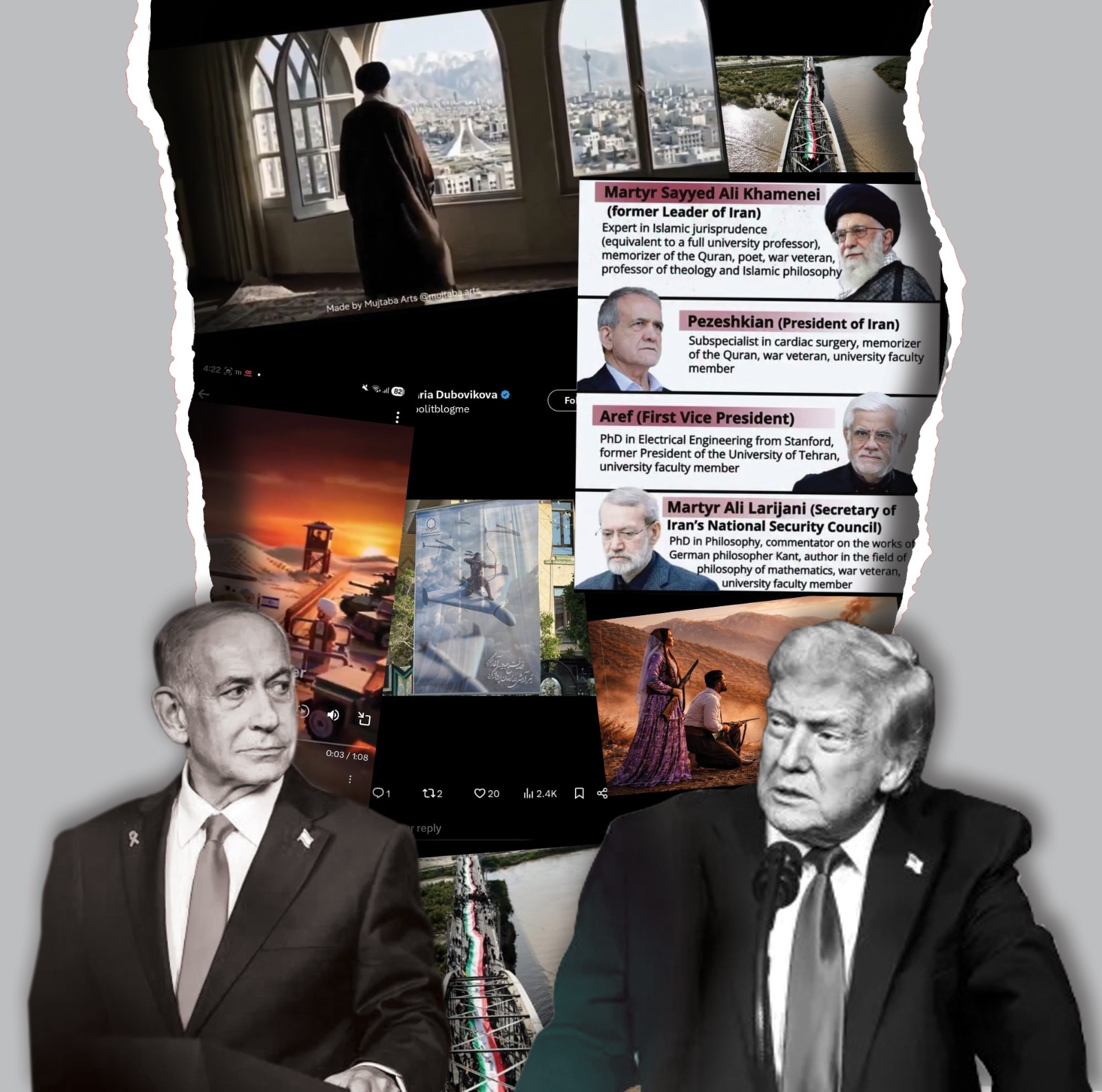
Conscious of this fact, Iran juxtaposed its current vulnerability against its civilisational history to present an image of righteousness. Before the war, most viewed Iran through the lens of a despotic regime which oppressed its own people, especially dissidents and women. However, during the war, Iran upturned that perception by successfully building the narrative of resistance against tyranny. This increased its support base among ordinary people, not only in West Asia, but in other parts of the world too. This was evident both in the outpouring of condolence messages after the assassination of Ayatollah Khamenei, and in the successful fund-raising drive by the Iranian embassies worldwide. In India alone, it managed to raise about USD 64 million.
War of Narratives
Narratives are an important component of any war and primarily has three main objectives. First, a positive narrative is meant to appeal to one’s core base to keep it consolidated. This is done by reinforcing your version of events and demonstrating to your core that your actions were forced upon you; that you did not chose to endanger their lives.
In the case of Iran, this was not difficult. Not only Iranians, but everybody across the world with interest in the region knew that Iran was desperate to avoid a war. That it had agreed to almost all conditions, including zero stockpiling of enriched uranium, in the talks mediated by Oman. Omani foreign minister al busaidi had since spoken about this in great detail. As a result, even those Iranians, who have been opposed to the Islamic republic knew that this was the war their government had not forced upon them. This is the reason there have been several reports of many among the Iranian Diaspora choosing to return to Iran during the war, both to stand with the nation, as well as to defend it.
Second, a successful narrative appeals to the base outside your core through repeated communication that portrays you as the victim of aggression/ tyranny and your fightback as just resistance. This is done to win over the support of those who were previously critical of your policies. Iran managed to do this by successfully resisting US-Israel bullying and aggression. It projected the war as the historic David versus Goliath conflict, in which it stood for truth and justice. The success of this projection could be seen in the way global public opinion swirled in favour of Iran. In Iran’s fightback, its former critics saw the comeuppance for the US hegemony in the world and Israel’s cruelty in West Asia.
Third, and most important, a successful narrative is aimed at demoralising the enemy. This is done by demonstrating to its support base that it is fighting an immoral/ illegal war. By constant reiteration of its failures, this also tells their support base that it is also losing that immoral/ illegal war.
Since the Vietnam disaster, the US has had a very low threshold for accepting casualties. Hence, in the war against Iran it had been extremely particular about reporting on US deaths. Aware of this fact, Iran through its social media engagement created doubts about the US government claims about the number of American deaths. This created an unease even among Trump’s hardcore supporters, including the white supremacists who didn’t care for the war initially. They feared that if the war continued, these numbers would go up. Iran also successfully communicated to the American people that Trump was fighting Israel’s war, that Iran has never been a threat to the US.
However, what really tipped over the Trump MAGA base was Iran’s setting up of a toll gate in the Strait of Hormuz. This led the markets to crash and prices to rise. The war came home to the MAGA club, creating a pushback against the war in the US. The biggest sign of this was in the massive ‘No Kings’ protest in various cities in the US on March 28. By some accounts, eight to nine million people participated in these protests across 3,300 locations. While organised primarily to protest Trump’s unilateralism, the driving sentiment was the war against Iran and America’s military expenditure abroad which did not serve the US nation. This referred to US’ blanket support to Israel and its expansionism in West Asia. The size of these protests shook the Trump Administration, forcing it to double down on ceasefire efforts, even though publicly it maintained the illusion of winning and sending Iran back to the stone age.
Given the multiplicity of the objectives and the target audience, a successful narrative therefore is layered with several lines of communication and messaging. It cannot be the repetition of one singular message. Iran, with its rich tradition of filmmaking, understands the nature and power of communication. Hence, after the assassination of Ayatollah Khamenei, it drew the attention of the Muslims worldwide towards his martyrdom. It invoked the battle of Karbala and martyrdom of Imam Hussain, likening Hussain’s resistance of Yazid’s tyranny through his truth to Iran’s resistance of what it cleverly called the ‘Epstein class’. The frequent reference to the Epstein class also put the US and Israel in the class of tyrants.
But it was mindful of not referring to the war as jihad. This avoidance of the religious phraseology was a conscious decision because when the US had started its ‘global war on terrorism’, the word jihad was frequently used as a synonym for terrorism, thereby demonising all resistance movements by Muslims worldwide. Hence, Iran didn’t want people to confuse its resistance with jihad.
Once Iran became confident of its resilience against the US-Israel combined, it started to refer to itself as a resistance force, which was standing up to tyranny, falsehood and injustice on the behalf of all oppressed people of the world—from native Americans and female victims of sexual assault by the Epstein class to victims of Hiroshima-Nagasaki bombing, Vietnam war, Gaza genocide and so on. Drawing upon its civilisational history as mentioned earlier, it referred to its pre-Islamic history, honouring religions like Zoroastrianism and Baha’ism, emphasising upon the equality of humankind, irrespective of religion. This it did through repeated iterations of its cultural diversity, showcasing different religious communities, including Jews, who live in harmony in Iran.
Since one of the recurring criticisms against the Islamic republic has been its treatment of women, Iran was prudent enough to include women in all its social media engagements, so as to demonstrate to the world how its female population enjoys equal citizenship and rights in the country. This engagement generated curiosity about Iran among even those who didn’t know where it was located on the map, or who knew it only as an evil regime, or an axis of terrorism. This curiosity led to self-education about Iran, which helped largely in changing its image.
Moreover, all through the war, Iran was mindful of addressing its Arab neighbours as brothers, even while it was launching retaliatory attacks on their territories. Iranian President Masoud Pezeshkian went to the extent to addressing them on video. Short of apologising for the attacks, he explained to them Iran’s position, urging them to stop the US from using their territories for launching attacks on Iran. This video address helped in communicating Iran’s position to the citizens of the Gulf states, where there was growing empathy for Iran despite the position of their respective regimes. While in Bahrain, people came out in Iran’s support, nearly threatening their own monarchical regime, the Qatari and Omani governments also assumed a very vocal neutral position on the war, refusing to side with the US.
Iran’s Outreach
As mentioned earlier, narratives must be rooted in truth. But that is not enough. For successful sustainment of any narrative one needs to raise its level. Iran did this when in the middle of the US-Israel onslaught, President Pezeshkian publicly shared Iran’s vision of a new West Asia by proposing West Asia Security Framework on March 21.
This was the reiteration of a similar proposal that his predecessor President Hassan Rouhani had presented to the UN General Assembly in 2019. He had called it Hormuz Peace Endeavour (HOPE). The idea was to get West Asian nations take collective ownership of their own security instead of outsourcing it to the United States. Hence, under HOPE he proposed four things:
• Regional Ownership: Self-explanatory, this envisaged end of US bases in West Asia.
• Freedom of Navigation: Under this, he proposed that the Gulf Cooperation Council (GCC) nations and Iran create a joint mechanism to guarantee security of energy and other resources transiting the Strait of Hormuz.
• Foundational Principles: This underscored the importance of building a cooperative model based on UN principles. Hence, all nations would respect each-others’ sovereignty and territorial integrity; they would not interfere in the internal affairs of other states; and all outstanding disputes, including territorial disputes, would be resolved peacefully through dialogue.
• Broad Cooperation: Through this, Rouhani proposed cooperation, rather than competition among the West Asian nations in areas of economics and environment.
The GCC viewed Rouhani’s proposal with suspicion. Their concern was that Iran had selfish motives for proposing HOPE. Of course, it had. The biggest was the removal of US bases from West Asia and easing of sanctions. However, none of these were at the cost of GCC. Yet, except Qatar and Oman, who expressed willingness to discuss, no other nation warmed to it. Eventually, they fell in line with others, and HOPE died.
Pezeshkian’s proposal went a little further than Rouhani’s. He spoke of an Islamic framework of co-existence, instead of US framework. This implied indivisible security, where each nation would draw their security from the security of the neighbour, unlike the US-Israel approach where one’s security comes from another’s vulnerability. His last point was basically the BRICS economic vision of trading in local currency and working towards developing digital payment infrastructure.
As happened with HOPE, the GCC ignored Pezeshkian’s proposal. Perhaps, that was only to be expected given the war, but once conversation on comprehensive end of the war begins, the idea of collective security and regional ownership should be discussed by the GCC, even though it looks unlikely, given Saudi Arabia and UAE’s recalcitrant behaviour.
On March 29, I spoke with an Emirati academic and analyst Prof. Abdul Khaleq. He put down the GCC’s hostility in general and UAE’s in particular, towards Iran to four threats that it poses. One, “For the past 47 years, Iran has been threatening to export revolution to the GCC nations,” two, “It is in occupation of three UAE islands for 50 years—Greater Tun, Smaller Tun and Abu Musa,” three, “Its nuclear and missiles programme is an existential threat to the GCC”, and four “It has been trying to destabilise the region through its proxies, such as Houthis, Hezbollah and Hamas.”
The ironies in his statement deserved follow-on questions. For instance, why is Iran’s nuclear and missile programme regarded as a threat and not Israel?
“UAE is 2,000km from Israel,” he said. “Iran is the immediate neighbour, hence a greater threat.”
Why does GCC object to Hamas and Hezbollah given that they are resisting Israel in their countries?
His answer: “Defence of Lebanon is the job of Lebanese government and not Hezbollah’s, which is the proxy of Iran.” The attempt to dwell further on this angered Khaleq.
“Do you want to have an argument with me?”
Finally, on the question of territorial dispute regarding the three islands and why they couldn’t be resolved through dialogue as proposed by Rouhani and Pezeshkian, he said, “Nobody trusts Iran. Everybody watches what it does.”
The two reasons for hostility towards Iran which Khaleq did not say stem from fear and envy.
One, fear of the size of Iran’s military and the capability of its technological, military-industrial complex which produced its nuclear programme, missiles (both ballistic and cruise) and drones despite 47 years of debilitating sanctions. The GCC have among the best military equipment imported from the US and other Europeans countries. Yet, they have extremely weak armed forces. The reason is that they resist strengthening their own militaries for the fear of a coup.
Two, fear of their own people. Being family-run monarchies, they worry that any engagement with Iran may kindle revolutionary sentiments among their own population, which may cause them to revolt against the regimes with the support of a powerful military. Hence, both the military and the people are kept disempowered. And the security is outsourced to the US.
To pass on their own fears of Iran, the Arab regimes use the cover of historic Sunni-Shia divide to justify permanent enmity. The truth is Sunni-Shia enmity has no basis in Islam. It was an artificially created hostility by the Sunni Arabs against Persian (now Iranian) influence among the Muslims. The first person to issue a fatwa calling both Shias and Sufis heretics and fit to be killed was Ibn Tahmiyyah in the 14th century which provided an Islamic cover to Sunni violence against them.
It was a political move then to consolidate power by the ruling classes, and it remains a political project by the ruling Arab elite to retain their influence on the region. This time by labelling Iran as a destabilising force.
The truth is that the biggest destabiliser in the region is Israel. And both war and peace in West Asia depends upon Israel, not Iran. The present ceasefire can only hold if Israel is demilitarized.





 VIDEO
VIDEO