

Power and Dominance
The carrier-SSN balance in modern warfare is a necessity
 RAdm. Sanjay Roye (retd)
Unconfirmed claims of an American aircraft carrier being targeted by Iran and the subsequent shifting of USS Abraham Lincoln’s deployment into the Indian Ocean has revived the age-old carrier versus submarine debate in a radically changed battlespace. The answer is no longer a simple ‘who wins?’ but a more nuanced recognition that carriers and SSNs serve different roles: one for power projection and sea control, the other for sea denial and undersea dominance.
The carrier remains unmatched for sustained air power and political signalling, but it is also a large, visible, high value node that must be wrapped in a dense protective envelope. The carrier’s survival depends less on its own toughness and more on the strength of the layers around it. But then that is true for almost all big and visible assets--strategic bombers, fighter aircraft, air defence systems, missile bases, tanks, operation centres, formation headquarters, and so on.
Two Faces of Naval Power
Modern navies have long struggled with balancing tension between the aircraft carrier and the submarine. The carrier symbolises openness, presence and power projection; the submarine symbolises stealth, ambiguity and sea denial. For much of the 20th century, the carrier dominated the imagination because it visibly delivered combat air power across the sea. The submarine, by contrast, offered denial, attrition and covert leverage, but less visible glamour.
Today, that image is shifting. The carrier is still valued, but its very prominence in the battlespace makes it more vulnerable. The SSN, meanwhile, is seen as one of the most efficient means of holding high-value units at risk, because it can combine stealth with long-range sensors and weapons. The net effect is that navies can no longer realistically treat one platform as the ‘principal’ capital ship and the other as a secondary asset. The most effective fleets are those that explicitly design their force structure around the different roles each plays.
The Carrier’s Role
The aircraft carrier remains the most flexible instrument for projecting sustained air power at sea. It can launch repeated strike, air defence, electronic warfare and reconnaissance sorties from a position at sea, without dependence on foreign airfields or transient basing agreements. That is why, despite the cost and vulnerability, navies as diverse as the United States, India, China, the United Kingdom and France continue to invest in carrier capability.
Logically, the carrier is a sea control and power projection tool. It can:
• Provide air cover for surface fleets.
• Suppress enemy air defences and strike land targets.
• Deter adversaries through visible presence.
• Support amphibious or expeditionary operations.
• Sustain air operations in theatres where local airfields are limited or politically problematic.
These advantages are especially valuable in the Indo-Pacific and the Indian Ocean, where basing is often contested or constrained by host-nation sensitivities. For India, the ability to deploy INS Vikramaditya and INS Vikrant into the northern Arabian Sea, Bay of Bengal or the wider Indian Ocean gives the Indian Navy a powerful signalling and deterrence capability vis-à-vis both Pakistan and China.
.JPG)
SILENT KILLER INS Chakra
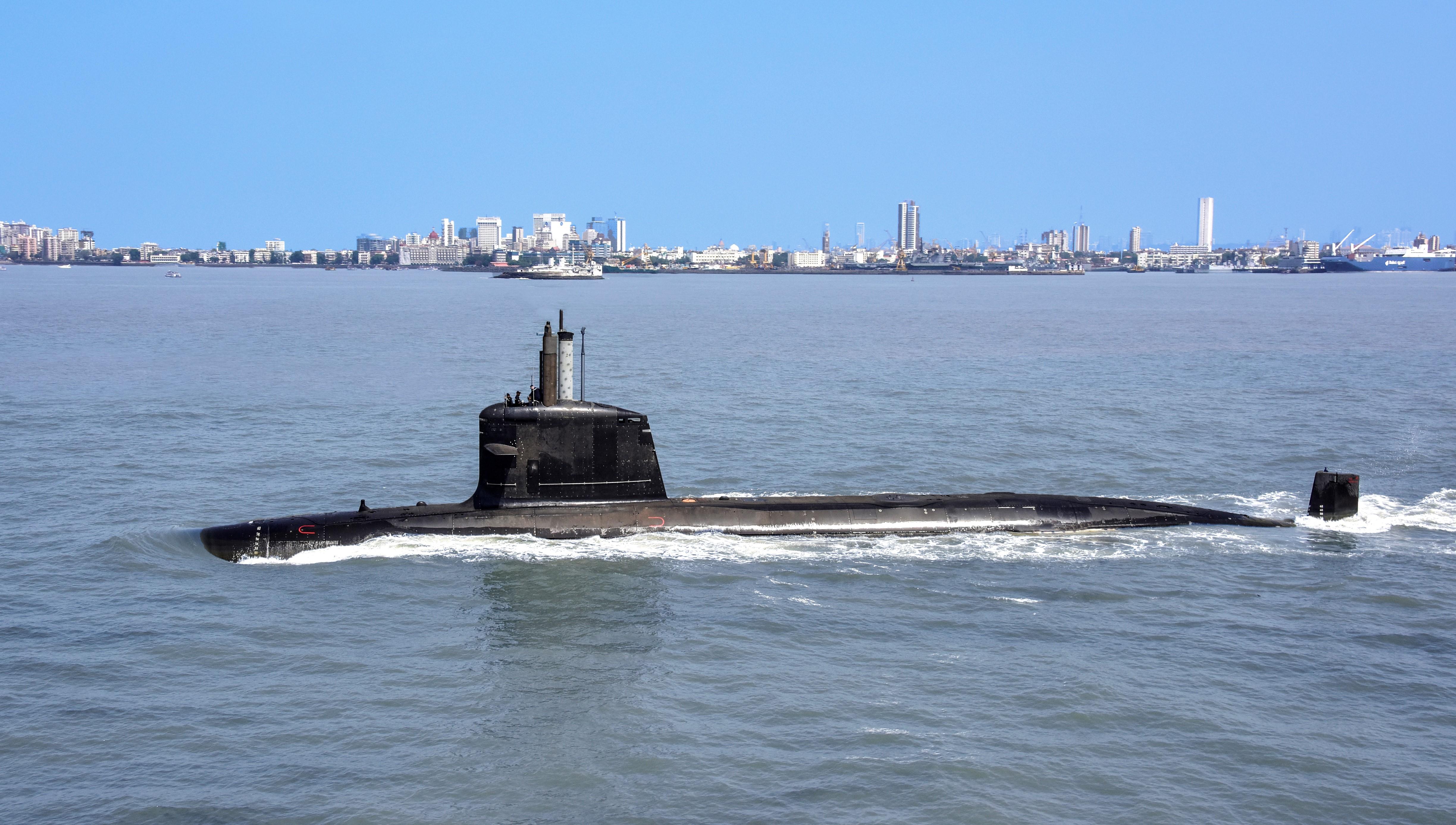
BUILDING CAPABILITIES INS Khanderi
But the carrier is never meant to operate alone. The carrier battle group or carrier strike group exists because a lone carrier would be too vulnerable. In a typical US Carrier Strike Group (CSG), the carrier sits at the centre of a protective constellation: US Navy’s combat management system Aegis-equipped destroyers and cruisers, ASW-focused escorts, one or more SSNs, logistics ships and an air wing packed with fighters, AEW&C and ASW helicopters. The carrier generates the sorties; the group keeps submarines, missiles, aircraft and drones at bay.
The SSN’s Role
By contrast, the SSN is a sea denial and undersea dominance platform. It is designed to remain hidden, stay on station for long periods, and strike at high-value targets when least expected. Its strengths lie in:
• Stealth and low detectability.
• High speed, long endurance and deep-water mobility.
• The ability to track and trail hostile forces covertly.
• The capability to launch torpedoes or missiles at ships and even land targets.
Because of this, submarines are uniquely suited to:
• Denying the enemy freedom of movement in key sea lanes and choke points.
• Imposing uncertainty on carrier groups and logistics routes.
• Providing covert reconnaissance and strike in support of broader campaigns.
• Protecting one’s own coasts, trade routes and high-value units indirectly.
The SSN is not a replacement for the carrier; it is a complement. It cannot generate the sustained air power of a carrier, nor provide the same kind of visible political presence. But it is often the most effective means of holding the carrier at risk, because it can exploit the physics of the undersea domain to stay beyond the reach of easy detection and retaliation.
The Ronald Reagan and Kitty Hawk warning: The relationship between carrier and submarine was driven home in a quiet way in 2005, when the Swedish Gotland-class submarine, the Halland, successfully ‘sank’ the US aircraft carrier USS Ronald Reagan during joint war games in the Pacific. Soon thereafter in 2006, a Chinese Song-class diesel-electric attack submarine reportedly tailed the USS Kitty Hawk carrier group in waters near Okinawa and then surfaced within roughly five miles of the carrier. The boat was said to have remained undetected until it chose to reveal itself, despite the presence of an American SSN and ASW helicopters assigned specifically to protect the carrier.
These incidents became a minor scandal in Washington, but its real value was doctrinal. It did not prove that carriers are obsolete, nor that submarines can casually sink them at will. Instead, it showed that even a sophisticated carrier group, with powerful ASW assets, can be penetrated by a quiet, well-handled diesel submarine, particularly in littoral and semi-enclosed waters. It also clearly demonstrated that to master undersea warfare, hydrology matters significantly.
These episodes became, in effect, a warning that the carrier’s survivability in the modern age is not a function of size or prestige but of:
• The quality of the ASW screen.
• The integration of underwater, airborne and surface sensors.
• The constant readiness of the group’s defensive layers.
From that perspective, the submarine is not the carrier’s rival; it is its primary challenger in the undersea domain. The carrier group must be designed to anticipate and counter that challenge.
The big and visible liability: The carrier is one of the most visible manifestations of the ‘big and visible is a liability’ rule. But it is far from the only one. The same logic now applies for all--at sea, on land and in the air.
In April 2022, the Russian Black Sea Fleet flagship Moskva, a large guided-missile cruiser, was reportedly sunk after being struck by two Ukrainian Neptune anti-ship cruise missiles. The resulting fires and explosions led to the loss of the ship, and her destruction had a disproportionate symbolic and operational impact on Russian naval prestige and presence in the Black Sea.
Recently, in March 2026, the Iranian frigate IRIS Dena was sunk in the Indian Ocean by a US Navy submarine, with heavy loss of life. Dena was not a carrier, but she was a visible flagship of Iran’s blue-water ambitions, and her loss reinforced the idea that large surface platforms operating within reach of a capable adversary can be erased quickly and decisively.
A year ago, Russian strategic bomber bases such as Engels-2, which host Tu-160 and Tu-95 long-range bombers, came under repeated long-range drone strikes, damaging infrastructure and reportedly losing the entire Russian strategic bomber fleet. This happened simultaneously in four different air bases on the same day using rather inexpensive drones. Ukrainian forces have also attacked fuel depots and logistics nodes that support these bases, causing large fires and disrupting operations.
The pattern is consistent:
• The bomber is a big, high-value, visible asset.
• The airfield and its fuel dumps are fixed, easily targetable nodes.
• A relatively cheap, long-range drone or missile can inflict a disproportionate effect.
Similarly, in the present ongoing conflict, every known parked Iranian aircraft is claimed to have been destroyed by US sources practically bringing the Iranian Air Force to its knees. The Iranians have retaliated by taking out a few US THAAD missile defence systems in the region (as claimed by them) with at least one confirmed destruction in Jordan. There are reports of several air refuelling tankers, and E-3 Sentry AWACS aircraft being damaged too (in Saudi Arabia). The Israelis and the US have targeted every known Iranian operations centre, artillery depot, tank deployment area, communication centre and other strategic/ tactical targets to illustrate the point that it is a universal thought that being big and visible is a liability.
The lesson is that the modern battlespace does not preserve sanctuary for large, high-value platforms simply because they are far from the front line or at sea. Geography alone is no guarantee of safety once the enemy can use long-range ISR, missiles and drones to reach into the adversary’s rear. It also does not mean that air forces around the world should not exist, nor does it mean navies should stop inducting larger vessels.
The Red Sea and the age of complex attacks: The Red Sea has become a live-fire laboratory for the kind of multi-vector, saturated attack that modern navies now expect. Iranian-backed Houthi forces have repeatedly used combinations of:
• Anti-ship cruise missiles.
• Ballistic and anti ship missiles.
• One-way attack drones (kamikaze UAVs).
• Artillery and rockets.
In one 2024 incident, US Navy ships and aircraft shot down 21 incoming missiles and drones aimed at a US warship, demonstrating the effectiveness of layered air and missile defence. But the same incident also highlighted the vulnerability of large, visible platforms.
A super-carrier in such a theatre would be the most attractive target of all. Its size, radar signature, infrared emissions and the constant movement of aircraft make it a prime cue for any missile or drone commander. The carrier’s survival in that environment would depend almost entirely on the rest of the carrier group: fighter CAP, AEW&C, Aegis-equipped destroyers, and inner-ring point defences. The carrier itself contributes mainly through its aviation; the hard work of surviving the salvo falls to the escorts.
 COMBINED OPERATIONS OF INS VIKRAMADITYA AND INS VIKRANT.jpg)
POWER PROJECTION Aircraft carriers INS Vikramaditya and Vikrant during an exercise
The Carrier’s Dilemma
The carrier, then, operates under a fundamental dilemma. It is:
• Politically invaluable, as a symbol of national power and a flexible tool for crisis response.
• Militarily valuable, as a source of sustained sea control and strike capability.
• Structurally vulnerable, because it is large, obvious and expensive to replace.
In high-intensity conflict, the political cost of losing a carrier is immense. That means national leaders may be reluctant to deploy carriers into contested waters, limiting their very utility as instruments of coercion. The carrier’s value is therefore self-limiting: the more powerful it is as a tool of power projection, the more sensitive its potential loss becomes.
The logical answer, as modern doctrine has shown, is to embed the carrier in a robust carrier battle group with strong ASW and air-missile-defence capabilities. The carrier does not replace the group; the group exists to make the carrier viable.
Submarine’s Natural Advantage
In contrast to the carrier’s visibility, the submarine’s natural advantage is stealth. The SSN, in particular, can:
• Remain undetected for long periods.
• Move rapidly to favourable firing positions.
• Attack with torpedoes or long-range anti-ship missiles from within the undersea environment.
This gives the submarine a powerful edge in a sea-denial strategy. A relatively small number of SSNs, properly positioned, can force a carrier group to operate cautiously, avoiding predictable routes and choke points. The submarine’s presence alone can shape the carrier’s behaviour, even if no contact is confirmed.
Moreover, the cost asymmetry is striking. A modern SSN is expensive, but far less so than a carrier and its air wing, let alone the associated logistics and escort ships. The submarine can therefore be a highly efficient instrument of attrition and deterrence, especially in blue-water and choke-point environments.
The Balanced Picture
The debate, then, should not be framed as ‘which platform wins?’ but as ‘which platform does what job?’ The carrier is the principal instrument for power projection and sea control; the SSN is the principal instrument for sea denial and undersea dominance. Neither can substitute for the other in any serious conflict.
For India, this balance is especially relevant. The Indian Navy’s carrier force, centred on Vikramaditya and Vikrant, is designed to provide sea-control and deterrence in the Indian Ocean. At the same time, India’s growing submarine fleet, including SSNs under development, will be key to protecting the carrier force, guarding the coast and deterring adversaries in the undersea domain.
The same logic applies to China. The PLAN’s carrier programme, centred on Liaoning, Shandong, Fujian and future hulls, is designed to project power into the Western Pacific and Indian Ocean. That programme is matched by a growing fleet of SSNs and SSKs, which are meant to hold US and allied carrier groups at risk and deny unrestricted access to key sea lanes.
In other words, the carrier and the SSN are not substitutes; they are the two poles of a mature naval force. The carrier brings the air wing and the political presence; the submarine brings the stealth and the undersea punch. The winning navy will be the one that can integrate both effectively, using the carrier for sea control and the submarine for sea denial.
The Indian Ocean
The Indian Ocean is a theatre where the carrier-SSN balance is particularly visible. It is a region of long sea lanes, choke points and overlapping maritime interests. Carriers can project presence and deterrence across a vast arc, from the Gulf of Aden to the Malacca Strait. But the same geography also offers excellent conditions for submarines, especially in the Arabian Sea, the Bay of Bengal, numerous choke points and the approaches to major ports.
For India, the carrier’s presence in the northern Arabian Sea during a crisis with Pakistan highlights the dual nature of the platform. The carrier can signal deterrence and hold Pakistani maritime assets at risk, but it must do so under the protection of a robust carrier group, including ASW-capable escorts, maritime patrol aircraft and helicopters. The carrier’s vulnerability in that environment is real, but so is its political and operational value.
China’s carrier interest in the Indian Ocean presents a similar picture. The PLAN’s carriers are designed to project power into the Indian Ocean, but they will have to contend with the same undersea and missile threats as any other carrier group. The Indian Navy’s SSNs and SSKs, along with land-based and airborne assets, will be key to holding those carriers at risk and preventing Beijing from freely dominating the region.
Conclusion
The right conclusion is not that carriers are obsolete, nor that submarines are magically superior. The right conclusion is that each platform has a distinct role, and modern naval power depends on keeping that distinction clear. The carrier is the instrument of power projection and sea control; the SSN is the instrument of sea denial and undersea dominance.
The Kitty Hawk episode, the sinking of Moskva and Dena, the attacks on Russian strategic bomber fleet in Engels, decimation of the Iranian Air Force, the Red Sea crisis and the broader missile-drone revolution all point to the same underlying reality: visible, high-value nodes are now more vulnerable than before. But that does not mean navies or other forces should abandon these platforms. It means they must protect them more intelligently and integrate them into a balanced force structure.
The future of naval warfare will be decided not by whether one platform ‘wins’ over the other, but by which navy can best combine the carrier’s reach with the submarine’s stealth. The carrier will remain the carrier, and the SSN will remain the SSN. The key is ensuring they are used together, not as rivals, but as complementary instruments of national power.
(The writer is a former captain of the Akula-class SSN INS Chakra, Commodore Commanding Submarines [West Coast], and Flag Officer Commanding Gujarat Naval Area)






 VIDEO
VIDEO