

Political Theatre
India is in the process of carrying out the biggest military reforms in terms of formation of Theatre Commands. The process gathered steam in December 2019 with the appointment of the first Chief of Defence Staff (CDS), General Bipin Rawat and the creation of the department of military affairs (DMA) under the ministry of defence (MoD).
The CDS is to be the permanent Chairman of the Chiefs of Staff Committee, head the DMA and be a single point military advisor to the defence minister. In a pathbreaking decision, the CDS was mandated by the Narendra Modi government to facilitate the restructuring of the existing 17 service specific military commands and the two Tri-Service Commands into five or six Integrated Theatre Commands (ITCs), for optimal utilisation of resources and bringing about jointness in operations.
It would be prudent to mention here that despite the Kargil Review Committee and the subsequently the Group of Ministers and the Naresh Chandra Committee recommending the appointment of a CDS, it took 20 years for the government to finally appoint a CDS. Now it expects a major military shake up like theaterisation to be completed in the next two to three years. This is intriguing indeed. It shows lack of forethought and foresight on the part of the political establishment. The CDS also seems to be in a tearing hurry to implement the political mandate of the government which is PMO driven. For a task of such gargantuan nature, given the complexity of the issues and challenges involved, undue haste to implement a well-intended reform can have disastrous consequences.
The concept of ITCs is the path which the Indian military will have to follow in the future to address the multiplicity and complexity of hybrid warfare. It is needed to ensure that the three Services function in a coordinated and mutually reinforcing manner, thereby enhancing their overall combat capabilities, and optimally utilising the infrastructure. The approach, unfortunately, has been totally faulty and lopsided. Logically, a major reform like this should have been government-driven and monitored, as happened in countries like the US. But in its wisdom the government decided to leave it to the military.
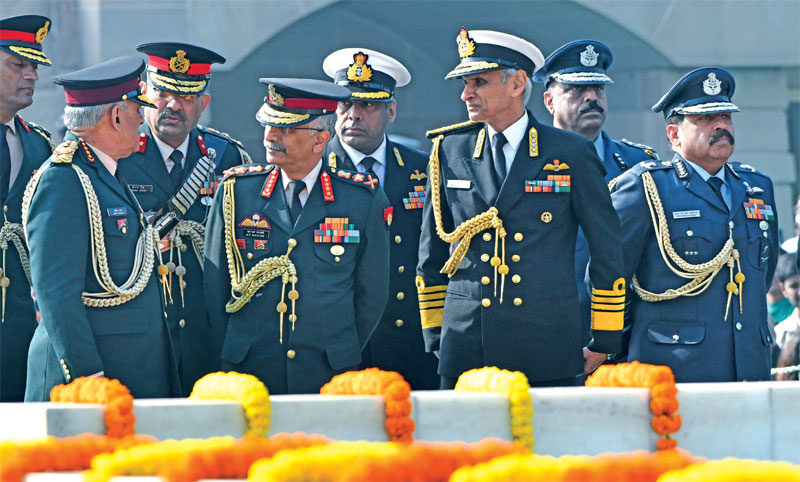
Chief of Defence Staff Gen. Bipin Rawat, Chief of Army Staff Gen. M.M Naravane, Chief of Naval Staff Admiral Karambir Singh,
and Air Chief Marshal Rakesh Kumar Singh Bhadauria during the Kargil Day ceremony
There is a need to critically analyse its total applicability in the Indian context. After all, India has a different security matrix and certainly cannot be compared to the American and the Chinese models. Aping them blindly will create more problems than solutions. Furthermore, this is certainly not the right time to push through such a major restructuring exercise when our northern neighbour is staring down at us across the LAC and is showing no signs of backing down in the near future. What’s more, the current instability in Afghanistan with the Taliban resurgence may encourage adventurism on the part of our western neighbour too.
Currently, the armed forces need to focus on these existing threats and not get embroiled in public spats and turf battles which were out in the open recently due to an immature statement by the CDS. At the ‘Global Counter Terrorism Council’ webinar, the CDS said that the IAF is a supporting arm of the army like the artillery and engineers. This ruffled the feathers within the IAF with the Chief of Air Staff giving a counter statement at the same event. The government obviously took a note of this and rightly appointed a committee with all stakeholders, including ministries of finance and home to iron out the differences. This does not bode well for the way forward on such a crucial reform.
Concept and Relevance
The concept of theatre commands is not new. The militaries of several countries already have it in some form or the other including the US, UK, France, and Russia, with China being the latest entrant. However, their theatre command concept is based on their global outlook and is part of their expeditionary character which certainly is not the case with India. The concept of theatre commands in essence implies centralisation of planning and execution of operations by allocation of resources under one commander. In other words, the concept aims to integrate the capabilities of the three services and optimally utilise their resources for future wars and operations.
Subscribe To Force
Fuel Fearless Journalism with Your Yearly Subscription
SUBSCRIBE NOW
We don’t tell you how to do your job…
But we put the environment in which you do your job in perspective, so that when you step out you do so with the complete picture.



 VIDEO
VIDEO