

PLAN Gets Deadlier
The Chinese hyphenate everything with ‘Chinese Characteristics’, the most prominent being President Xi Jinping’s ‘Socialism with Chinese Characteristics for a New Era’. This rings true with respect to the technologies used in the People’s Liberation Army Navy’s (PLAN’s) nuclear submarines which have incorporated ‘imitative innovation’ of technologies from the East and West.
China began its nuclear submarine programme in July 1958 when Mao Zedong and the Central Military Commission (CMC) authorised the 09 Project. Progress was slow in the early years due to severe lack of nuclear expertise and the political and economic chaos from Mao’s Great Leap Forward. After China successfully detonated its first atom bomb on 16 October 1964, the CMC revisited the nuclear submarine programme and authorised its restart in March 1965. The Chinese may have adopted Soviet technology gained from the experience of Type 033 (Romeo Class) which they were building under license. It is also believed that there was a strong French influence.
Since submarine nuclear technology was a closely guarded secret in the Soviet Union and the West, Chinese engineers had to rely on information on civilian nuclear-powered merchant ship designs. After much debate, the designers selected a loop-type pressurised water reactor, similar to that on Savannah (a US nuclear merchant ship) and Lenin (a Soviet ice breaker), which had a rating of 48 megawatts. With the reactor type formally approved in July 1965, China proceeded to simultaneously design and build both the land-based prototype and the first Type 091 submarine.
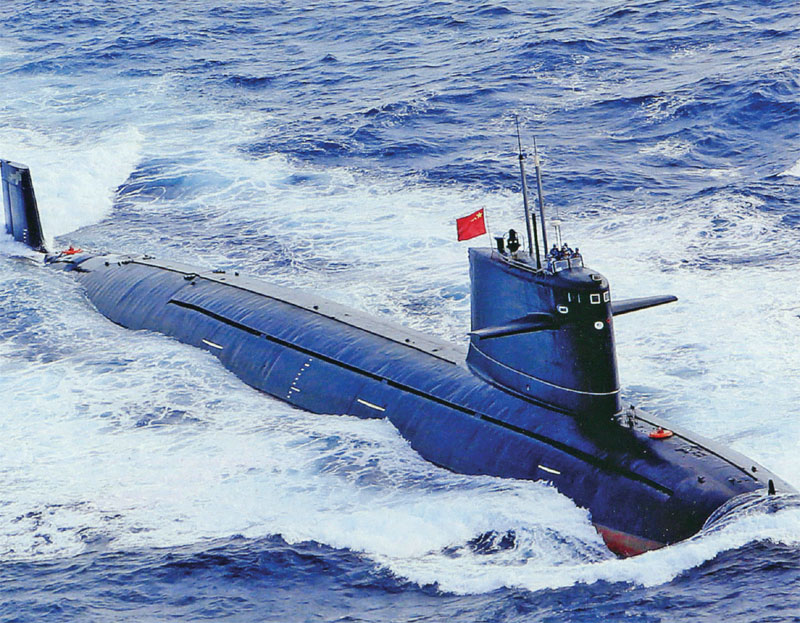
Type 093 Shang class SSN
The First Generation
Construction began on the lead SSN (Type 091, Han) in November 1968, and the submarine was launched two years later and commissioned in August 1974, followed by a second boat in 1980. These boats had severe problems with the reactor systems and the crew was exposed to high radiation levels. Hence, the length of the next version was extended by eight metres to provide additional room for crew habitability and badly needed improvements to nuclear safety.
Parallelly, the power of the reactor was enhanced to 58 megawatts, allowing them to achieve a speed of 25 knots as against 22 knots previously. Due to ongoing reliability issues, the first deep dive to 300 metres was made by the Hull 404 (the fourth Type 91) only in April 1988, 14 years after the commissioning of the first boat. Classified as loud by Western sources, a total of five boats were made.
The SSBN Type 092 (Xia) was laid down in September 1971, but the boat was launched only in 1981 and commissioned in 1983. This boat may have been similar to 091, with an increase of the beam to 11m and the addition of a missile section. The first successful launch of SLBM was conducted only in 1989. Due to its heavier displacement, it could achieve only 22 knots. It was also classified as loud by Western sources. Only one boat was made, and she was hardly deployed.
The Second Generation
From the experience of the first generation submarines, three key areas were identified for improvement. These were: reliable propulsion plants, higher speeds and lower radiated noise levels.
Type 093 (Shang Class SSN): The first two units of Type 093 (Shang Class) were launched in 2002 and 2003 and were commissioned in December 2006 and March 2007 respectively, after a gap of nearly 15 years since the last of the 091s. The reason was that nuclear-powered submarines were not a priority for Deng Xiaoping and the programme was revived after Jiang Zemin became the General Secretary of the Chinese Communist Party in 1994. The first two boats of 093 class were more capable than the improved 091, but could not meet the desired speed and quieting levels. The next set of four boats was commissioned between 2015-2018 after a long delay. The China Maritime Studies Institute (CMSI) China Maritime Report No. 30 says that this delay could be due to the improvements made to the first two boats of this class. There is also a belief that the 093 was influenced by the Russian Victor Class SSN. These boats were powered by two 75 megawatt reactors and could achieve a top speed of 30 knots.
Subscribe To Force
Fuel Fearless Journalism with Your Yearly Subscription
SUBSCRIBE NOW
We don’t tell you how to do your job…
But we put the environment in which you do your job in perspective, so that when you step out you do so with the complete picture.





 VIDEO
VIDEO