Despite being in a state of economic meltdown for the past three years, Pakistan continues to rely on full-scale imports of new-generation weapon systems and their components, with Turkey now joining the list of suppliers that had earlier included China and South Africa. This trend was evidenced by the range of exhibits displayed at IDEF ’23, the 16th International Defence Industry Fair held between July 25 and 28 at Istanbul, where Pakistan’s state-owned Global Industrial & Defence Solutions (GIDS) exhibited several of its new products.
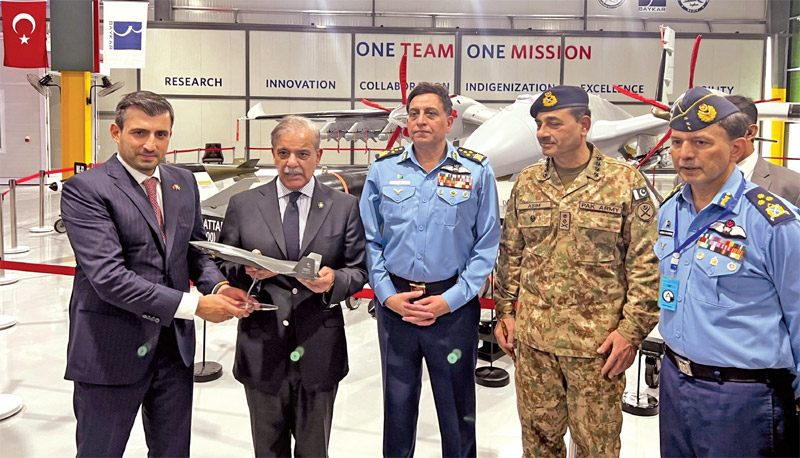
Bayraktar Baykar Bayraktar Akinci’s official handover to the PAF last June
In October 2018, the state-owned Aviation Industry Corporation of China (AVIC) and the Kamra-based Pakistan Aeronautical Complex (PAC) had agreed to co-produce 48 CAIG CH-4B Wing Loong-II medium-altitude long-endurance unnamed aerial vehicles (MALE-UAV) for both the Pakistan army and the Pakistan Air Force (PAF). The PAF had by then been operating four fully-imported CH-4A Wing Loong-Is (an earlier variant). The first confirmed sighting of this in Pakistan occurred in 2016, when a CH-4A crashed in the vicinity of Mianwali air base.
The Pakistan army’s aviation corps had then opted to procure the CH-4B variant from the China Aerospace Science & Technology Corp (CASC), with the first batch of five CH-4Bs arriving in Pakistan in early 2021. Later the same year, both the army and the PAF decided to forego the procurement of additional CH-4Bs in favour of procuring from Turkey the Bayraktar Akinci MALE-UAVs, the first of which were delivered to Islamabad on March 8 this year by a PAF Ilyushin IL-78MP transport aircraft with tail number R11-003, which took off from Tekirdağ Çorlu Atatürk Airport, where Baykar Defence’s test and production facilities are located.
Along with the Akinci MALE-UAVs, Baykar will supply its 20 km-range Kemankes loitering munition that comes powered by a turbojet engine developed by Kale Arge. Since 2011 this company has developed three types of turbojets. The KTJ-1750 has a four-stage axial compressor design capable of producing 1,750 Newtons of thrust at sea level and operating at speeds of up to Mach 0.95. The KTJ-1750 has a diameter of 202mm, weighs 25kg, has a specific fuel consumption value of 0.12KG/H/N and a thrust/ weight ratio of 1:11, and a length of 464mm. The KTJ-3200 turbojet, comprising a four-stage axial compressor, annular combustion chamber and a single-stage turbine, with a thrust power of 3,200 Newtons, is 63cm in length, approximately 30cm in diameter, and weighs 50kg. The compressor stages of the ITAR-free engine are made of aluminium and the combustion chamber and the turbine is made of Nickel-based superalloys. Since the compressor uses monolithic (one-piece) rotors, the engine has low fuel consumption and high thermal efficiency.








 VIDEO
VIDEO