

Oriental Novelties
The 12th China International Aviation & Aerospace Expo (held biennially at Zhuhai in southern Guangdong) that kicked off on November 6 and closed on the 11th, played host to a wide variety of guided weapons employed for asymmetric warfare, as well as new-generation mission avionics for air combat aircraft platforms, plus the ever-growing types of homegrown unmanned aerial systems (UAS).
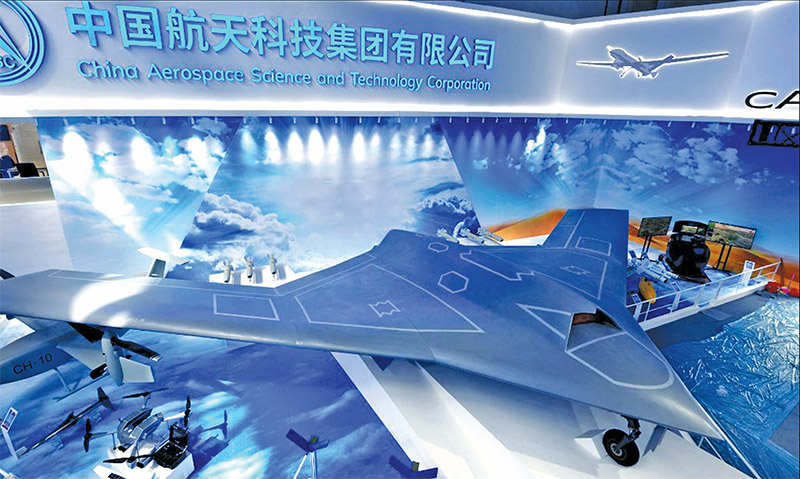
CaiHong-7 UAS on display at the expo
However, the expo this time will be remembered for the J-20 emerging in full-blow, since the People’s Liberation Army Air Force (PLAAF) was authorised to ‘de-classify’ this multi-role combat aircraft (referred by China as a fourth-generation homegrown platform) for both flying displays in fully armed configuration as well as a full-scale indoor exhibit mock-up. Four J-20s came to deliver flying demonstrations for four days on the 6th, 9th, 10th and the 11th (a fifth J-20 was on standby at the dual-use airport in Foshan in the Pearl River Delta), with the last day also being the PLAAF’s 69th anniversary. Lt Gen. Xu Anxiang, the PLAAF’s deputy commander, revealed on that day that the demonstrations were indicative of the J-20s having attained Initial Operational Capability (IOC).
Combat Aircraft
Leading the presentation on the J-20 was Yang Wei, Chinese Academy of Sciences academician and chief designer-cum-engineer of the J-20 (under Project 718), who was backed up by Chief test Pilot Li Gang, the winner of the PLAAF’s ‘Golden Medal of the Meritorious Flying Personnel Medal of Honour’. At 15 years, Yang became the youngest student majoring in aerodynamics at the Northwestern Polytechnical University at Xi’an, in northwest China’s Shaanxi Province.
In 1985, Yang graduated with a master’s degree and joined the Chengdu Aircraft Design Institute (CADI), which is owned by the Chengdu Aircraft Industry Group (CAIG) in Chengdu, Sichuan Province. For the next 30 years, he participated in and led the design of a series of homegrown combat aircraft including the J-10 and FC-1/JF-17. Yang’s first task after joining the CADI was to participate in and later lead the development of digital fly-by-wire flight controls. He also implemented all-digital simulation tests for combat aircraft. In 1998, 35-year-old Yang was given the task by Song Wencong, then the chief designer of the J-10, to fix the J-20’s design problems, optimise its design and complete its certification of airworthiness. Two years later, at 37, Yang became the youngest chief aircraft designer in China for both the J-20 and the FC-1/JF-17 light multi-role combat aircraft (L-MRCA).
Li Gang revealed that at least five rounds of review and selection took place of the J-20’s design optimisation. From the plan on paper to the wooden model, then to the metal model, the participating engineers and test pilots worked on the slightest details, especially in the arena of cockpit ergonomics. The end-result was a cockpit with one principal frontal panoramic active-matrix liquid-crystal display (AMLCD), two side-mounted AMLCDs, and two sidebar-mounted controls — a first in China — one for throttle and the other being the control-stick.
This, according to Li Gang, offers three advantages: the pilot’s hemispherical field-of-view is clearer for optimising the effectiveness of the helmet-mounted display system, the aircraft’s agility increases, and it is more conducive to pulling higher G-forces. All in all, the designers and the engineers chose a complex aerodynamic configuration to reconcile the low observability, agility and controllability of the J-20. The frozen configuration thus made the J-20 into an air superiority platform (much like the MiG-31) when armed with four PL-15 beyond visual range air-to-air missiles and four PL-10E short-range air combat missiles, with its mass empty weight being 17 tonnes, normal take-off weight being 25 tonnes, with the maximum being close to 30 tonnes. Maximum speed is Mach 2.5, cruising altitude is 20km, unrefuelled combat radius is 1,100km, and the unrefuelled ferry range is 5,500km.
The J-20’s airframe is dotted with areas where antennae are embedded below the skin, as well as where other stealthy composite structures are used to minimise the aircraft’s radar cross-section. The airframe features large divertless supersonic inlets, including various porous panels that also help separate turbulent boundary layer air from its skin — a process required to feed its engines with stable airflow throughout its flight envelope. The giant manoeuvring canard foreplanes help to give the J-20 its agility, although they are unlikely to move much when the aircraft is in combat cruise configuration where minimising its frontal radar signature (through reduced canard deflections) is critical to its survival. They also work as big air-brakes during rollout after touching down.
On the J-20’s faceted nose, apertures exist for a missile approach warning system while on the chin there’s a faceted infra-red search-and-track sensor called EOTS-86 is mounted. An actuated aerial refuelling receptacle on the right side of the fuselage is hidden under the skin of the aircraft, which otherwise features seamless joining of structures, saw-toothed access hatches and operating doors, edge-aligned apertures, and overall smooth surfaces. The J-20’s 170km-range, liquid-cooled active phased-array multi-mode radar (AESA-MMR), still under process, was developed by the China Electronics Technology Corp’s (CETC) Nanjing Research Institute of Electronics Technology (NRIET), also known as No 14 Institute. The main octagonal array covers 120 degrees and is positioned in a slanted plane, with supporting side-planes on each side. Together, they offer 300-degree airspace volume coverage, with only the rear 60-degree hemisphere remaining blind.
Subscribe To Force
Fuel Fearless Journalism with Your Yearly Subscription
SUBSCRIBE NOW
We don’t tell you how to do your job…
But we put the environment in which you do your job in perspective, so that when you step out you do so with the complete picture.




 VIDEO
VIDEO