

On Her Feet
The year 2021 started with positive signalling towards ‘Atmanirbhar’ Bharat. In the second week of January, the Cabinet Committee on Security (CCS) cleared the purchase of 83 Light Combat Aircraft (LCA) Mk1A, including 10 trainers, to be built by Hindustan Aeronautics Ltd (HAL) at a cost ranging between Rs 38,000 to Rs 47,000 crore (depending upon which media report you refer to). An improvement on Mk 1, the ‘A’ of the new fighter would incorporate such enhancements as Electronic Warfare System, Advanced Electronically Scanned Array (AESA) radar, beyond visual range (BVR) missiles and software defined radio.
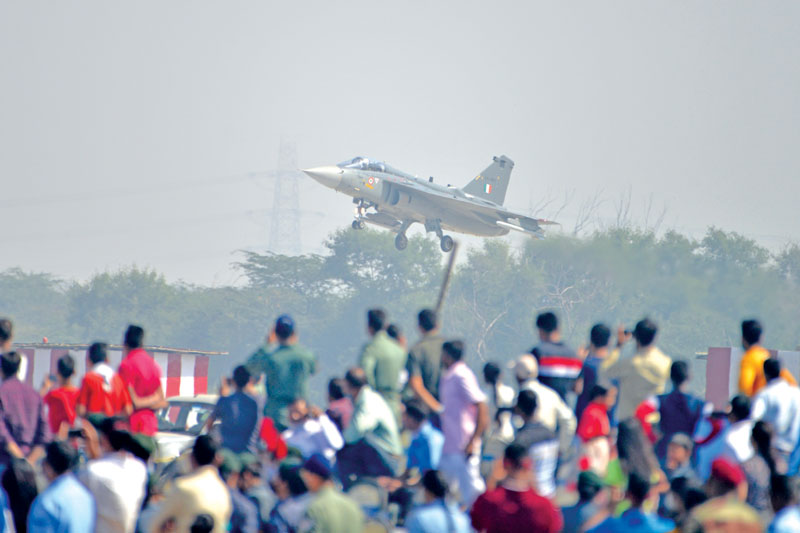
In a ministry of defence (MoD) press release, the defence minister insisted that while LCA-Mk1A has 50 per cent indigenous content, over time it will be increased to 60 per cent. The first of these aircraft will roll out by 2023-24. To ensure that there are no slippages on the timelines, HAL is likely to set up a third line of production. Incidentally, it is also executing the orders for 40 LCA-Mk1, which were ordered by the Indian Air Force (IAF) in the batches on 20 each of Initial Operational Clearance (IOC) and Final Operational Clearance (FOC). While 16 of the former have been delivered so far (and operate from Air Force Station Sulur in Tamil Nadu), the delivery of the latter is to commence soon.
In an interview to a news agency, the day after the CCS decision, chief of air staff, Air Chief Marshal RKS Bhadauria said, “Order of 83 aircraft is huge. When this kind of order takes shape in the next eight-nine years, the entire ecosystem will get set up. For military aviation, it will be a big step. It will make a big base for fighter aircraft production, maintenance and support.” He added, “It is a huge step for IAF capability building. It is also a big boost to our indigenous industry. It is also a big recognition of our designers. It is a huge step for Indian Air Force (IAF) and for the country.”
Even though the current LCAs held by the IAF are deployed away from the front, perhaps they are being put through their paces, the CAS told his interviewee that eventually the LCA fighters (the recent approval of 83 will take the total number in service to 123), which will give the stand-off weapons capability to the IAF, will be deployed on the frontline.
No one can argue with CAS’ contention that the order of 83 fighters, expected to be placed during Aero India 2021, is huge. He is also correct in saying that it will create an entire ecosystem for military aviation in India. If things go according to the plan, then this ecosystem will become the springboard for future fighters, including the 5th generation. Hopefully, that will not take as long as the LCA did.
However, two questions remained unasked. One, does the LCA fighter programme really usher in atmanirbharta or self-reliance? And two, between self-reliance (actually self-sufficiency is more accurate, but that’s immaterial) and operational preparedness, what is the critical military requirement? An ancillary question that would fit in between the above two is, should self-reliance in hardware even be a desirable goal, given the development cost and fast obsolescence of technology? More on that later.
But first thing first. Why did the government of India switch from the pragmatic ‘Make in India’ to anachronistic ‘atmanirbhar Bharat’ which has the echoes of ‘swadeshi’ that Gandhi called for during the struggle for freedom from the British?
In a single word, the answer is China. Even before the crisis broke out on the erstwhile Line of Actual Control (LAC) in late April 2020, the industrial capacity of China had been exercising the popular nationalist sentiment. This is the reason from time to time the government, led by the Prime Minister himself, used to urge the citizenry to shun Chinese goods in favour of Indian wares. This appeal used to be more fervent before the festive season started August onwards and China-made home décor items (mostly low-tech, small value items) used to flood the Indian markets.
With Covid-19 impacting global trade, the slogan of self-reliance sought to inject the right amount of nationalistic sentiment among people forced into isolation by the pandemic. And then China sauntered into the Indian territory, forcing even greater reliance on nationalism. For want of popular options, ‘atmanirbharta’ or self-reliance was made to shoo-off ‘Make in India’ even in defence.
Prime Minister Modi was conscious of the limitations the term imposed. Hence, appearing in a webinar organised by Federation of Indian Chambers of Commerce & Industry (FICCI), titled, ‘Atmanirbhar Bharat—Defence Industry Outreach’ on 27 August 2020, Modi explained that his vision of ‘Atmanirbhar’ Bharat did not envisage an inward-looking or isolationist India as the phrase suggested. Instead, it aimed “…To make the global economy more stable, for global peace, and making India a self-reliant country.” This was the most amazing interpretation of the term self-reliance. How India making its own weapons would stabilise global economy or usher in global peace remained unexplained.
Subscribe To Force
Fuel Fearless Journalism with Your Yearly Subscription
SUBSCRIBE NOW
We don’t tell you how to do your job…
But we put the environment in which you do your job in perspective, so that when you step out you do so with the complete picture.






 VIDEO
VIDEO