Contrary to the present-day widespread belief that China’s People’s Liberation Army (PLA) has since 2017 been expanding its ground-based combat-support infrastructure in both the Xinjiang Uygur Autonomous Region (XUAR) and Tibet Autonomous Region (TAR), in reality such efforts have been underway in a sustained manner since 2002 itself, and which began acquiring greater momentum since 2010.
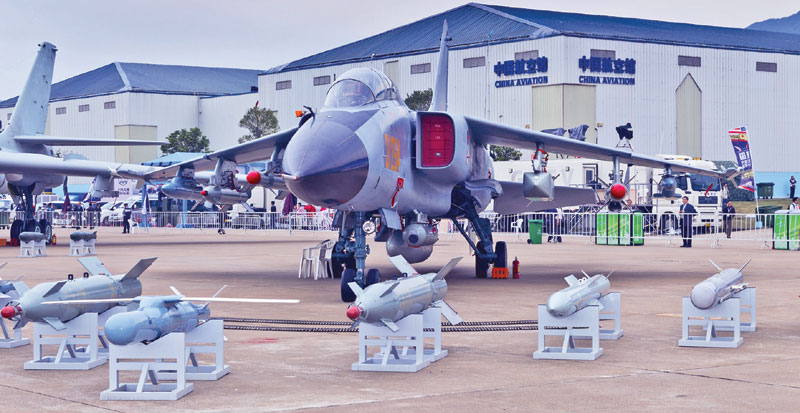
PLAAF JH-7A bomber armed with standoff PGMs
In particular, both the PLA Ground Forces (PLAGF) and the PLA Air Force (PLAAF) have been singularly focussed on the acquisition of airpower-related capabilities and capacities, which had been highlighted by this author in the past (FORCE November 2016 issue, pages 17-21; September 2017 issue, pages 8-11; and September 2019 issue, pages 30-33).
Since the early part of the previous decade, the PLAGF and PLAAF have built six major dual-use logistics support nodes at Linzhi, Ngari, Qiama, Rutog, Seni Nagqu and Yaophu, all of them within TAR and which host storage facilities for both ammunition stockpiles and petroleum, oil and lubricants (POL) required by the Tibet Military District (TMD). Within the XUAR, similar facilities were built at Urumqi and Kasghar, with their supporting forward administrative bases being built at Moldo Spanggur Tso, Tianshuihai and Demchok to the east of Ladakh.
Now an underground, hardened ammunition storage facility at Tianshuihai is being built, which will resemble the South Xinjiang Military District’s ammunition storage facility at Urumqi. Also, in the previous decade dedicated combined-arms training bases and field-firing ranges were constructed; ones located at Lhari to the south of the Nyenchen Tanglha mountain range north of Arunachal Pradesh serving TAR while the Saitulla training base in Pishan County by the north bank of the Karakash River and the firing range at the base of the Tangulla mountain range (at an altitude of 5,000 metres/16,404 feet) within the Nagqu Prefecture in central TAR catering to the formations coming under the command of the South Xinjiang Military District.
New Dual-Use Airports and Heliports
It was in 2018 that Beijing began building what is perhaps TAR’s first dedicated air base (with a 3km-long runway) at the site of the old Damxung Airport in the Damxung County of Lhasa. Built in 1955, the Damxung Airport was the world’s highest airport at that time. In addition, work has begun on constructing the Lhunze Airport in Lhoka (Shannan Prefecture) at an altitude of 3,700m/12,139ft), north of the Upper Subansiri and Tawang districts of Arunachal Pradesh. Another airport is coming up at Purang (4,755m/ 13,205 ft) near the trijunction of Nepal-Tibet-India, north of India’s Pithoragarh district of Uttarakhand state.
And yet another airport (4,480m/14,700ft) is being built between the Tingri and Lhatse counties, north of Zangmu, the border post with Nepal. Back in the latter half of 2017, the PLAAF began expanding its permanent presence at the existing dual-use Lhasa-Gonggar Airport (3,570m/ 11,713 ft), Ngari Gunsa Airport 4,274m/ 14,022ft) and Shigatse Airport (3,782m/12,408 ft) by constructing new aprons, tarmacs and parking bays for Mi-171E and Z-8G medium-lift utility helicopters, ZW-10 attack helicopters, CH-5 and EA-03 medium-altitude long-endurance unmanned aerial vehicles (MALE-UAV) and KJ-500 airborne early warning and control platforms.








 VIDEO
VIDEO