

New Frontier
‘The deep sea contains earthly treasures that aren’t remotely understood or developed, but if we want to obtain these treasures, then we must master key technologies for entering the deep sea, surveying the deep sea, and developing the deep sea’
Chinese President Xi Jinping
During the Cold War, space and undersea warfare were the two most contested areas between the United States (US) and Soviet Union. Militarisation of space started in the Sixties with the placement of military communication satellites and was at its peak in the Eighties with the Star Wars program, but gradually declined after the end of the Cold War, only to resurge thanks to miniaturisation of satellites and low cost of space based assets. Today all major countries have extended their frontiers from immediate air space to outer space.
The ‘militarisation of the deep sea’ is however a recent addition to the lexicon. Advancements in modern technologies have exponentially increased the density of undersea pipelines, optical fibres and power cables crisscrossing the oceans. Also, deep sea surveillance which was constrained by the opacity of the medium has now become more translucent if not transparent.
The term militarisation of the deep sea involves efforts to increase one’s footprint over underwater assets ocean-wide and undertake operations to target an enemy’s infrastructure while guarding one’s own. This piece will examine the policy, strategy and resources employed by nations to strengthen this vital domain. China figures foremost because of the massive strides it has made and also the fact that there is a lot of literature in the open media about them. This piece will however not cover developments and capabilities related to naval weapons and sensors, though it is intrinsic to the subject.
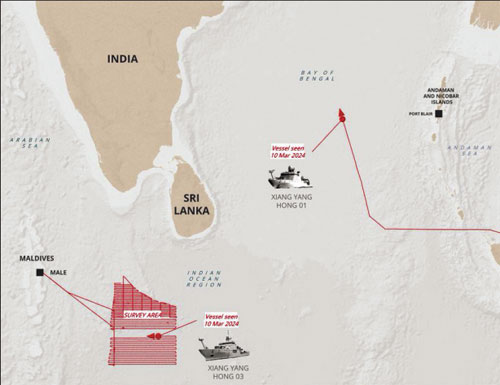
Figure 1- Screengrab of Xiang Yang Hong 01 and 03 on 10 March
United Nation Convention on Laws of the Seas
The United Nation Convention on Laws of the Seas UNCLOS defines the Exclusive Economic Zone (EEZ) as an area of 200 nautical miles from the coastline which can be exclusively used by the coastal state. This led to a mad scramble by China and to a lesser degree, other South China Sea littorals, to plant their flag on uninhabited islands and rocky outcrops, with a view to claim the EEZ around these features. The seas beyond EEZ or the national continental shelf of a state is called the ‘the Area’ which is the ‘common heritage of mankind’. In the ‘Area’ all states are free to conduct activities such as laying submarine cables and pipelines, constructing artificial islands and other installations, fishing and scientific research subject to certain conditions.
China’s Maritime Lebensraum
China is expanding her footprint in the ‘Area’ with the constant and nagging presence of her Oceanographic ships and fishing fleet and by expanding her underwater surveillance network. Chinese activities today mirror that of the treasure expeditions by Admiral Zheng He during the period 1405-1433 which went as far as Persian Gulf, Red Sea and east coast of Africa. These expeditions were directed towards advertising the rising military and economic power of the Ming Dynasty with a view to overawe, coerce or compel these states.
Today, China has extensive and broad maritime rights and interests in the polar regions, deep-sea areas and other ocean areas. Chinese policymakers believe that maintaining a claim to these rights requires research activities to assert them.
Whole of Government Approach: China has a very strong Civil Military Interaction (CMI) framework driven by the Chinese Communist Party (CCP). The State Oceanic Administration, now called the Ministry of Natural Resources (MNR) works closely with Chinese Academy of Science (CAS) and the Qingdao National Lab and the People’s Liberation Army (PLA) Navy to build an integrated network of fixed and mobile sensors in the South China Sea, Western Pacific and Indian Ocean.
Subscribe To Force
Fuel Fearless Journalism with Your Yearly Subscription
SUBSCRIBE NOW
We don’t tell you how to do your job…
But we put the environment in which you do your job in perspective, so that when you step out you do so with the complete picture.



 VIDEO
VIDEO