

New Branch, New Challenges
Air Cmde A.K. Sachdev (retd)
The Air Force Day parade this year took place at Chandigarh, the first time it was held outside Delhi, and marched to the theme of the ‘IAF: Transforming for the Future.’ In his address at the parade, the Chief of Air Staff (CAS), Air Chief Marshal V.R. Chaudhari touched upon various strands running through this theme.
These included the Agniveer induction, the inclusion of space and cyber wars to the traditional land, sea and air domains of warfare, the emergence of hybrid warfare, the need for modern, flexible and adaptive technologies for the IAF, jointness among the three services, Aatmanirbhar/ Make in India campaigns and the criticality of sustaining and enhancing the fighting potential of the IAF.
As a step towards recalibrating the IAF and transforming it to prepare for future conflicts, he announced the government’s approval of a new branch of officers in the IAF called the Weapon Systems (WS) Branch, reiterating the fact that this was the first time since India gained independence that a new operational branch was being created.
So, what are the salient features of the new branch and their allied future repercussions?
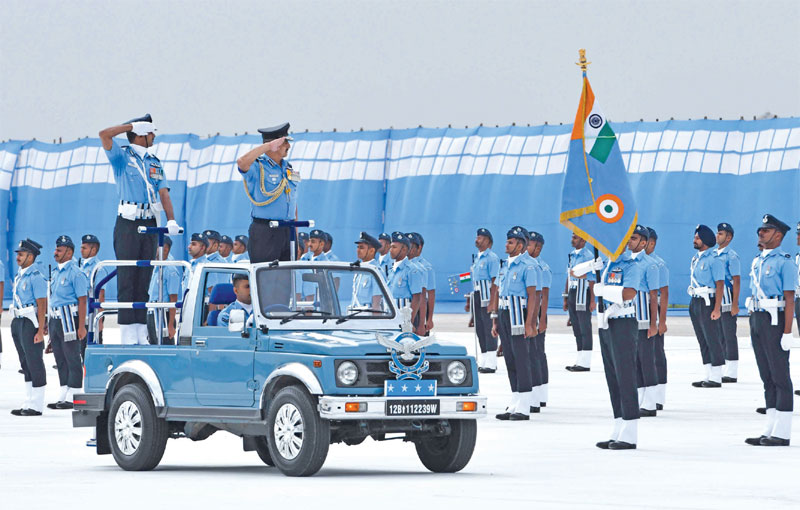
CAS Chaudhari during IAF Day parade
Framework So Far
The IAF was officially established on 8 October 1932, with its first flying unit being formed on 1 April 1933, with six officers who had trained with the IAF to be pilots and 19 Havai sepoys who were airmen. The officers were all said to belong to the General Duties (Pilot) branch and indeed, to become an officer in the IAF, one had to be a pilot. All other tasks to support the flying effort were undertaken by airmen. As India was still not independent, the Royal Air Force (RAF) officers controlled all headquarters and stations.
During the build-up to World War II in 1939 the Chatfield Committee proposed the re-equipment of RAF squadrons based in India and authorised an IAF Voluntary Reserve into which officers were commissioned in the General Duties (Observers) and General Duties (Air Gunners) branches too. Aspiring pilots who failed to make it to the flying sub-branches were assigned to equipment branch or the Administration & Special Duties (A&SD) branch. During the first years of the World War, new branches were progressively set up: Education, Accounts, Meteorology, Balloon, Signals, Armament, Radar, Electrical and Engineering.
Despite having ageing aircraft (in contrast to the RAF) the IAF performed exceedingly well and was bestowed with the prefix ‘Royal’ in 1945. After the war, the need for balloons diminished considerably and the Balloon branch was removed. Soon, observers were not needed and that sub-branch was discontinued with the General Duties (Navigator) branch being introduced in 1946. The Radar branch was removed in 1947.
Just before the 1971 war, the IAF’s 14 branches were reorganised into nine (on September 1) with a new nomenclature: Flying (Pilot)/Flying (Navigator) (i.e., F(P)/ F(N)), Administration (ADM), Logistics, Aeronautical Engineering (Mechanical), Aeronautical Engineering (Electronics), Meteorological, Education, Accounts and Medical. This was the dispensation at the time of the announcement of the new WS branch.
Weapon Systems Branch
At almost the same time as the chief of air staff was announcing the formation of a new branch, the ministry of defence (MoD) issued a short press release stating the government had approved the creation of a new Weapon System branch to entail unification of all weapon systems operators under one branch dedicated to the operational deployment of all ground-based and specialist airborne weapon systems encompassing four specialised streams: Surface-to-Surface Missiles (SSMs), Surface-to-Air Missiles (SAMs), Remotely Piloted Aircraft (RPA) and Weapons System Operators (WSOs) in twin/multi-crew aircraft.
Subscribe To Force
Fuel Fearless Journalism with Your Yearly Subscription
SUBSCRIBE NOW
We don’t tell you how to do your job…
But we put the environment in which you do your job in perspective, so that when you step out you do so with the complete picture.






 VIDEO
VIDEO