

Money Over Matter | The Challenge of Sinking Shafts
Pokhran II took place in May 1998 under Operation Shakti. A total of five tests with weapon-grade plutonium were conducted — three on May 11 and two on May 13. The tests included a 45 kt fusion bomb (also called hydrogen or thermonuclear bomb), a 15 kt fission bomb (atomic bomb) and three experimental sub-atomic devices of 0.5, 0.3 and 0.2 kt respectively.
Dr K. Santhanam of the Defence Research and Development Organisation (DRDO) was the director for the test site preparations. In an interview to Times Now television channel in April 2008, he revealed that India had dug two deep shafts at Pokhran in 1981-82. The fission and fusion bombs were placed in these shafts. For sub-atomic tests, use was made of three abandoned dry wells in the near vicinity. These wells had earlier been dug by the villagers and deserted as no water had been struck.
The Indira Gandhi government had decided to carry out tests in 1982-83 and the army was asked to sink the shafts. 113 Engineer Regiment completed the task ahead of schedule, but the tests were shelved due to external pressures. More than a decade later, Prime Minister P.V. Narasimha Rao asked the scientists to go ahead with the tests in 1994-95. Unfortunately, the US satellites detected the preparations. Once again, India was forced to abort the tests.
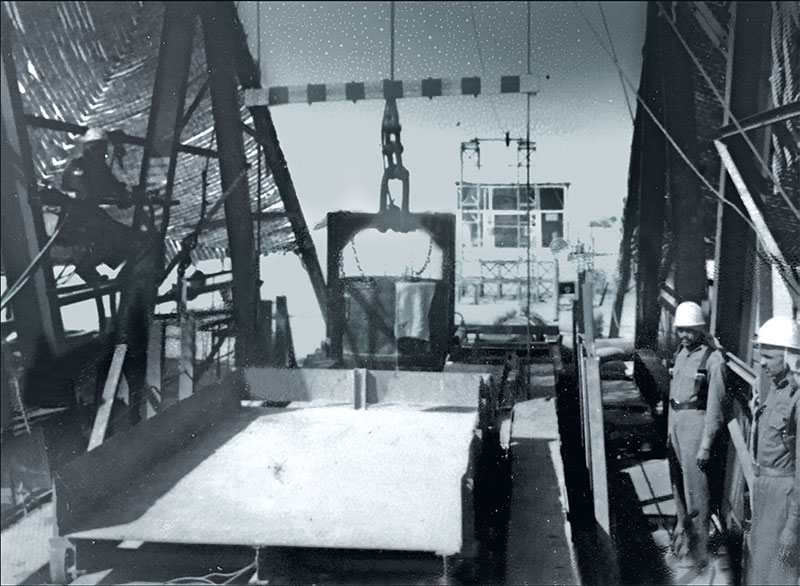
Hoisting bucket with winder assembly in the background at the shaft site; ©Photo Courtesy NIKITA DHINGRA
A word about shaft sinking will be in order here. To approach underground mineral seams, a vertical opening (shaft) is provided from the surface to the mining zone. These shafts are used to carry men, material and equipment to the mining zone; as also, to haul the extracted ore to the surface. Being the lifelines of all underground mines, shafts are sunk with exacting technical specifications. All mining manuals term shaft sinking to be the most dangerous and hazardous assignment of all mining operations. It is considered to be the most unforgiving task where even a minor slip-up results in casualties.
Essentially, a shaft contains a head-frame (tower) to house the hoist; a shaft collar of reinforced concrete to provide foundation support to the head frame and to accommodate mechanism for men, materials and services to enter and exit the shaft; and shaft barrel that continues from the collar to the planned depth. The shaft also houses exhaust ducts (for extracting stale air at working face), pipes for compressed air for the operation of pneumatic tools, dewatering pipes and circuits for 24-volt electrical fittings. It requires domain expertise and specialised equipment. There are a handful of shaft sinking companies in the world, normally called ‘sinkers’. All mining companies outsource shaft sinking operations to them.
113 Engineer Regiment, located at Jodhpur, was asked to undertake this onerous task. The regiment was under the command of the late Lt Col K.C. Dhingra (later rose to the rank of Major General). Col Dhingra was an extremely intelligent officer with a phenomenal memory and exceptional capacity for sustained hard work. The regiment was acutely aware of the criticality of the task and the trust that had been reposed in its capability to deliver. It was determined not to let the nation down. I was a Major in the regiment and had the privilege of being involved from the beginning to the culmination of the task.
It was an unprecedented assignment. To sink a shaft hundreds of feet deep with no experience and no equipment was a huge challenge — more so as none of the officers had ever visited a mine or seen a shaft; nor had anyone studied mining engineering which is a specialised course. Although site preparations for Pokhran-I were also carried out by the army engineers, the task was of an entirely different genre and did not entail sinking of subterranean shafts ab initio. Pokhran-I was conducted at a much shallower depth, using an abandoned dry well.
Site Selection
It was the month of January 1981. After an exercise in the desert, Col Dhingra asked me to accompany him for an operational reconnaissance. While driving to the Pokhran ranges he told me that the regiment had been tasked to sink a deep shaft of more than 500 feet. Repeatedly stressing the need for secrecy of the mission, he gave out other broad parameters. With maps in our hands, we traversed the ranges many times over the next two days to get a feel of its extent and zeroed in on to a nine square km area that satisfied our security and secrecy concerns. It was well away from the highways and the villages. The aim was to identify a location where water would pose minimal impediment to the shaft sinking operations. Hence, site selection was a highly critical step and warranted deliberate treatment.
Subscribe To Force
Fuel Fearless Journalism with Your Yearly Subscription
SUBSCRIBE NOW
We don’t tell you how to do your job…
But we put the environment in which you do your job in perspective, so that when you step out you do so with the complete picture.




 VIDEO
VIDEO