In a report submitted to the government, minister of state for defence Subhash Bhamre has ostensibly been scathing in condemning the current dispensation for its failure on all aspects of defence production and procurement. The key weaknesses flagged in the report are — multiple and diffused structures with no single-point accountability; duplication of processes; avoidable redundant layers doing the same thing again and again; delayed execution; no real-time monitoring; and no project-based approach. Resultantly, only 8 to 10 per cent deals fructified within the stipulated time period during the last three years. The Bhamre report has also admitted that the mission ‘Make in India’ has failed to take off in the defence sector.
There cannot be a more severe damning of an organisation, that too by its own leadership. For the uninformed, it may come as a big jolt but for those who are conversant with the functioning of the ministry of defence (MoD), Bhamre report carries no surprise value. As a matter of fact, what amazes the knowledgeable observers is that it has taken so long for a minister to realise and admit the rot that afflicts MoD.
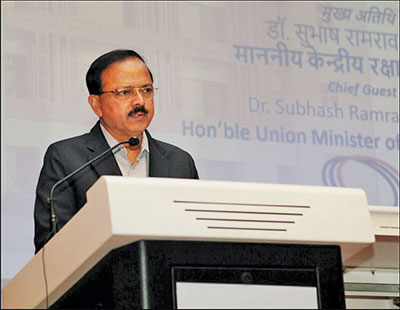
Union Minister of State for Defence, Dr. Subhash Bhamre
The Modi government had declared ‘Make in India’ mission to be the cornerstone of its nation-building initiative and defence manufacturing was rightly identified as one of the key sectors. With a view to align and delineate the Defence Procurement Procedure (DPP) towards the achievement of the objectives of ‘Make in India’, MoD constituted an expert committee under Dhirendra Singh in May 2015. Consequent to the receipt of the committee report, DPP-2016 was promulgated with effect from 1 April 2016.
DPP-2016 strives to adopt a three-pronged approach to support ‘Make in India’ initiative — institutionalisation, streamlining and simplification of the procedure to promote indigenous design, development and manufacturing of defence equipment, platforms, systems and sub-systems; refinement of ‘Make’ procedure to ensure increased participation of the Indian industry; and enhancement of the role of MSMEs. The private sector has been given due recognition through the partnership route.
Post-Kargil reforms resulted in the creation of the existing procurement structures and procedures with the Defence Acquisition Council (DAC) under the defence minister as an apex authority. Unfortunately, the regime suffers from a multiplicity of agencies involved in defence acquisitions. Lack of single point authority with decision-making powers results in dilution of accountability. That is the reason why no functionary has ever been held responsible for failing to deliver and the armed force continue to suffer critical equipment deficiencies. Additionally, the government of India functions on the basis of consensus. Such an arrangement not only results in undue delays but also distorts policy objectives and blurs delineation of authority/responsibility.





 VIDEO
VIDEO