The rise in tensions between India and Pakistan, and consequent reports that the Indian Navy went on war readiness mode post-Pulwama has once again focused attention on the need to beef up the naval arm of Indian armed forces. Reports said the navy, which was conducting its biggest war games ever, TROPEX 19 (Theatre Level Operational Readiness Exercise) off Kochi, quickly redeployed the carrier battle group comprising INS Vikramaditya, nuclear submarines and scores of other ships, submarines and aircraft, as tensions escalated.
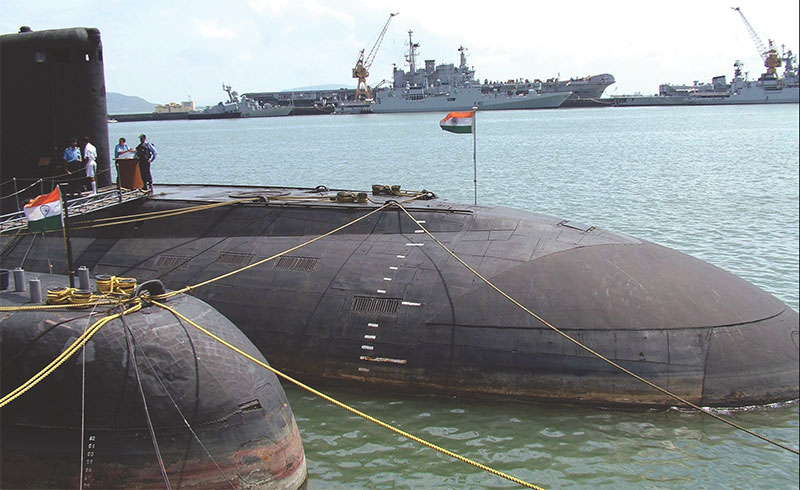
Indian Navy’s submarines docked at harbour
While the limelight has been on the army and the air force for four wars over 70 years, the navy, which played a small, but effective role in the 1971 war, has been a neglected child for long. Being a status quoist power, India in the past never considered a substantial role for the navy. There were two reasons behind this. One, the Pakistan navy was a smaller fry in Rawalpindi’s scheme of things. Second, China was more concerned with economic growth, and its security concerns related to South China Sea and the US Pacific Command.
The Indian Navy played an active role twice, once while smashing a coup by Sri Lankan Tamil mercenaries in Maldives in November 1988 and later providing support to the Indian Peace Keeping Force (IPKF) as it took on the Liberation Tigers of Tamil Eelam (LTTE) in Sri Lanka, in an ill-advised mission between 1987 and 1990.
For decades, the navy had the vast Indian Ocean all by itself. But things changed in the last few years.
The rise of China as a world economic power, and its consequent power play with the US had unexpected consequences. Anticipating an inevitable conflict with the US, the Chinese leadership began feverishly beefing its armed forces, and that included its navy. Fearing American interdiction and disruption of its energy supply lines stretching from the Gulf via Malacca Straits to the industrial hubs in eastern China, Beijing has begun building its navy into a powerful offensive force. And it has been looking for bases or friendly support and logistical infrastructure in the Indian Ocean, ranging from Myanmar and Bangladesh in the east, Sri Lanka in deep south, to Pakistan in Arabian Ocean to Djibouti overlooking the Bab al-Mandab Strait.





 VIDEO
VIDEO