

Modi in Melbourne
Indian Prime Minister’s recent visit came under a lot of criticism from Australians as well as Indian students
By Meenakshi P
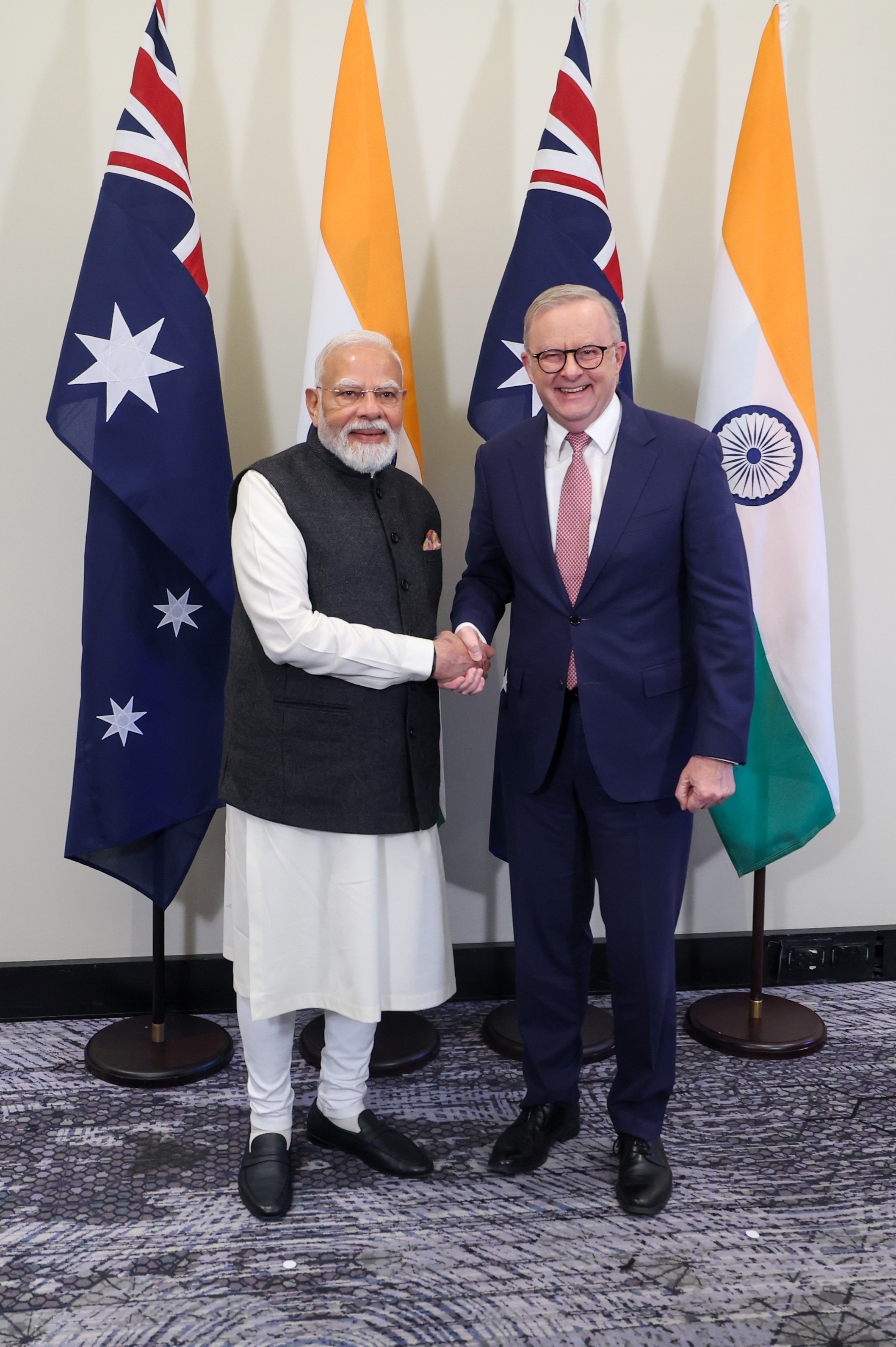
When Indian Prime Minister Narendra Modi walked into Marvel Stadium in Melbourne, hand in hand with Australia’s Prime Minister, Anthony Albanese, a 30,000 strong enthused Indian diaspora was waiting to greet them.
The crowd erupted into the now familiar chants of ‘Modi Modi’ and ‘Bharat Mata Ki Jai’, signalling the flagging off of the great jamboree that Modi’s supporters are known for. The venue was pulsating with the sounds of manjeeras and dhols and the roar of the crowds as the two heads of state entered the stadium. To a detached observer it would seem like Melbourne was getting ready to host a rockstar—a term Albanese has used in the past to describe Modi.
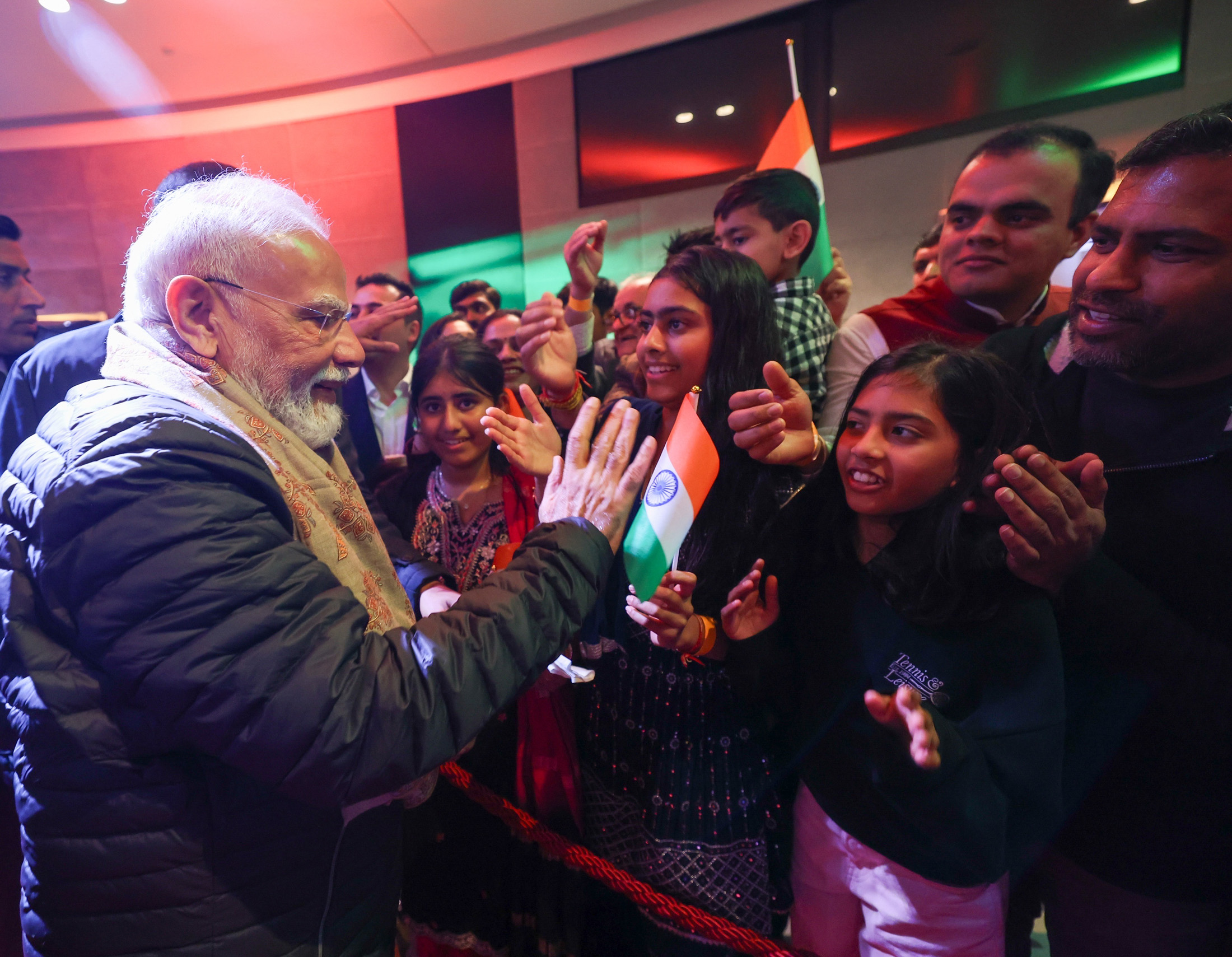
Months before Modi’s visit to Melbourne (his third in a row since 2014), over 400 local community groups and volunteers under the aegis of Australia India Foundation had begun their outreach to get the Indian diaspora involved in the event. Modi’s team headed by a Yogendra Verma (based in Melbourne) had reached Australia to co-ordinate with various cultural organisations, religious groups and businesses.
The Goan Overseas Association, Anjuman-e-Saifee (a well-established Bohra Muslim trust that watches over 600 families across Melbourne, Sydney, Perth and Adelaide), Melbourne Christian Assembly and Australian Sikh Council were all reportedly approached to be a part of the Melbourne Meets Modi event. Organisers registered over 400 diverse organisations from the Indian diaspora with over 600 volunteers helping to put together the event and clocking up 30,000 volunteer hours.
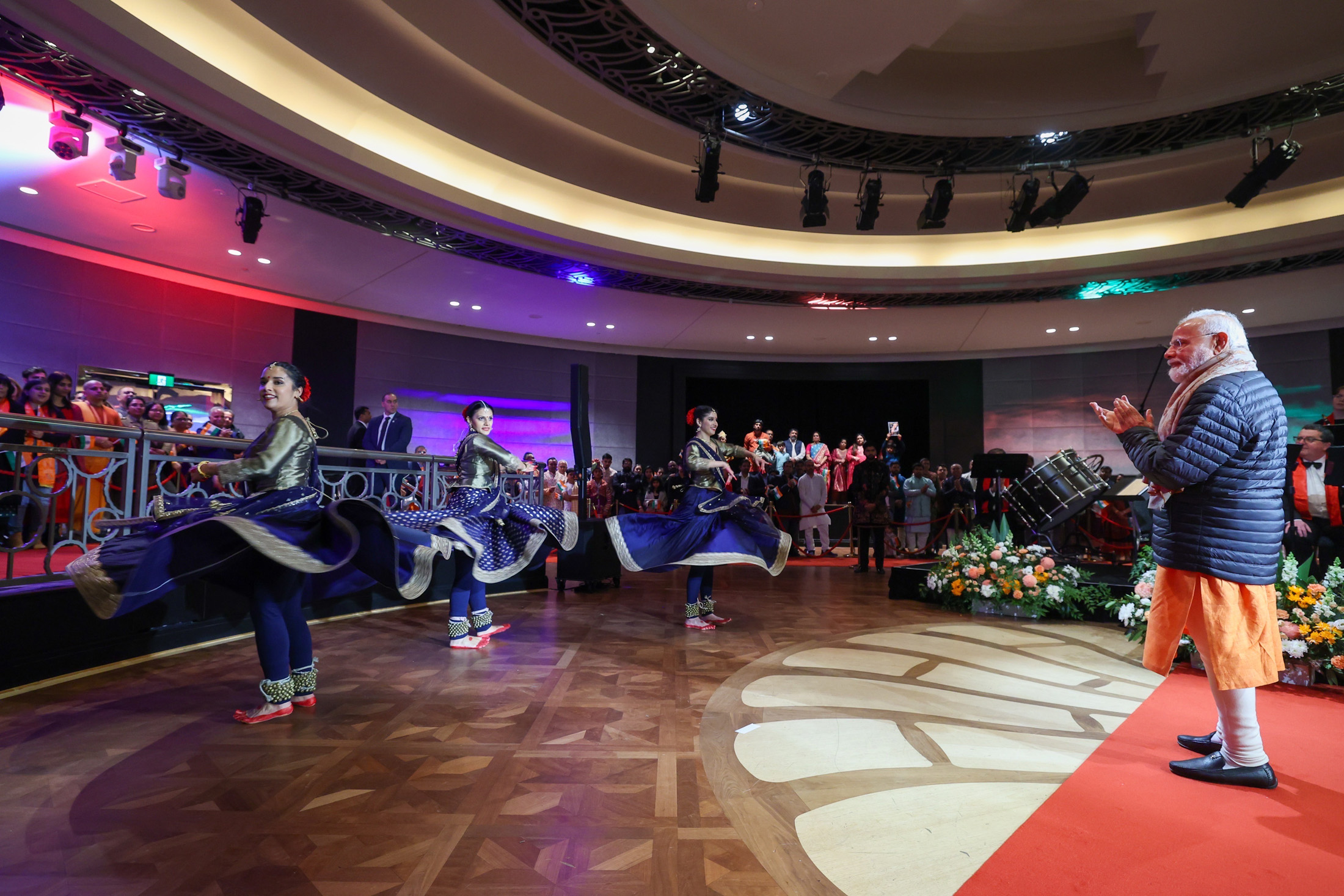
Local temples invited registrations from their communities for the Modi Meets Melbourne event receiving an enthusiastic response. It was reported in the Australian media that chartered flights were flown in from different states for the event. I could personally attest to one flight full of families from Sydney.
Clearly, this was a well-oiled machinery staging a very important spectacle for Australia and India. Wracked by controversies at home, this event is being seen by many in the Indian community as a political statement to Modi’s detractors back home, saying, his popularity and connect with his supporters is intact.
Dig beneath the surface and the divisions in the diaspora burst out into the open, particularly on social media platforms. There have been heated debates in Indian Australian Groups on Facebook and X, with several Indians openly criticising the scale and intent of the event.
One social media commentator, not wishing to be named, observed, “This is the first time in India’s political history that a prime minister has been holding political rallies outside of his own country. In my living memory I cannot re-call a single head of state who has done this though there have been several hugely popular world leaders like Nelson Mandela, Obama, Lawrence Wong of Singapore, Jacinta Ardern of New Zealand and Luiz Da Silva of Brazil. Not one of them have resorted to these public spectacles to inflate his/ her public perception.”
Those more favourably inclined towards Modi maintain that as the head of state of his country, he is perfectly within his rights to request a meet up with a diaspora that is now the largest overseas born migrant group in Australia; that he has been quite effective at leveraging foreign policy and engagement with the diaspora to build political support in India.
This is a very astute strategy and has long been a hallmark of Modi’s, but this time around it was met with stiff resistance by Australians. There were a large number of locals protesting outside Marvel Stadium with chants of ‘Modi, Go Back’ and other unprintable expletives. As someone living here for two decades, this is the first time one was witnessing a protest against a particular community.
Marissa Jones, a retired IT professional, thought the whole event was a bit bizarre as she watched Albanese and Modi walk in hand in hand like two schoolboys. Carmen Marie, a healthcare professional questioned why there seemed to be a lack of Australian representation at the event with no balance or symbolism apart from the very gauche traditional welcome to the original owners of the land that Modi trotted out from the stage which became a point of contention amongst many Australians as this is reserved for the local indigenous leaders rather than heads of state.
Jacinta Allen, the premier of Victoria (equivalent to a chief minister in India), the southern state of Australia, faced scattered hooting and booing from the crowd clearly impatient to hear from Modi rather than either the Australian prime minister or the premier.
When Modi did eventually take the mike, he spoke for 40 minutes praising his countrymen for being the cheeni (sugar) in the milk of Australian society; lauding the rapid strides India has taken in technology and economy; and highlighting bi-lateral ties with Australia. What stuck out as a sore thumb, however, was the dissonant note of Operation Sindoor. The Indian prime minister brought it up as a dog whistle saying that non-resident Indians (NRIs) would have noted India’s growing regional power during the attack on Pakistan. Blasts, he said, were targeting terrorist camps in Pakistan but the sounds of those blasts were echoing worldwide. This was a signal for the crowd to start cheering wildly with chants of ‘Modi Modi’ and ‘Bharat Mata Ki Jai’ ricochetting off the walls of the stadium.
As the camera panned to a close up of the Australian Labour Party members sitting in the front row, their discomfort was clearly visible. Speaking to one of the attendees of the event, Sai Ram noted, “This country has never been an overtly political one”. He fears that this could have repercussions for the Indians community.
In the last decade and a half, Australian governments have been amping up immigration numbers as the local population rapidly ages. In 2024, Indians alone had hit the one million mark, narrowly passing Britain.
This has resulted in several challenges for the Indian community with rising cases of racism, a tightening of the screws on visa and migration regulation and housing scapegoating. But these were not concerns Modi addressed at the event. He chose the more emotionally provocative topic of terrorism against India.
The event has caused a political backlash for the Albanese government with one political commentator stating on a popular news channel that Australia has ‘got played’. Almost to a voice newspapers have accused the Albanese government of trying to court the Indian Australian community for votes. The government is being accused of allowing foreign interference. Writing for the Financial Review, Cathal Leslie, an economist, says, ‘Imagine Xi Jinping filling Marvel Stadium with 30,000 flag waving supporters, at an event organised by someone who had served as president of a group explicitly established to promote the Chinese Community Party abroad, with the Prime Minister and Victorian premier applauding along.
Nobody would hesitate over what to call it: a political rally for a foreign power, held on Australian soil, blessed by our elected leaders.’
Jay Shah, organiser of Modi Meets Melbourne event and President of the Overseas Friends of Bharatiya Janata Party, has come under attack as well, with newspapers accusing him of carrying on an image-management exercise for the government of India, aimed at growing their clout in Australia. Leslie re-iterates in his article, ‘a government that invokes social cohesion has just thrown a party for the sub-continent’s most polarising politician.’
Modi may have dazzled a crowd of 30,0000 people in Melbourne, but it seems his own country continues to grow disenchanted with his and his party’s performance. He flew back from Australia and straight into the storm of student protests that have erupted all over the country. His education minister was forced to resign as India’s Gen Zs mounted a strong protest against their government’s education policies. The Cockroach Janata Party (CJP), a social media birthed viral satirical movement, was born overnight in response to a careless comment from the Indian Chief Justice of the Supreme Court, Surya Kant, who termed unemployed youth as cockroaches and parasites. The party seems to have found traction in Australia as well, with Sydney, Melbourne and Canberra holding parallel protest in support of the students demonstrating for educational reforms and accountability.
Asked why a vigil and protest were organised in Australia, Nandini Sen Mehra, policy officer with Hindus for Human Rights, said that many in Australia and New Zealand had been asking for a platform to show their support for students back home which birthed the idea of holding a vigil for the 21 students who died by suicide in the NEET paper leaks.
Anger was palpable at the Federation Square event in Melbourne. The crowd may have been of middling strength but every protestor I spoke with passionately voiced their concerns about the direction the country of their birth is taking. Udhyayan, studying business administration in RMIT, one of the leading universities in Australia, said, “Ultimately, I will be heading home after studies. What job prospects can I hope for with a 40 percent unemployment rate in the country? Our future looks bleak with most countries cracking down on immigration and things not looking good in India for us.”
Perhaps it’s time for Modi and his government to pay heed to the rising voices of discontent in India. A filled-to-capacity arena chanting ‘Modi Modi’ is no measure of a politician’s success. Rather, a country doing well on all human development indices is.






 VIDEO
VIDEO