

Mobility, Lethality & Safety
With the stand-off in Ladakh showing no signs of abating, government of India authorised emergency procurement of several types of weapons and equipment to strengthen Indian positions all along the Line of Actual Control (LAC) last year. Top on the list were vehicles—for quick and secure transportation and fighting.
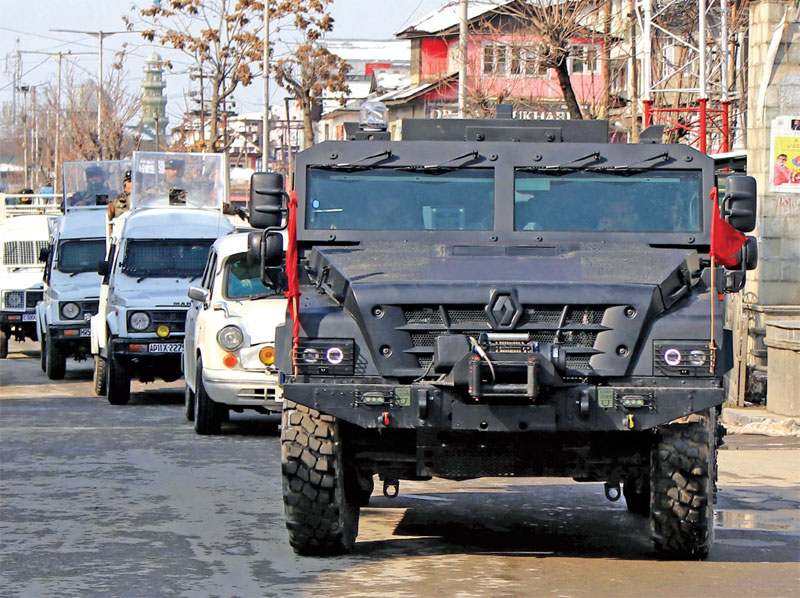
Renault Truck Defense’s Sherpa drew curious onlookers when it was first deployed in Srinagar in 2018
Sensing an opportunity, Russia offered India its 18-tonne Sprut SDMI lightweight tanks. The offer was made to the defence minister Rajnath Singh during his visit to Russia in June 2020. As of now, the matter hangs there, with India still evaluating the offer. Meanwhile, after China deployed Type 15 light tanks in the area in August 2020, India had to rely upon what it had—the heavier battle tanks. Also, under emergency purchase, Indian Army directly placed the order for M4 armoured vehicles with Bharat Forge in February 2021.
In the last few years, Indian defence purchases have become crises-driven instead of long-term capability building. When tensions between India and Pakistan heightened two years ago, the government announced the buying of 198 armoured personnel carriers (AFV) for the Indian Army. These, they said, would replace the Soviet Origin BRDM combat reconnaissance patrol vehicles. Several deals followed this, and a number of Indian private sector companies bagged orders for manufacturing of military vehicles needed by the Indian armed and paramilitary forces catering to different war zones and terrains.
While IED remains the main threat in LWE, J&K is also seeing a gradual increase in the usage of this deadly tactic by the adversaries. A per a newspaper report, intelligence officials and forensic experts in 2019, ‘warned of more Pulwama-style improvised explosive device (IED) attacks on personnel in J&K,’ in which a suicide bomber attacked the CRPF’s convoy, killing 40. India remains one of the highest IED-affected countries around the globe.
Given this, the requirement of military vehicles, both for transportation and fighting has increased. In fact, the trend worldwide is for multi-utility vehicles that provide all three: safety, mobility and fighting capability. In India, however, we still have a neat distinction between different kind of military vehicles and their uses.
Transport Vehicles
Armoured personnel carriers are used to transport troops in combat zones. These vehicles, depending upon the terrain can be wheeled or tracked. Armoured personnel vehicles are not used in direct combat (though some have defensive capabilities), unlike infantry fighting vehicles which provide direct fire support to the troops.
With the increase in sub-conventional warfare often conducted in semi-urban/ urban and inhabited places, militaries around the world are relying heavily on military vehicles. Consequently, original equipment manufacturers (OEMs) have been investing in these vehicles. For lightweight bullet-proof armour, Honeywell has come up with bullet-proof fibre and ballistic composite materials such as Spectra Shied, Gold Shield and Gold Flex. These light-weight materials are used for armouring of vehicles apart from helmets, vests and plates.
Newspaper reports in December 2020 stated that the CRPF would soon induct the Sherpa Light all-terrain vehicle. It is a 4x4 tactical and light armoured vehicle designed by Renault Trucks Defense, France. Sherpa, despite its armoury, offers high mobility. It can be used for tactical purposes such as patrol, convoy escort, command and liaison. The Sherpa Light can accommodate four personnel who can fire from inside the vehicle. It is fitted with a camera and can sustain a blast of up to 10kg RDX. Sherpa was recently spotted on the roads of Kashmir. The CRPF started using the MPVs only after the 2016 militant attack that claimed lives of eight personnel. Sherpa was deployed in Kashmir in 2018, and later in November and December 2020. This vehicle is already in use with National Security Guards (NSG) and Central Industrial Security Force (CISF).
Subscribe To Force
Fuel Fearless Journalism with Your Yearly Subscription
SUBSCRIBE NOW
We don’t tell you how to do your job…
But we put the environment in which you do your job in perspective, so that when you step out you do so with the complete picture.






 VIDEO
VIDEO